Best Coffee Scales (2026)
Coffee ratios only mean anything if the numbers behind them are real. A "1:2 shot" measured with a scale that lags half a second behind the actual weight on the platform isn't 1:2 — it's a guess with decimal points attached. Most of what separates a good coffee scale from a mediocre one has nothing to do with the resolution printed on the box.
We're recommending one scale for the vast majority of buyers rather than padding out a ranked list, because the category doesn't need five picks — it needs an explanation of what actually matters (resolution, response time, auto-tare, timer integration) so you can tell a good scale from a fast-looking spec sheet.
Our top picks
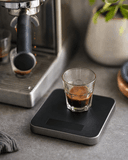 Best OverallAcaia Pearl
Good
Our score: 79 / 100
Acaia Pearl
Good
Our score: 79 / 100
The Pearl's real advantage isn't its 0.1 g resolution — plenty of cheap scales claim that too. It's response time: the readout tracks weight in something close to real time, which is what actually lets you stop a shot or a pour-over on target instead of a beat late. Add a low profile that clears most portafilters and an auto-starting timer, and it's the scale most working baristas reach for.
How we chose
We prioritized response time and reading stability over headline resolution numbers, since two scales can both claim 0.1 g precision while one lags noticeably behind the true weight during active flow. We also weighted physical design — platform height, footprint under a portafilter — heavily, since a scale that's technically precise but too tall to fit under your machine is a poor fit for espresso use regardless of its spec sheet.
What to look for
Why weighing matters more than scooping
A "scoop" of coffee is not a fixed amount of coffee — bean density varies by roast level (darker roasts lose mass and expand, so a scoop of dark roast weighs meaningfully less than the same scoop of light roast) and by bean origin and processing. That variance alone can swing a scoop from 8 grams to 11 grams of actual coffee, which is the difference between a well-balanced shot and a badly underdosed one. Weighing removes that variable entirely and is the single highest-leverage change most people can make to get consistent coffee.
Resolution — 0.1 g is the real floor
For espresso, where doses commonly sit between 15 and 20 grams and small errors have an outsized effect on a small total, 0.1 g resolution is worth insisting on. For drip and pour-over, where doses and total water are much larger, 1 g resolution is usually fine — but a 0.1 g scale still works for both, so there's little downside to just buying the more precise option if the price gap is small.
Response time — the spec nobody prints but everyone feels
This is the one that actually separates good scales from bad ones in daily use, and it's almost never listed on a spec sheet. A scale with slow sampling shows you a weight that's already out of date by the time you react to it — on a fast-flowing espresso shot, that lag can mean overshooting your target yield by a gram or more before the display catches up. The only reliable way to judge this is real usage or trusted reviews, not the spec sheet.
Auto-tare and timer integration
Auto-tare — the scale zeroing itself out automatically when you place a container on it — saves a genuinely annoying manual step multiple times per drink. A built-in timer that starts on flow detection and stops when flow stops removes the need for a separate stopwatch or phone, and for espresso specifically, having shot time and weight on the same display (rather than glancing between a scale and a phone timer) measurably reduces how often you miss your target window.
Platform height and footprint
This sounds trivial until you own a scale that's too tall to fit under your portafilter without propping the espresso machine's drip tray out of the way. A low-profile design isn't a luxury feature for espresso use — it's close to a requirement.
Battery vs. plug-in
Battery-powered scales (like the Pearl) avoid a permanent cord on the counter but eventually need charging and, in sealed designs, eventually show battery capacity fade after a few years of daily cycles. Plug-in scales avoid that fade entirely at the cost of a permanent cord and less flexibility in where you place them.
Frequently asked questions
Do I really need a $150 scale, or will a $20 one work?
A $20 kitchen scale will get you accurate dosing for drip and pour-over, where you're not racing a fast-flowing shot. For espresso specifically, the response-time gap between a cheap scale and a purpose-built one becomes a real, felt problem — you'll consistently overshoot your target yield by the time a laggy display catches up.
What's the actual difference between 0.1g and 1g resolution?
For a 36g yield espresso shot, 1g resolution means your measurement could be off by up to a full gram either way, which is roughly 3 percent of the total — enough to matter when you're trying to dial in a precise ratio. For a 400ml pour-over, that same 1g of imprecision is a rounding error.
Is a scale with a built-in timer actually necessary?
Not necessary, but it removes real friction — juggling a phone stopwatch and a scale display at the same time while also watching the shot itself is exactly the kind of small annoyance that leads to skipped measurements over time.
How much bean-to-bean variance does weighing actually eliminate?
Roast level alone can shift a fixed-volume scoop's actual weight by 2 to 3 grams for the same nominal scoop size, since darker roasts are less dense. On a typical 18g espresso dose, that's over 10 percent of the total dose varying for reasons that have nothing to do with your technique.