Best Espresso Prep Accessories
Grinder and machine get all the budget attention, and the last few inches of prep — distributing the grounds, tamping them — get treated as an afterthought. That's backwards. A puck that's unevenly distributed or inconsistently tamped channels water unevenly no matter how good the grinder behind it was.
Two accessories address the two real variables in that last step: a WDT tool fixes distribution, a calibrated tamper fixes pressing force. Neither is expensive, and together they cost less than a single grind burr upgrade.
Our top picks
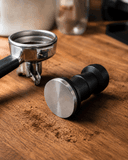 Best TamperEspro Calibrated Tamper
Good
Our score: 73 / 100
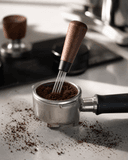 Best Distribution ToolBarista Space WDT Tool
Good
Our score: 77 / 100
Espro Calibrated Tamper
Good
Our score: 73 / 100
A spring-loaded tamper that stops transmitting force to the puck once it hits a fixed, calibrated threshold — click, and you're done, regardless of how hard you keep pressing. It removes tamp-force inconsistency entirely, which matters most for beginners still building technique and for any setup with more than one person pulling shots.
Barista Space WDT Tool
Good
Our score: 77 / 100
A cluster of fine needles that breaks up clumps in the grounds before tamping — clumps that a hand tamp alone presses flat without actually eliminating, leaving dense spots and gaps that cause channeling. At under 20 dollars, it's one of the cheapest, most effective fixes available for uneven shots.
How we chose
We picked one tool per real, distinct variable in puck prep — distribution and tamp force — rather than listing multiple competing options for the same job. Both picks were selected for solving their specific problem cleanly and affordably, not for being the most premium version available.
What to look for
Distribution vs. tamping — two different problems
Distribution is about how evenly grounds are spread across the basket before any pressure is applied; tamping is about pressing that spread of grounds into a firm, even puck. A perfectly calibrated tamp applied to badly distributed grounds still channels, because you've pressed an uneven pile into an uneven puck at a consistent force. Fixing only one half of this equation is a common, avoidable mistake.
What causes channeling in the first place
Channeling happens when water finds a lower-resistance path through the puck — usually a gap or a looser pocket left by an unbroken clump or an unevenly distributed grind — and rushes through that path fast while the rest of the puck extracts more slowly or not at all. The visible sign is a thin, fast, often lighter-colored stream from one side of the portafilter spout instead of a slow, even, syrupy flow.
Why tamp force matters less than people think
Within a broad range — roughly 15 to 30 pounds of force — the specific number matters far less than consistency shot to shot. A calibrated tamper's real value isn't hitting some magic ideal force; it's guaranteeing the exact same force every single time, which removes one variable from your troubleshooting entirely when a shot goes wrong.
Needle count and depth on WDT tools
More needles cover the basket surface faster per stirring pass, and adjustable depth lets you match the tool to your basket's depth and your dose size so you're stirring the full column of grounds, not just the top layer. Beyond that, the differences between WDT tools at different price points are mostly handle material and finish, not fundamentally different function.
Order of operations
Distribute first with a WDT tool, breaking up clumps and leveling the surface, then tamp with consistent force on top of that even bed of grounds. Doing it in the reverse order — tamping first, then trying to stir — defeats the purpose, since you'd be breaking apart a puck you just compressed.
Frequently asked questions
Do I need both a WDT tool and a calibrated tamper, or just one?
They fix two different problems, so ideally both — a WDT tool addresses distribution, a calibrated tamper addresses pressing force, and channeling can be caused by either. If you can only start with one, a WDT tool is the cheaper, higher-impact first purchase for most people, since clumping is a more common root cause than force inconsistency.
Can I skip these and just tamp harder or more carefully by hand?
You can get good results with careful hand technique alone, and plenty of experienced baristas do exactly that. These tools exist to remove variables for people whose technique isn't already dialed in, or for multi-person households and cafés where consistency between different people matters.
How much do these tools actually improve shot quality?
For someone already dealing with visible channeling or inconsistent shot times, the improvement is often immediately noticeable — evener flow, more repeatable extraction. For someone whose shots are already pulling evenly, the improvement is smaller, since they've already solved the problem by hand.
What order should I use them in?
Distribute with the WDT tool first to break up clumps and level the grounds, then tamp with consistent force on top of that. Tamping before distributing defeats the purpose, since you'd have to break apart a puck you just compressed.