Best French Press (2026): Why the Bodum Chambord Is Still the One to Buy
I'm not going to pad this guide with four or five French presses just to hit a round number. The category itself hasn't changed much in decades — full immersion brewing through a metal mesh screen — and one design has quietly stayed the reference point the whole time it's been around. This guide covers the Bodum Chambord as the headline pick, and spends the rest of its space explaining the category itself: how immersion brewing actually works, why mesh and paper produce such different cups, and what grind size does to a French press specifically, since that's more useful to you than a list of minor variations on the same idea.
Our top picks
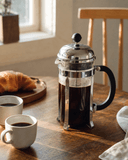 Best OverallBodum Chambord French Press
Good
Our score: 77 / 100
Bodum Chambord French Press
Good
Our score: 77 / 100
The chrome-and-glass silhouette that basically defines 'French press' in most people's heads, and for good reason — a well-sealed mesh plunger, a protective steel frame around the glass beaker, and replacement parts that keep it running for a decade or more. Four minutes, zero technique, a full pot for a group.
How we chose
Rather than force a ranked list of five French presses that are all minor variations on the same design, we're recommending the one that gets the fundamentals right and has the track record to back it up: a genuinely protective metal frame around the glass (unlike unprotected all-glass presses), a well-engineered plunger seal, and easily sourced replacement parts. If your only goal is a French press that works well and lasts, this is the one to buy without overthinking it.
What to look for
Mesh vs. paper filtration. This is the single defining trait of French press coffee. A metal mesh screen — used in every genuine French press, including the Chambord — lets coffee oils and fine sediment pass through that a paper filter would catch. That's the entire source of French press coffee's heavier body and fuller mouthfeel compared to any pour-over method. It's a style choice, not a flaw: if you want that texture, mesh is non-negotiable, and no French press with a paper option is really doing the same thing.
Grind size. French press demands a notably coarser grind than pour-over or drip — think coarse sea salt or breadcrumbs. Too fine a grind does two bad things at once: it pushes more sediment through the mesh into your cup, and it makes the plunger harder to press evenly, which itself pushes more grounds around the seal. Coarse grind is the single easiest fix for gritty French press coffee, more impactful than which specific press you buy.
Glass protection. An unprotected glass beaker is a real liability on a busy counter. Look for a metal frame that actually cages the glass rather than a cosmetic ring — it's the difference between a knock against the faucet being a non-event or a broken carafe.
Steep time and pour-off. Four minutes is the standard steep time for most grinds and roasts. The part people miss: pour the whole thing out immediately after pressing. The mesh doesn't fully seal grounds away from brewed coffee, so leaving it in the beaker keeps extracting and turns your second cup bitter and over-strong.
Frequently asked questions
Why does French press coffee always have some sediment?
The mesh screen catches large grounds but lets fine particles through — there's no paper barrier to stop them. A coarser grind reduces the amount noticeably, but a completely sediment-free cup isn't something a mesh filter can produce, by design.
Is French press coffee stronger than drip or pour-over?
It's typically brewed at a similar strength ratio, but it reads as 'stronger' because the retained oils and body make it feel heavier and richer, not because there's necessarily more caffeine or coffee per ounce.
How long does a French press actually last?
With the Chambord specifically, the glass beaker is the main wear item, and it's sold separately as a replacement part — the chrome frame and plunger mechanism can realistically outlast several beakers over a decade or more of regular use.
Should I leave brewed coffee in the French press to stay warm?
No — pour it out into cups or a separate carafe right after pressing. The mesh doesn't create a full seal between grounds and liquid, so coffee left in the beaker keeps extracting and turns bitter within twenty or thirty minutes.