Fellow Atmos vs Timemore Airtight Canister
Buy the Fellow Atmos Vacuum Canister if…
You're storing whole beans for several weeks at a time and want the most effective seal you can buy in a polished, gift-worthy design, and you're fine with an extra cleaning step for the vacuum mechanism.
Buy the Timemore Airtight Canister if…
You go through beans in one to three weeks, want a dead-simple container with nothing to break, and would rather buy two or three cheap canisters than one expensive one.
Side by side
| Specification | 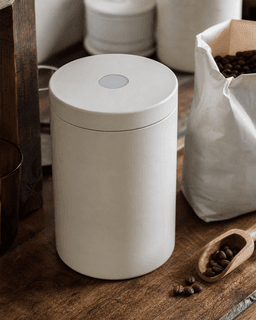 | 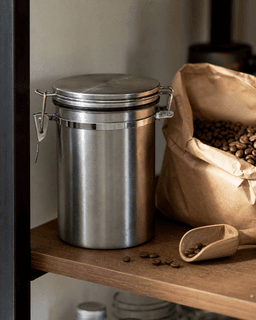 |
|---|---|---|
| Our score | 76Best | 74 |
| Capacity | 0.7 L (also sold in 1.2 L and 2 L) oz | Multiple sizes, roughly 12-20 oz beansBest |
| Seal type | Twist-to-vacuum spring-loaded lid | Airtight silicone gasket |
| Material | Stainless steel (glass version also available) | Stainless steel body |
| Vacuum/CO2 valve | Vacuum seal only | No |
| Warranty | 1 yr | 1 yr |
At a glance
The Fellow Atmos and the Timemore Airtight Canister solve the same basic problem — keeping air away from your beans — with two very different levels of mechanical effort. The Atmos uses a vacuum-style seal you engage by twisting the lid, actively pulling air out of the chamber. The Timemore just relies on a gasket compressing against the rim, keeping air out passively without removing what's already inside when you close it.
Price reflects that gap: the Atmos sits well above the Timemore's roughly $15-25. Whether that's worth it depends almost entirely on how long your beans typically sit before you finish them.
Where they differ
Sealing mechanism
The Atmos's vacuum action is the real differentiator — it's doing active work to reduce the oxygen inside the canister, not just blocking new air from getting in. For whole beans stored over several weeks, that measurably slows the staling process compared to a passive seal. The Timemore's gasket seal is a well-proven, simple method that keeps out ambient air exchange but doesn't touch the oxygen already trapped inside once it's closed.
Best coffee format for each
This is a genuinely important distinction and worth stating plainly: Fellow's own guidance leans toward whole beans for the Atmos, because the vacuum mechanism's moving parts get harder to clean when fine coffee grounds work their way into the seal over repeated use. If you grind fresh right before brewing and only ever store whole beans, that's not an issue. If you store pre-ground coffee, the Atmos becomes more of a maintenance chore than its polished design suggests.
The Timemore has no such caveat — with no valve or pump to worry about, it's just as easy to clean whether you're storing beans or grounds, which is one of the more underrated practical advantages of a simpler design.
Design and material
The Atmos leans into premium design — a polished, display-worthy object that looks intentional sitting out on a counter, which is part of why it's a popular gift. The Timemore is more utilitarian: solid, functional stainless steel that does its job without asking to be admired.
Cost and how you'd actually use it
Because the Timemore is inexpensive, it's realistic to buy two or three and dedicate one per open roast — genuinely useful if you regularly have more than one bag going. The Atmos's higher price makes that same multi-canister approach a much bigger investment, so most owners buy one and rotate beans through it as roasts change.
Cleaning routine
The Atmos requires occasional attention to the vacuum seal and valve area to keep the mechanism working smoothly, especially if any fine particles get in. The Timemore just needs a wipe-out or a rinse — there's nothing mechanical to maintain.
Which should you buy
If you buy whole-bean coffee in modest quantities and want the beans to stay close to fresh for three, four, or more weeks, the Fellow Atmos's active vacuum seal genuinely earns its price — it's doing more preservation work than a passive seal can. Just plan to store whole beans in it, not grounds, and budget a little extra attention to keeping the seal mechanism clean.
If you go through a bag in one to three weeks, keep more than one roast open at a time, or just want the simplest possible container with nothing to fuss over, the Timemore Airtight Canister is the more sensible buy — and cheap enough that owning a few of them costs less than one Atmos.
Neither one is magic, and it's worth saying that plainly: roast date, how much light your beans see, and how often you're opening the lid all matter more to freshness over time than which canister you choose. Buy the storage that matches your actual coffee-drinking pace, not the one with the more impressive-sounding mechanism.
Frequently asked questions
Does the Fellow Atmos keep coffee fresh longer than the Timemore canister?
For whole beans stored over several weeks, yes — its vacuum-style seal actively removes air rather than just excluding it, which slows staling more effectively than the Timemore's passive gasket seal over that longer window.
Is the Fellow Atmos good for storing ground coffee?
Not ideally — per Fellow's own guidance, the vacuum mechanism is better suited to whole beans, and using it with ground coffee makes the mechanism messier to clean since fine particles get into the seal.
Why would someone choose the cheaper Timemore canister over the Atmos?
Simplicity and price — the Timemore has no mechanism to maintain, is easy to wipe clean, and costs little enough that you can buy several and dedicate one per roast without a second thought.
Does either canister keep coffee fresh indefinitely?
No — roast date, light exposure, and how often the container gets opened all affect freshness more than the container itself. Neither canister stops staling completely, they just slow it down to different degrees.