Terminology
Nugget Ice vs Cubed Ice: What's the Difference?
On this page
Ask someone who owns a nugget ice maker why they bought it, and you'll rarely get a practical answer first — you'll get "the texture." That's not a marketing accident. Nugget and cube ice are made by fundamentally different processes, and the process is exactly why they feel so different in your mouth and in your drink.
The short answer
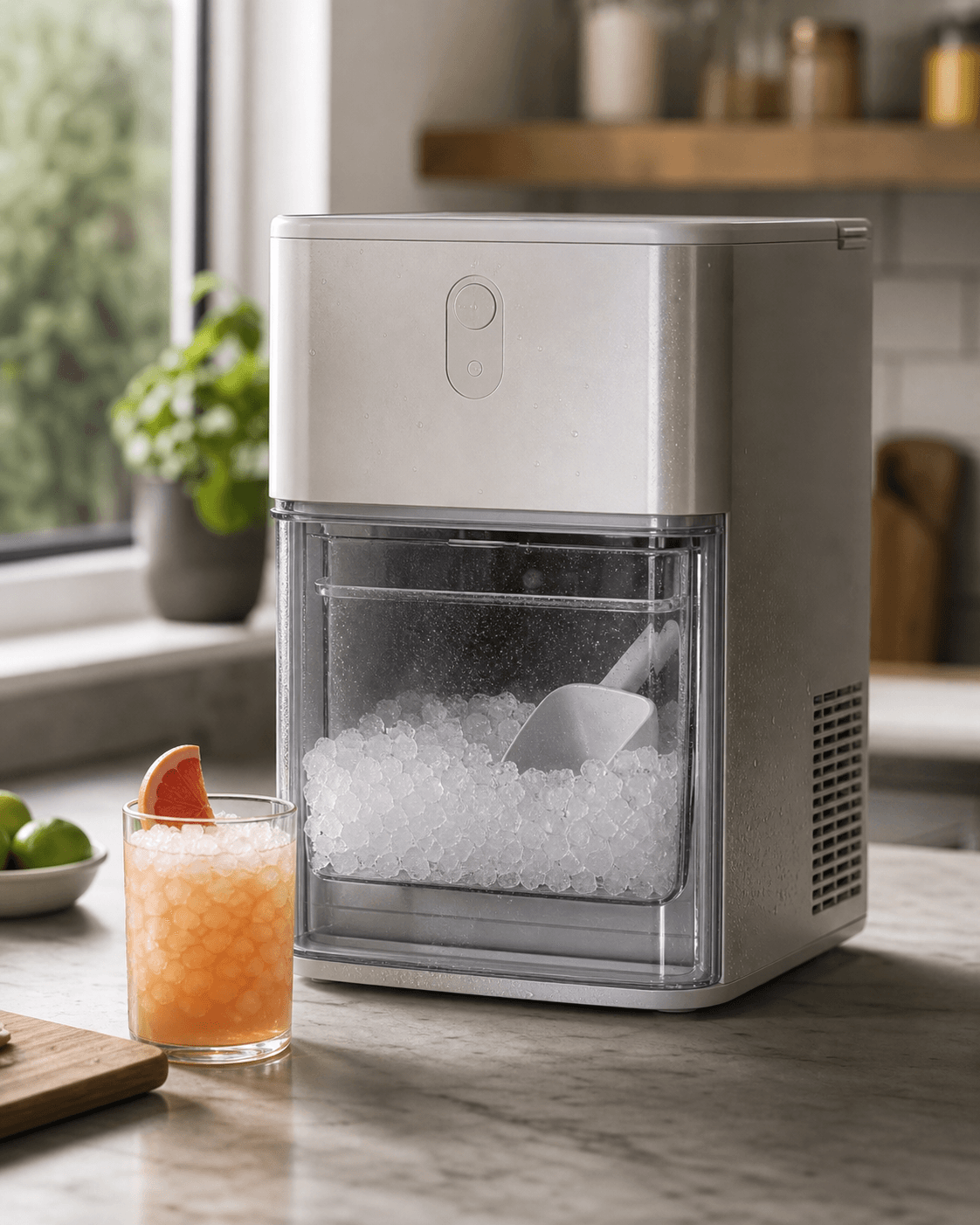
Cube ice is water frozen solid, directly, in a mold — it's one dense, solid piece per cube. Nugget ice (also called pellet ice, or "sonic ice" after the fast-food chain that popularized it) is made by freezing a thin layer of ice onto a cold plate, scraping it off as soft flake ice, and then compressing that flake ice into small cylindrical pellets. That compression step is the whole story — it traps small air pockets and leaves the ice more porous than a solid cube, which is why nugget ice is softer, easier to chew, and melts faster.
How nugget ice is actually made
The flake-freezing step
Inside a nugget ice maker, water runs over a cold evaporator surface, where it freezes into a very thin sheet — much thinner than a cube would be. A mechanism (usually an auger, a rotating screw-like part) continuously scrapes that thin ice layer off the plate before it can build up into anything solid.
The compression step
That loose, scraped flake ice then gets pushed through a compression stage, where it's packed together into small, roughly cylindrical pellets — the shape most people recognize as nugget ice. The compression is what turns loose flakes into a solid-enough pellet to hold together and scoop, but it doesn't eliminate the tiny air gaps between the original ice flakes, which is the key structural difference from cube ice.
Why that structure matters
Those trapped air pockets and the overall greater surface area (compared to a solid cube of the same volume) are what make nugget ice soft enough to bite through without hurting your teeth, and what make it melt noticeably faster once it hits a drink. A solid ice cube resists chewing and melts slowly because it's dense, uniform, and has comparatively little surface area exposed to room-temperature liquid.
Why melt rate is the practical trade-off
Faster melting isn't automatically bad — it depends entirely on what's in the glass. For water, soda, or anything you're drinking quickly, nugget ice's fast melt is mostly a texture bonus with little downside; you'll finish the drink before dilution becomes noticeable. For a cocktail or a pour of whiskey you're sipping slowly, that same fast melt becomes a real problem — the drink dilutes and weakens meaningfully faster than it would with a dense cube, which is why most craft cocktail bars use large, dense, slow-melting cubes (or clear ice, made through an even slower directional-freezing process) rather than nugget ice.
Why people have such strong opinions about it
Texture preference in food and drink is genuinely personal, and ice is no exception — some people find chewing ice satisfying and actively seek out soft, chewable nugget ice, while others find chewing ice unpleasant or even mildly taboo (there's a long-running informal association between ice-chewing and anxious habits) and prefer ice that's meant to be left alone in the glass. Neither preference is more correct; it's closer to a preference like liking crushed versus cubed ice in a fountain soda — mostly about mouthfeel, not performance.
The GE Opal's popularity is really a case study in this: it didn't reinvent nugget ice, which restaurants and fast-food chains had been serving for years. It just made the specific soft, chewable pellet texture people already associated with a nostalgic fountain-drink experience available as a countertop appliance, and the sheer strength of people's texture preference did the rest.
Practical takeaway
If you're deciding between a nugget ice maker and a standard cube-ice maker, the decision really comes down to two questions: do you or your household have a genuine preference for soft, chewable ice over hard ice, and are you mostly drinking water/soda/quick drinks rather than slow-sipped cocktails or spirits where dilution speed matters? Answer both in favor of nugget ice, and a machine like the Opal is worth considering. Answer either one the other way, and a standard — and usually cheaper — cube ice maker will serve you better.
Frequently asked questions
Why does nugget ice melt faster than cubed ice?
It's made of compressed flake ice, which is more porous and has more surface area exposed to your drink than a solid cube — more surface area means faster melting and faster dilution.
Is nugget ice more expensive to make at home than cube ice?
The machines that make it (like the GE Opal) tend to cost more than basic cube-ice makers, mainly because compressing flake ice into pellets requires more mechanical complexity than freezing water in a simple mold.
Which is better for cocktails, nugget or cube ice?
Dense cube ice is generally preferred for spirits and cocktails because it melts slower and dilutes the drink less; nugget ice is better suited to water, soda, and drinks you're finishing quickly.
Why do some people love nugget ice so much?
It's genuinely a different texture experience — soft and chewable rather than hard — and for people who like to chew ice, that texture is the whole appeal in a way cube ice can't match.