Explainer
What Is WDT and Does It Actually Help Your Shots?
On this page
The short answer
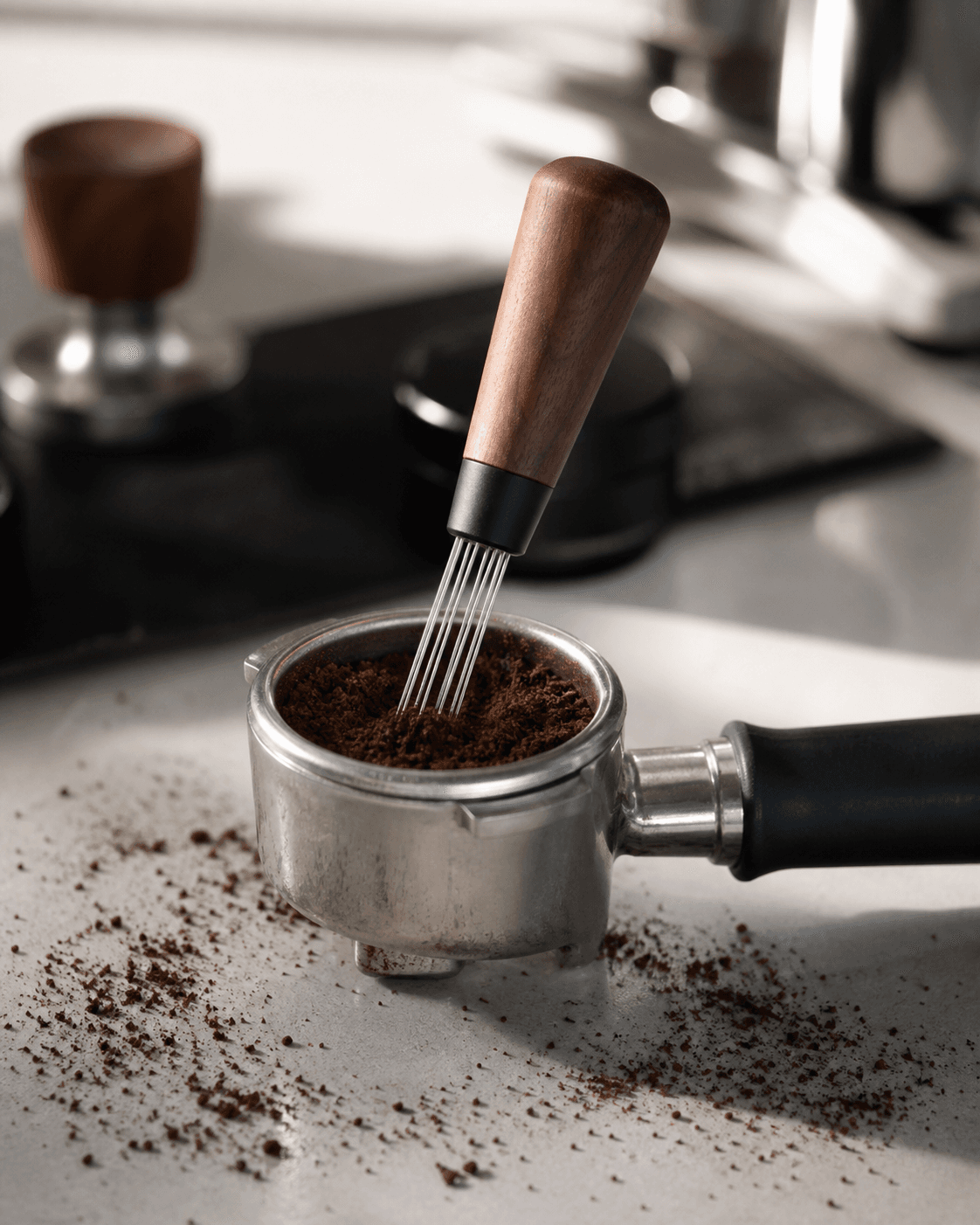
WDT — Weiss Distribution Technique — is the practice of stirring fine needles through ground coffee before tamping to break up clumps and even out the density of the grounds, and it works by removing the gaps and dense pockets that cause water to channel unevenly through the puck during extraction.
Where the name comes from
The technique is named after John Weiss, an Australian home barista whose method of using a cluster of fine needles to stir coffee grounds spread through online coffee communities well before commercial brands started selling purpose-built tools for it. What began as a DIY fix using sewing needles or paperclips is now a standard accessory category, with dedicated multi-needle tools from brands like Barista Space and others.
What clumping actually does to your shot
Ground coffee naturally clumps
Coffee grounds, especially from burr grinders with any static buildup, tend to stick together into small clumps rather than falling as loose, individual particles. This is more pronounced with oily dark roasts, single-dose grinders, and humid conditions, but happens to some degree with almost any grinder.
Clumps create uneven density in the puck
When you tamp a pile of grounds containing clumps, the tamper presses the surface flat but doesn't actually break the clumps apart — it compresses around them, leaving denser pockets where clumps sit and looser, gap-prone areas between them. That uneven density is the direct cause of channeling.
Channeling is water taking the easy path
During extraction, pressurized water pushes through the puck along whatever path offers the least resistance. A loose gap left by unbroken clumping is exactly that kind of low-resistance path — water rushes through it fast, under-extracting that channel while the denser surrounding coffee extracts more slowly or barely at all. The visible symptom is a thin, fast stream or spurt from one side of the portafilter spout instead of a slow, even flow across the whole basket.
How WDT fixes it
Stirring fine needles through the grounds before tamping physically breaks apart clumps, redistributing the coffee into a loose, more uniform pile with far less density variation. Tamping that evenly distributed pile produces a puck with much more consistent resistance throughout, which gives water fewer easy paths to channel through.
Does the evidence actually back this up?
The mechanism is solid and well understood — clumping causing density variation causing channeling is basic, observable physics, and many baristas report visibly more even flow immediately after adopting WDT, with fewer spurts and blonde (over-extracted, pale) streams late in a shot. What's less settled is rigorous, controlled measurement of exactly how much it improves extraction yield or taste across different grinders and beans — most of the evidence is mechanistic reasoning plus widespread observational reports rather than published, controlled studies. That's a real limitation to be honest about, even though the underlying cause-and-effect is not seriously disputed within the specialty coffee community.
When WDT matters most
It matters most with single-dose grinders (more prone to retention and static clumping), oily dark roasts, and any setup where you've noticed visible channeling or inconsistent shot times without other explanations. It matters least if your grinder already produces loose, non-clumping grounds and your shots are already pulling evenly — in that case, you've likely already solved the problem some other way.
The practical takeaway
Try it before assuming it'll fix a problem — stir gently across the full basket surface with a needle tool or even a toothpick before tamping, watch whether your shot flow becomes more even, and judge from there rather than treating it as a guaranteed fix. It's a cheap, low-risk technique to test, and for a real subset of setups it makes a genuine, visible difference.
Frequently asked questions
What does WDT stand for?
Weiss Distribution Technique, named after John Weiss, an Australian home barista credited with popularizing the practice of stirring fine needles through coffee grounds before tamping to break up clumps.
Do I need a dedicated WDT tool, or can I use something I already own?
A toothpick, sewing needle, or paperclip works as a free starting point and does the same basic job on a single point at a time. A multi-needle cluster tool covers the basket surface faster and more evenly in one pass, which is the main reason dedicated tools caught on despite costing money for something a toothpick technically does too.
Will WDT fix channeling on its own?
It fixes channeling caused by clumping specifically, which is a common but not the only cause — channeling can also come from an unlevel basket, uneven tamp force, or a worn or misaligned burr set producing inconsistent particle sizes. WDT is one fix among several possible ones, not a universal solution.
Is there real evidence WDT improves extraction, or is it placebo?
There's a plausible, well-understood mechanism — breaking up clumps reduces the density variation that causes channeling — and it's visibly confirmed by many baristas watching shot flow become more even after adopting it. It hasn't been the subject of many controlled, published studies, so the evidence is mechanistic and observational rather than formally proven, but the underlying physics of clumping and channeling is well established.