Troubleshooting
Why Does My Pour-Over Taste Weak or Watery?
On this page
Weak or watery pour-over coffee means the water didn't extract enough soluble flavor from the grounds before it drained through, and that comes down to one of four things: too little coffee for the water you used, a grind too coarse for your dripper, a pour that rushed past the grounds without saturating them evenly, or water that wasn't hot enough to extract efficiently. I've watched people blame the beans for this more often than any other variable, and it's almost never the beans.
Your ratio is too weak
This is the simplest cause to rule out and the one people skip because they're eyeballing instead of weighing. If you're using a loose scoop-and-guess method, it's easy to end up closer to 1:20 than the 1:15–1:16 range that produces a full-bodied cup.
Fix: Weigh both coffee and water. Start at 1:16 — 20g coffee to 320g water for a single mug and a half, or 30g to 480g for a larger pot — and move to 1:15 if you prefer it stronger. Don't eyeball this step; it's the single biggest lever you have.
Your grind is too coarse
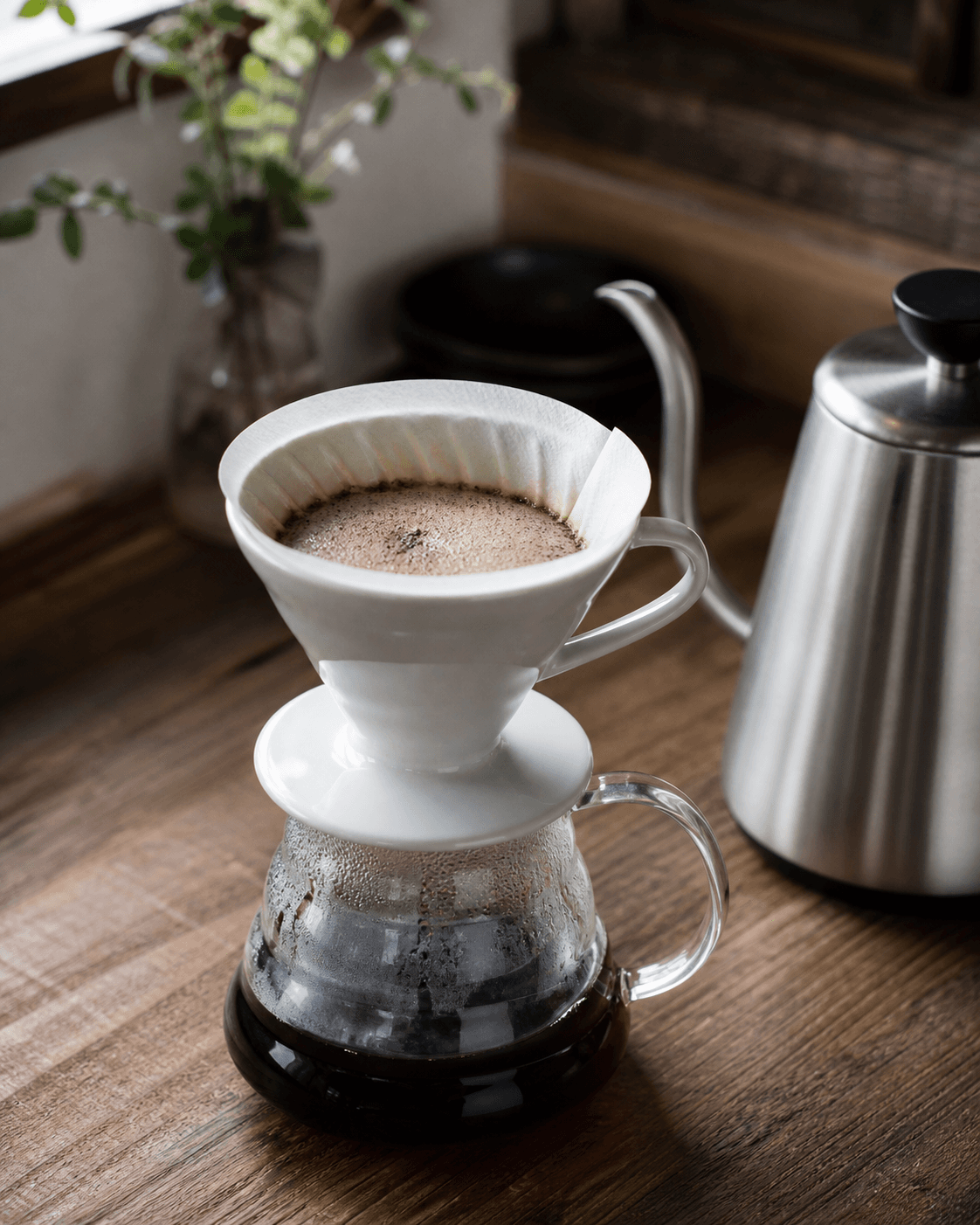
A dripper like the Hario V60 already drains fast because of its large single hole and spiral ribs, which is part of its design appeal but also means a coarse grind drains through even faster, leaving water too little contact time with the grounds.
Fix: Grind finer — closer to table salt than sea salt for a V60 — and expect total brew time to land around 2:30 to 3:30 for a standard 20-gram brew. If your pour-over is finishing in under 2 minutes and tasting thin, that's a strong signal the grind needs to come in.
Your pour is too fast or the bed isn't saturating evenly
Pouring too quickly, or dumping water off-center, means large parts of the coffee bed never get properly wetted before water exits through the filter. Unsaturated grounds contribute almost nothing to the cup, which is functionally the same as using less coffee than you weighed out.
Fix: Bloom first — pour about twice the coffee's weight in water (40g for a 20g dose), let it sit 30–45 seconds so it degasses and saturates evenly, then continue in slow, controlled circular pours, keeping the water level fairly consistent rather than pouring all at once. A gentle, spiral pour that revisits the center and edges keeps the whole bed extracting.
Your water isn't hot enough
Water below about 195°F extracts less efficiently across the board — sugars and body in particular suffer, since they need more thermal energy to dissolve than the sharp, easily-extracted acids do. A kettle that's cooled for a couple of minutes off the boil, or one used straight off the stove without checking, can land well outside the ideal window without you noticing.
Fix: Target 200–205°F, just below a full rolling boil. If you don't have a temperature-controlled kettle, pour boiling water off the heat and wait roughly 30 seconds before brewing — that's usually enough to land in range.
Working through the fixes
Start with the scale — ratio is the most common cause and the easiest to verify in ten seconds. Grind next, since it directly controls contact time in a fast-draining dripper. Pour technique and bloom come third, and they matter more than people expect; an even bloom alone can noticeably improve a weak cup even without touching grind or ratio. Water temperature is worth checking last, mostly because it's the hardest to get wrong badly enough on its own to cause real weakness, but it compounds every other issue if it's off.
Frequently asked questions
Why does my pour-over coffee taste watery even with good beans?
Good beans won't save a ratio that's too weak or a bed of grounds that water blew through without saturating evenly — those two issues cause most watery pour-overs regardless of bean quality.
What coffee-to-water ratio should I use for pour-over?
Start around 1:16 by weight — for example 20 grams of coffee to 320 grams of water — and adjust toward 1:15 if you want it stronger.
Should pour-over water be boiling?
No, and that's part of the problem for some people — target 200–205°F, just off a full boil, since fully boiling water can actually scorch the grounds rather than fix weakness.
Why does my V60 finish too fast and taste thin?
A fast total brew time, often paired with a pale, watery-looking result, usually means the grind is too coarse for the Hario V60's fast-draining cone, so water spends less time in contact with the grounds.