On this page
Here's an unpopular opinion that happens to be correct: a $300 espresso machine paired with a $200 burr grinder will out-perform a $900 all-in-one machine with a mediocre built-in grinder, most days of the week. People spend their whole budget on the machine and treat the grinder as an afterthought, and it's backwards.
The grinder sets your ceiling
Espresso extraction depends on a fine, consistent particle size creating even resistance across the whole puck. If your grinder produces an inconsistent particle spread — some fine dust, some undersized boulders mixed in — no machine feature fixes that after the fact. A PID won't even out an uneven puck. A 15-bar-rated pump won't either. The water finds the path of least resistance through your puck regardless of how sophisticated the machine pushing it is, and an inconsistent grind guarantees channeling no matter what's upstream of the portafilter.
This is why the built-in grinders on integrated machines are so often the weak link — they're a cost-engineering compromise squeezed into a shared housing with the boiler and pump, competing for both space and budget against features that show up more prominently on a spec sheet, like pressure rating or milk-frothing automation. A dedicated grinder doesn't have to make that trade-off; its entire budget goes into burr quality and consistency.
A concrete comparison
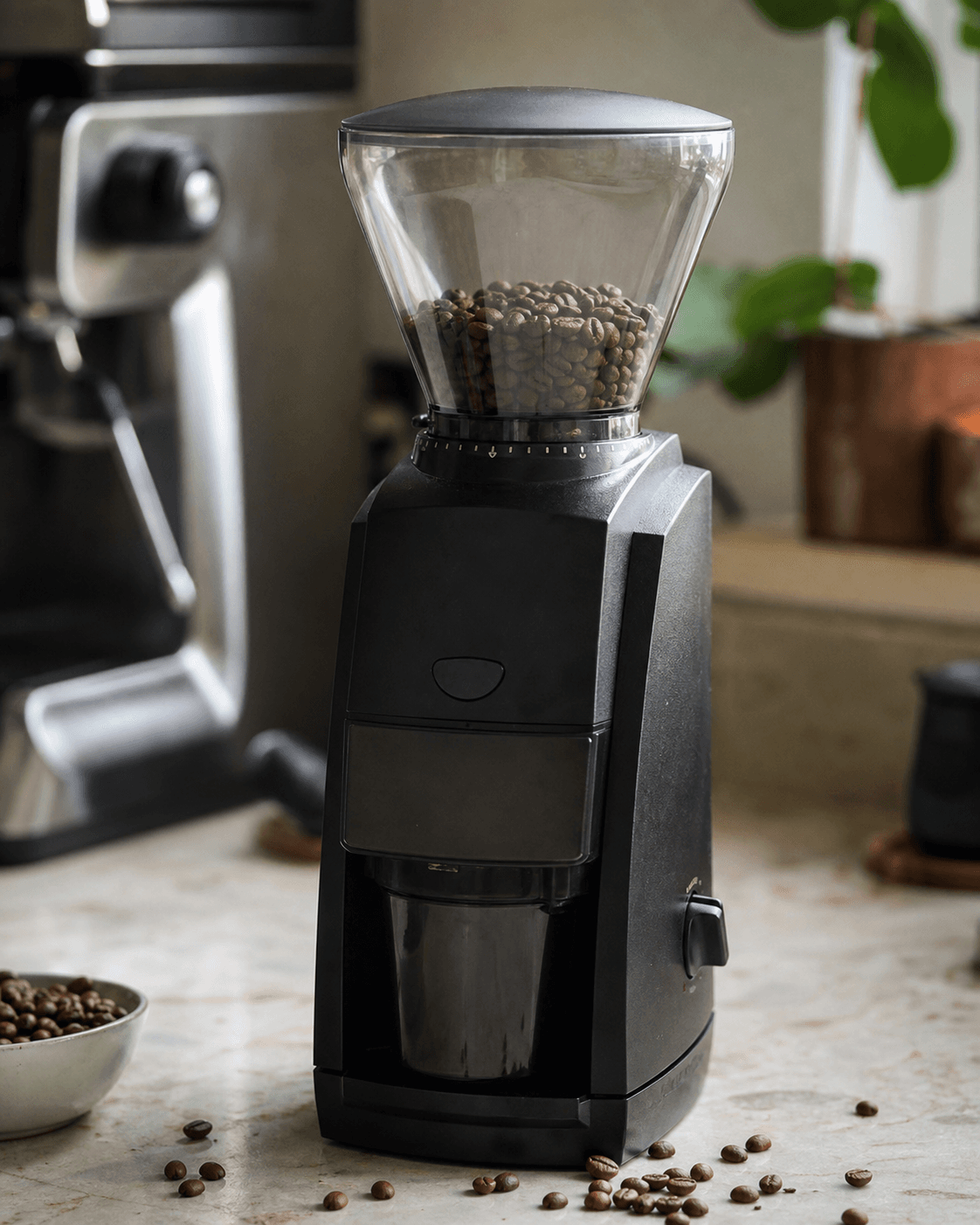
Take a machine like a Baratza Encore ESP, a dedicated single-purpose grinder built specifically for espresso-range grinding with 40mm flat steel burrs and a stepped adjustment fine enough for real dial-in work. Pair it with a basic non-PID espresso machine, and you can get a genuinely good, evenly-extracted shot — sweet, balanced, minimal channeling — because the raw material going into the portafilter is consistent.
Now take a fancier all-in-one machine with a built-in conical grinder sharing space and a motor budget with the rest of the unit. Even a well-reviewed all-in-one's stock grinder often produces a noticeably wider particle spread than a dedicated grinder at the same price point, because grinder performance was one line item among several the manufacturer had to balance. The machine might have better temperature stability, a nicer steam wand, and a more attractive finish — and the coffee can still taste worse, because the grind going in was never good enough to give any of that machine sophistication something to work with.
Why this gets overlooked
Grinders are unglamorous. They don't have a pressure gauge to admire, a milk-frothing wand to demo, or a shiny chrome finish that photographs well in a marketing shot. Machines get the spotlight because they're the visible, tactile part of the ritual — you interact with the machine every single time you make coffee, while the grinder just sits there and does its (crucial) job quietly in the background. That visibility bias is exactly why so many people over-invest in the machine and under-invest in the grinder, then wonder why their $800 setup doesn't taste as good as the $5 shot from the café down the street, which almost certainly has a commercial-grade grinder behind the counter.
Where this argument has limits
This isn't an argument for buying a terrible machine — a machine with no pressure regulation at all, wildly unstable temperature, or a portafilter/basket combo so poorly designed that even distribution is difficult will still cap your results regardless of grind quality. The claim is about the mediocre-vs-mediocre trade-off, not the extremes. A great grinder can't fully compensate for a genuinely broken machine, but it will compensate for a merely average one far more than an average grinder compensates for a genuinely great machine.
Practical takeaway
- If your budget forces a choice, put more of it into the grinder — a dedicated burr grinder with fine adjustment beats an integrated grinder in an all-in-one machine almost every time.
- Don't judge an all-in-one machine's coffee quality only by its pump pressure or PID — check independent reviews of its built-in grinder specifically.
- If you already own a decent machine and an underwhelming grinder, upgrading the grinder is usually the higher-impact next purchase.
- Treat the grinder as the first purchase decision, not the leftover budget after the machine.
Frequently asked questions
Is this true for drip coffee too, or just espresso?
It applies to both, but espresso makes the gap far more visible because the extraction window is short and pressure-based — grind inconsistency has nowhere to hide in 25-30 seconds.
What's the minimum grinder quality I should look for?
A dedicated burr grinder with an espresso-capable range and decent adjustment granularity — something like a Baratza Encore ESP is a realistic entry point built specifically for this.
If I have to choose, should I buy the machine or the grinder first?
Buy the grinder first — it sets a ceiling on quality that no machine, however good, can raise; you can always upgrade the machine later and immediately benefit from the grinder you already own.