Explainer
Why You Should Weigh Your Coffee (Not Scoop It)
On this page
The short answer
A coffee scoop is not a fixed amount of coffee — it's a fixed volume, and the actual weight of beans that fill that volume swings by several grams depending on roast level and bean density, which is exactly the kind of invisible variable that makes home coffee inconsistent from one morning to the next.
Why a scoop lies to you
Roast level changes bean density measurably
Roasting drives moisture and mass out of a bean while also causing it to expand — a dark roast can lose 15 to 20 percent of its green weight through this process while ending up larger in volume than a light roast of the same original bean. That combination means a scoop that holds, say, 10 grams of a light roast might hold only 8 to 8.5 grams of a dark roast from the same bag size, purely because of how roasting changed the bean's density.
Origin and processing add more variance on top
Beans from different origins and different processing methods (washed, natural, honey) also pack differently by volume even at similar roast levels — natural-processed beans in particular tend to be less dense than washed beans of the same roast level. Stack that on top of roast-level variance and a "one scoop" measurement across two different bags of coffee can vary by 2 to 3 grams without you doing anything differently.
What that variance actually does to a shot
On an 18-gram espresso dose, a 2-gram swing is over 10 percent of your total dose — enough to meaningfully shift your brew ratio and change extraction, tasting either thin and sour (underdosed relative to the recipe) or heavy and bitter (overdosed), for reasons that have nothing to do with your grind setting or technique. On a drip brew using a larger total amount of coffee, the same absolute gram variance matters proportionally less, but it's still there.
What weighing actually fixes
Weighing coffee removes bean density as a variable entirely — 18 grams is 18 grams whether it's a light roast Kenyan or a dark roast Sumatran, which means every other variable you're adjusting (grind size, ratio, brew time) is being adjusted against a stable baseline instead of a moving one. This is the actual reason serious coffee people weigh everything: not perfectionism for its own sake, but eliminating a hidden variable so the variables you're actually trying to control are the only ones changing.
Weight matters for water too, not just coffee
Eyeballing water against a fill line on a carafe or kettle is, in practice, a bigger source of error than scooping coffee — it's easy to be off by 50 milliliters or more without a scale, and that's a larger proportional error than typical scoop-to-scoop coffee variance. Weighing both sides of the ratio — coffee and water — is what actually locks in a repeatable recipe.
The practical takeaway
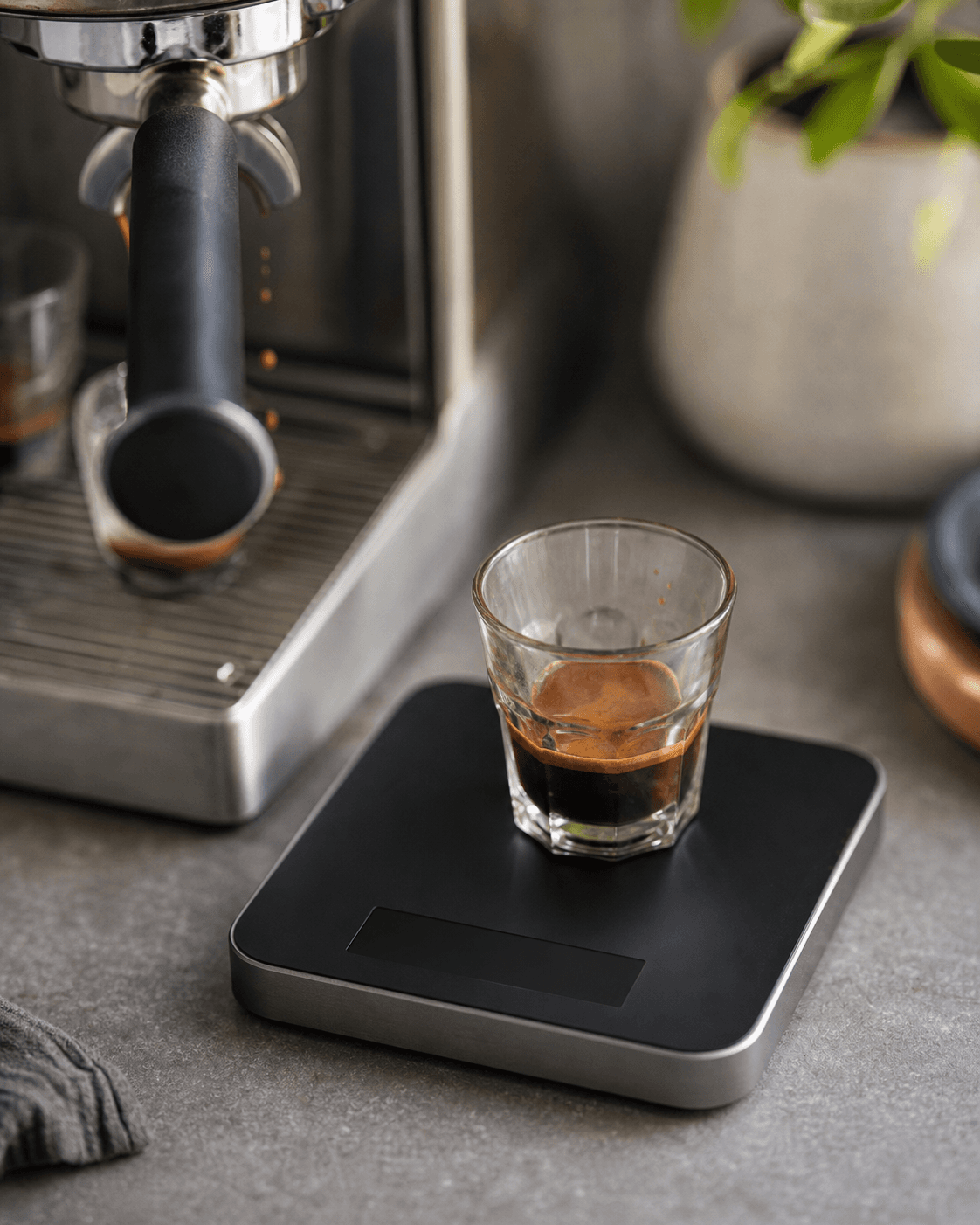
Start with a basic digital scale if you don't already have one — 0.1g resolution is worth having for espresso, 1g resolution is fine for drip. Weigh your dose before grinding, weigh your water or your yield during brewing, and write down a ratio that works for a given bean so you have an actual baseline to adjust from the next time something tastes off. The upgrade to a faster, coffee-specific scale like the Acaia Pearl matters most once you're weighing consistently and start noticing that a laggy scale is making you overshoot your targets — it's a refinement on a habit, not a replacement for starting the habit in the first place.
Frequently asked questions
How much does bean density actually vary between roasts?
Enough to matter — a dark roast bean loses 15 to 20 percent of its mass during roasting through moisture and mass loss, while also expanding in size, which means a fixed-volume scoop of dark roast holds noticeably fewer actual grams of coffee than the same scoop of a lighter roast.
Is a kitchen scale accurate enough for coffee, or do I need a coffee-specific one?
A basic kitchen scale with 0.1g or even 1g resolution is accurate enough for the actual measurement. What a coffee-specific scale like the Acaia Pearl adds is response time — fast enough tracking to stop a pour or a shot right at your target weight, which matters much more for espresso than for slower brew methods.
What's a good starting ratio to weigh out?
For drip and pour-over, 1:16 to 1:17 (coffee to water by weight) is a common, solid starting point. For espresso, 1:2 (dose to yield) is the standard starting ratio most recipes build from.
Does weighing water matter as much as weighing coffee?
Yes, arguably more for drip methods — pouring water by eyeballing a fill line on a carafe is a bigger source of error than scooping coffee, since it's easy to be off by 50ml or more without a scale, which shifts your ratio far more than typical scoop variance does.