Researched
Breville Juice Fountain Cold Review: Fast Juice, With the Usual Centrifugal Trade-Offs
It's the juicer for someone who wants fresh juice in under a minute and doesn't mind the noise or the slightly lower yield that comes with centrifugal spinning.
On this page
Speed is the whole pitch here. Drop a whole apple in, hit the switch, and you've got a glass of juice before a masticating juicer has finished pressing its first piece. What that speed costs you is the more interesting story.
Who this is for
Buy this if your juicing routine is mostly hard produce — apples, carrots, beets, celery — and you value getting a glass of juice fast over squeezing out every last drop of yield or nutrients. The 3-inch feed chute means less chopping, which matters a lot on a weekday morning.
Skip it if leafy greens, wheatgrass, or maximum yield per pound of produce are your priority — a masticating (slow) juicer will consistently pull more juice out of spinach and kale, and the juice keeps longer before oxidizing. It's also a poor fit if noise is a dealbreaker in your kitchen; this is not a quiet machine.
Design and build
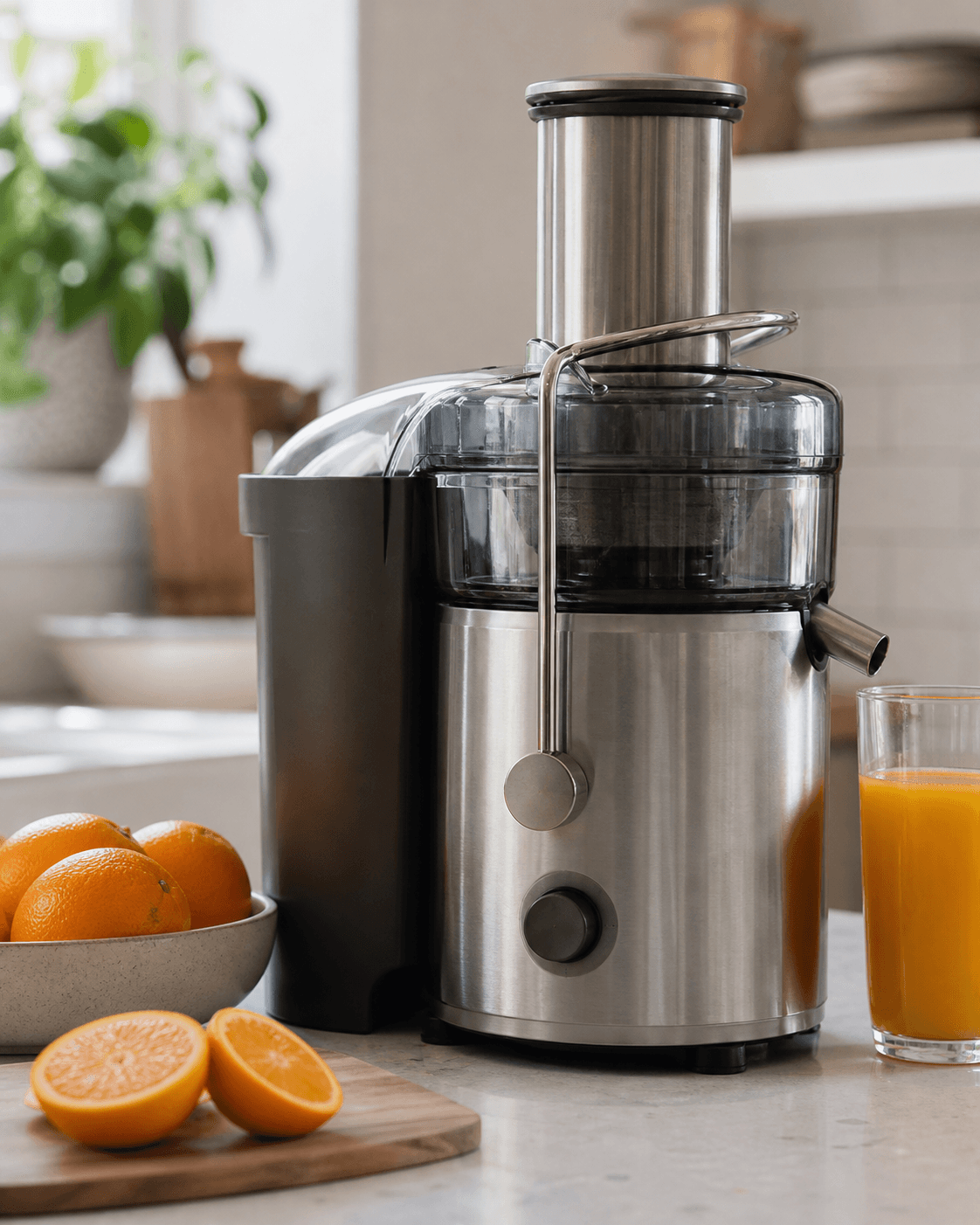
The body's a tall, wide unit — Breville's stainless-steel-faced design looks the part on a counter, but it needs real counter real estate, more than most blenders. The feed chute is the standout physical feature: at 3 inches across, it swallows whole small apples, whole carrots, and halved larger produce without much precutting, which shaves real minutes off juicing sessions compared to juicers with a 2-inch or narrower chute.
Inside, the juicing basket uses a micro-mesh filter and a stainless steel cutting disc that spins at one of two selectable speeds. The pulp collector is large enough that a normal juicing session for two or three people typically doesn't require a mid-run pause to empty it, which is a bigger deal than it sounds — stopping to dump pulp mid-batch is one of the most annoying parts of juicing on smaller machines.
Centrifugal juicing, and what "cold spin" means here
Traditional centrifugal juicers spin fast enough to generate real friction heat, which can degrade flavor and nutrients slightly and speeds up oxidation. Breville's cold-spin engineering on this model is aimed at minimizing that heat transfer during the spin cycle — it doesn't chill the juice, but it reduces how much the juicing process itself heats things up versus older centrifugal designs. It's a real, if modest, improvement — don't expect masticating-juicer-level freshness retention, but it's noticeably better than a bargain centrifugal juicer from a decade ago.
Dual-speed control
Speed 1 (about 6,500 RPM) is meant for soft produce — berries, citrus, soft fruit — where high RPM would just create foam and waste yield. Speed 2 (about 13,000 RPM) is for hard, dense produce like carrots, beets, and apples, where you need the extra force to break down fiber. Matching speed to produce type genuinely improves yield and reduces foam versus running everything at max speed, and it's an easy habit to build after a few uses.
Yield versus a masticating juicer
This is the honest trade-off of the whole centrifugal category. Fast spinning extracts juice efficiently from hard, wet produce (apples, carrots) but does a noticeably worse job on leafy greens and herbs, where a slow masticating press squeezes out meaningfully more juice per pound. If your juice routine leans heavily on kale, spinach, or wheatgrass, this isn't the right tool — you'll be paying for produce that ends up mostly in the pulp bin instead of your glass.
Noise
Centrifugal juicers are, as a category, some of the loudest small appliances in a kitchen, and this one doesn't buck that trend — running at 13,000 RPM with a hard vegetable in the chute is genuinely startling the first time you hear it, especially early in the morning. If you have a household that's asleep when you juice, this is worth testing in-store or budgeting for some friction with housemates.
Daily use and cleaning
This is where centrifugal juicers ask for a trade against their speed advantage. The mesh filter basket, cutting disc, and pulp bin all need a real scrub after each use — dried pulp fiber sticks in the mesh holes and, left overnight, turns into a genuine chore. Most parts are dishwasher-safe, which helps, but a quick hand-rinse of the mesh basket right after juicing (before pulp dries) saves a lot of scrubbing later. Budget 5-10 minutes for a full cleanup, more if you let it sit.
Maintenance and longevity
The main long-term wear points are the mesh filter (which can eventually clog or tear with heavy daily use over a few years) and the motor brushes on any high-RPM centrifugal design. Replacement filter baskets are available from Breville and are a reasonable expense compared to replacing the whole unit. With normal care — rinsing promptly, not forcing oversized produce through the chute — this style of juicer typically holds up for several years of regular use.
How it compares
Omega NC900 (masticating) — slower, quieter, better yield especially on greens, and juice that keeps 2-3 days versus about a day for centrifugal output. The trade is time: masticating juicing takes noticeably longer per glass, and the narrower feed chute means more precutting.
Hurom-style masticating juicers — similar story to the Omega: better for greens and juice longevity, worse for speed and hands-off convenience with hard whole produce.
Cheaper centrifugal juicers — you'll find machines under $100 that spin fast too, but with narrower feed chutes, smaller pulp bins requiring more frequent stops, and motors that struggle more with dense root vegetables. The Juice Fountain Cold's bigger chute and dual-speed control are genuinely worth the price step up if centrifugal juicing is the format you want.
Value
At $300-350, this sits in the middle of the juicer market — a real step up from bargain centrifugal juicers in chute size, pulp capacity, and speed control, but well short of masticating-juicer pricing (which often runs higher still) and their yield/freshness advantages. It's a fair price for what it is: the fast, convenient end of juicing, done competently.
Verdict
If fast and convenient beats maximum yield and drink longevity for your morning routine, this juicer delivers exactly what it promises — apples and carrots into juice in under a minute, minimal precutting, and a pulp bin that doesn't need constant emptying. Just go in knowing centrifugal is a format with real trade-offs against masticating juicers, not a lesser version of the same thing.
What we like
- 3-inch feed chute means less pre-cutting of whole fruits and vegetables
- Dual-speed motor lets you match RPM to soft vs. hard produce
- Cold-spin design reduces heat transfer to the juice versus older centrifugal designs
- Large pulp bin means fewer stops to empty it mid-batch
What we don't
- Centrifugal spinning means more oxidation and a shorter fresh-drink window than masticating juicers
- Loud — high RPM centrifugal juicing is one of the noisier kitchen tasks
- Lower juice yield from leafy greens and wheatgrass than a masticating juicer
- Wide juicing basket and mesh filter take real scrubbing time to clean well
Specifications
| Type | Centrifugal (cold-spin technology) |
|---|---|
| Motor power (W) | 850W |
| Feed chute (in) | 3 in |
| RPM | 6,500 / 13,000 (dual speed) |
| Yield | Good for a centrifugal juicer, below masticating-juicer yield on leafy greens |
| Ease of cleaning | Dishwasher-safe parts, large pulp bin |
| Warranty (yr) | 1 |
Frequently asked questions
Is the Breville Juice Fountain Cold a masticating juicer?
No — it's centrifugal. It spins produce against a mesh filter at high RPM rather than slowly pressing it, which is faster but yields less juice from leafy greens.
How loud is the Breville Juice Fountain Cold?
Loud — high-RPM centrifugal juicing is one of the noisier things you'll run in a kitchen, especially on the 13,000 RPM setting for hard produce.
Can whole apples go through the feed chute?
Small to medium apples fit through the 3-inch chute whole; larger ones need a rough halving first.
How long does the juice stay fresh?
Centrifugal juicing introduces more air and oxidation than masticating juicing, so plan to drink it within about a day for best flavor and nutrient retention, versus 2-3 days for masticating-juicer output.
Keep reading
- Hamilton Beach Big Mouth Pro Review: Juicing for Under $100
Poor
Our score: 58 / 100
- Breville Juice Fountain Multi-Speed Review: The Other Breville Juicer
Fair
Our score: 66 / 100
- Kuvings B1700 Review: Masticating Juicing Without the Precutting Chore
Good
Our score: 77 / 100
- Hurom H200 Review: Slow-Squeeze Juicing at Its Clearest
Good
Our score: 77 / 100