Researched
Cosori Pro II Air Fryer Review: The Budget Pick That Doesn't Feel Like One
A 5-quart single-basket fryer that costs about $110 and out-punches its price on capacity and ease of use. The default recommendation for anyone who just wants one good air fryer without overthinking it.
On this page
The short version
$110 for a 5-quart air fryer with 11 presets and a touchscreen used to sound like a spec sheet that couldn't possibly hold up in practice. It mostly does. The Cosori Pro II isn't the most powerful or capacious fryer on the market, but it does the fundamental job — crisping food with hot circulating air — reliably and without asking you to spend $200 to get there.
Who it's for — and who should skip it
This is the right pick if you want one straightforward air fryer for a household of one to three people, cooking one dish at a time, and you'd rather spend $110 well than $200 on features you won't use. It's also a sensible first air fryer if you're not sure how much you'll actually use one — the price makes the experiment low-risk.
Skip it if you regularly cook two different foods at different temperatures for the same meal — a single basket can't do that in parallel, and you'll end up running back-to-back batches. Skip it too if you're cooking for a crowd regularly; 5 quarts is a real capacity, but it's not built for feeding six people in one pass.
Build & materials
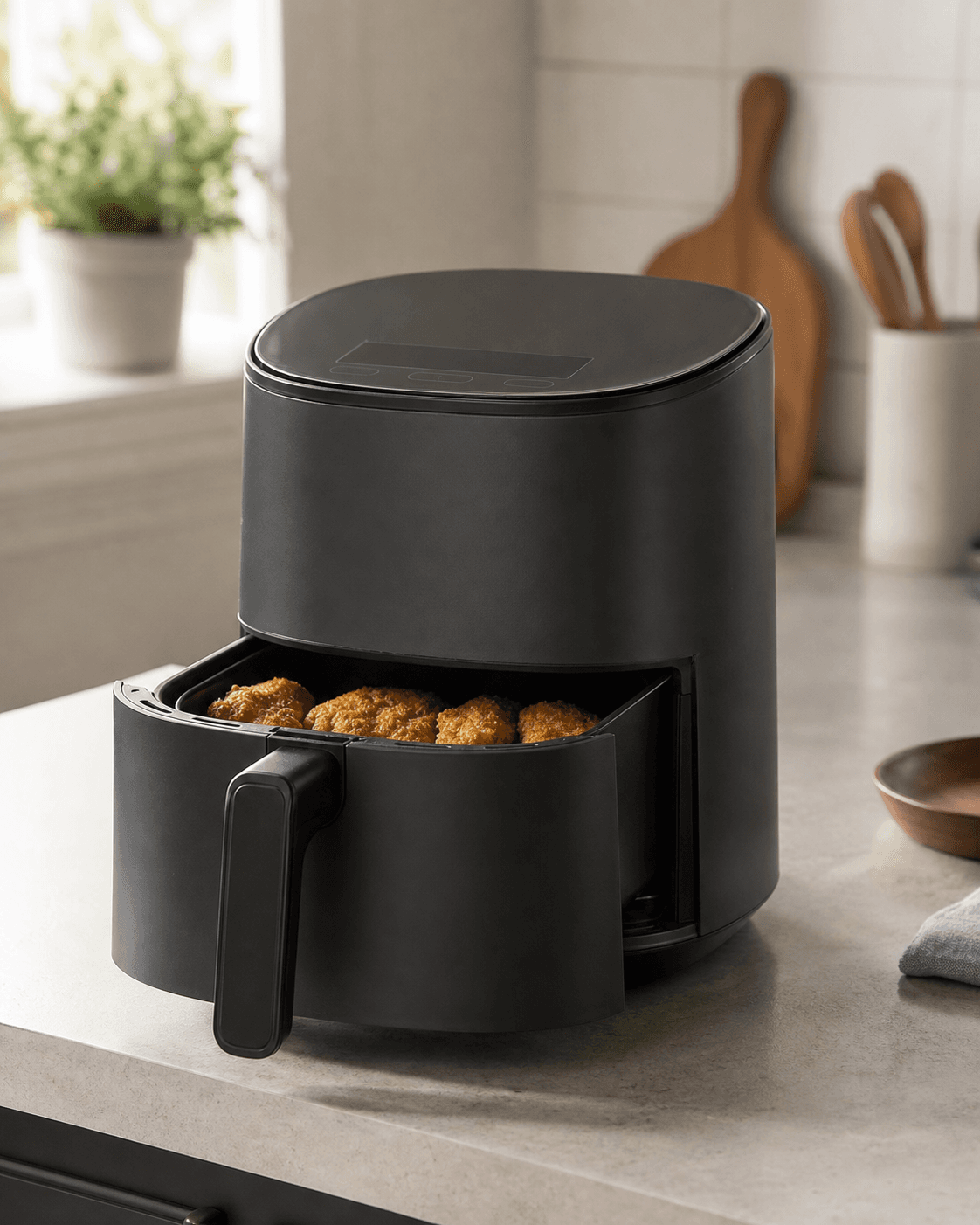
The housing is plastic, as is standard across this entire price category, with a metal cooking chamber and a nonstick-coated metal basket and crisper plate. The touchscreen control panel sits on top, flush and simple, with the 11 presets laid out as icons rather than a scrolling menu. It doesn't feel premium, but it also doesn't feel flimsy — the basket has a solid, weighted pull to it, and the housing doesn't flex or rattle during operation.
Core performance
Heating consistency and crisping
The 1500-watt element and fan combination gets the unit to temperature quickly and holds it steadily — fries and frozen foods crisp evenly with a single shake or flip partway through, which is the real test of whether an air fryer's internal air circulation is doing its job rather than just blasting heat from one direction. At max temp (450F) it handles thin-cut items well; thicker cuts of protein benefit from dropping to 375-400F for a longer, more even cook rather than pushing max heat the whole time.
Preset usefulness
Eleven presets cover the realistic use cases — fries, chicken, fish, vegetables, bake, reheat, dehydrate, and a few others — and in practice they're reasonable starting points rather than exact-perfect settings; you'll still want to check food a few minutes early the first time you use a given preset with your specific food and adjust from there. What they do well is remove the guesswork of "what temperature should chicken wings even be" for someone new to air frying.
Capacity in real use
5 quarts sounds abstract until you load it — it's roughly a pound and a half of chicken wings in a single, mostly non-overlapping layer, or about 1.5 pounds of fries. That's genuinely useful for 2-3 people eating the same food; push past that and you're doing multiple batches, which eats into the time savings that's the whole point of owning one.
Secondary performance: noise and smoke
It runs on the quieter side for this category — noticeable but not intrusive, comparable to a kitchen exhaust fan on low. The more relevant issue is smoke: fatty foods like wings or bacon render grease onto the crisper plate, and if that plate isn't wiped between batches or the basket isn't shaken to prevent grease pooling, you'll get visible smoke and a burnt-fat smell. This isn't unique to Cosori — it's physics common to every basket-style air fryer — but it's worth knowing before your first batch of wings sets off a smoke detector.
Daily use & ergonomics
The touchscreen is legible and responsive, and the basket-and-crisper-plate assembly pulls out as one piece rather than requiring you to fish a plate out separately, which is a small but real convenience during cooking when you want to shake the basket. At 5 quarts it's compact enough to leave on the counter in most kitchens without dominating the space, unlike the larger dual-zone units.
Maintenance, longevity & repairability
The basket and crisper plate are dishwasher-safe, and hand-washing them promptly after use (rather than letting grease dry on) keeps the nonstick coating performing well longer. Like essentially every nonstick air fryer basket on the market, coating wear over 2-3 years of regular use is the realistic lifespan concern — this isn't a Cosori-specific weakness, it's inherent to the category, and metal utensils accelerate it. The 2-year warranty is better than the 1-year standard many competitors offer at this price.
How it compares
Ninja Foodi Dual-Basket (~$170-200): More capacity and the ability to cook two things at different settings simultaneously, at a real premium in both price and counter space. Worth it only if you actually need the parallel cooking.
Instant Vortex Plus (~$100-120): Similar price and capacity range, comparable performance; the choice between the two often comes down to preset layout preference and which brand's app ecosystem you're already using, if any.
Philips Airfryer XXL (~$250-300): Philips' twin-turbostar technology and heavier-duty build justify a real premium for people who air fry daily and want to future-proof against wear — most casual users won't recoup that difference in noticeably better food.
Value analysis
This is close to the value benchmark in the air fryer category right now — a 5-quart basket, 11 presets, and a 2-year warranty for around $110 is difficult for competitors to beat without cutting corners somewhere else. The honest caveat is that "value" here means doing the fundamentals well, not doing anything exceptional; if you want dual-zone cooking or heavier-duty long-term construction, you're paying more elsewhere for real, specific upgrades.
Known issues
The most common complaint across owner reports is basket coating wear after a year or two of frequent use, particularly with acidic or heavily seasoned foods and metal utensils — avoidable with care, but a real long-term consideration. A second recurring note is smoking with high-fat foods when the crisper plate isn't cleaned between batches. A smaller subset of owners with the Wi-Fi-connected version report the app being more hassle than it's worth for day-to-day use.
Verdict
A 9 on value isn't hyperbole here — few air fryers at this price match the combination of capacity, preset usefulness, and warranty length. It's not the most versatile fryer you can buy (that's the Ninja dual-basket, at nearly double the price), but for a single household cooking one dish at a time, it's the sensible default, and the one we'd point most first-time buyers toward.
What we like
- 5-quart basket is large for the price and the footprint
- Touchscreen presets are actually intuitive, not buried in a manual
- Runs quieter than most fryers in this price bracket
- Genuinely good value — few competitors match capacity and features at this price
What we don't
- Single basket means no parallel cooking of two different foods
- Basket nonstick coating shows wear faster than the metal underneath deserves
- Can smoke with high-fat foods (wings, bacon) if the crisper plate isn't kept clean
- App connectivity (on Wi-Fi models) is a nice-to-have, not essential, and adds setup friction
Specifications
| Capacity (qt) | 5 |
|---|---|
| Type | Single basket |
| Temp range (F) | 100-450 |
| Presets | 11 |
| Wattage (W) | 1500 |
| Dishwasher safe | Yes (basket and crisper plate) |
| Warranty (yr) | 2 |
Frequently asked questions
Is 5 quarts enough for a family?
For two to three people eating the same food, yes, comfortably. For four or more, or for two different dishes at once, you'll be running multiple batches — which is where a dual-zone unit earns its extra cost and size instead.
Does it really smoke during cooking?
With high-fat foods like wings or bacon, some smoking is common in most air fryers if rendered fat pools on a dirty crisper plate. Wiping the plate between batches and not overloading it largely prevents it.
Do I need the app-connected version?
No — it's a convenience for remote monitoring and recipe browsing, not a functional upgrade to the cooking itself. The non-connected version cooks identically for less money.
How does the touchscreen hold up over time?
It's a capacitive touch panel rather than physical buttons, and it's held up well in most long-term owner reports — occasional oil residue on the screen is the main gripe, and it wipes off easily.