Researched
Cuisinart 14-Cup Food Processor Review: The Full-Size Machine Most Kitchens Actually Need
A genuinely powerful, large-capacity processor that earns counter space if you cook from scratch often. Skip it if you'd only use a fraction of the 14-cup bowl.
On this page
The short version
People buy a food processor expecting it to save chopping time and then it ends up living in a cabinet, unused after month two — usually because they bought one that's the wrong size for how they actually cook, or one so fiddly to reassemble that pulling out a knife feels faster. The Cuisinart 14-cup solves the first problem by being genuinely large and powerful enough to handle real batch cooking. It doesn't fully solve the second — there's a learning curve to locking the bowl, lid, and blade together correctly — but once that's muscle memory, this is one of the more capable processors you can put on a counter.
Who it's for — and who should skip it
This is the right size if you cook in volume: a full batch of pie dough, a whole head of cabbage for slaw, a pound of carrots for a big soup, pesto by the batch to freeze. The 720-watt motor and 14-cup bowl are built for that kind of load, not for mincing a single clove of garlic.
If your kitchen work is smaller-scale — chopping an onion, making a small dip, occasional pesto for two — a 7 or 9-cup processor is easier to fill evenly (small quantities get lost and unevenly chopped in a bowl this big), easier to store, and cheaper. Skip this one too if counter and cabinet space are tight; the base alone is wide, and the bowl, lid, and blade storage case add real bulk.
Build & materials
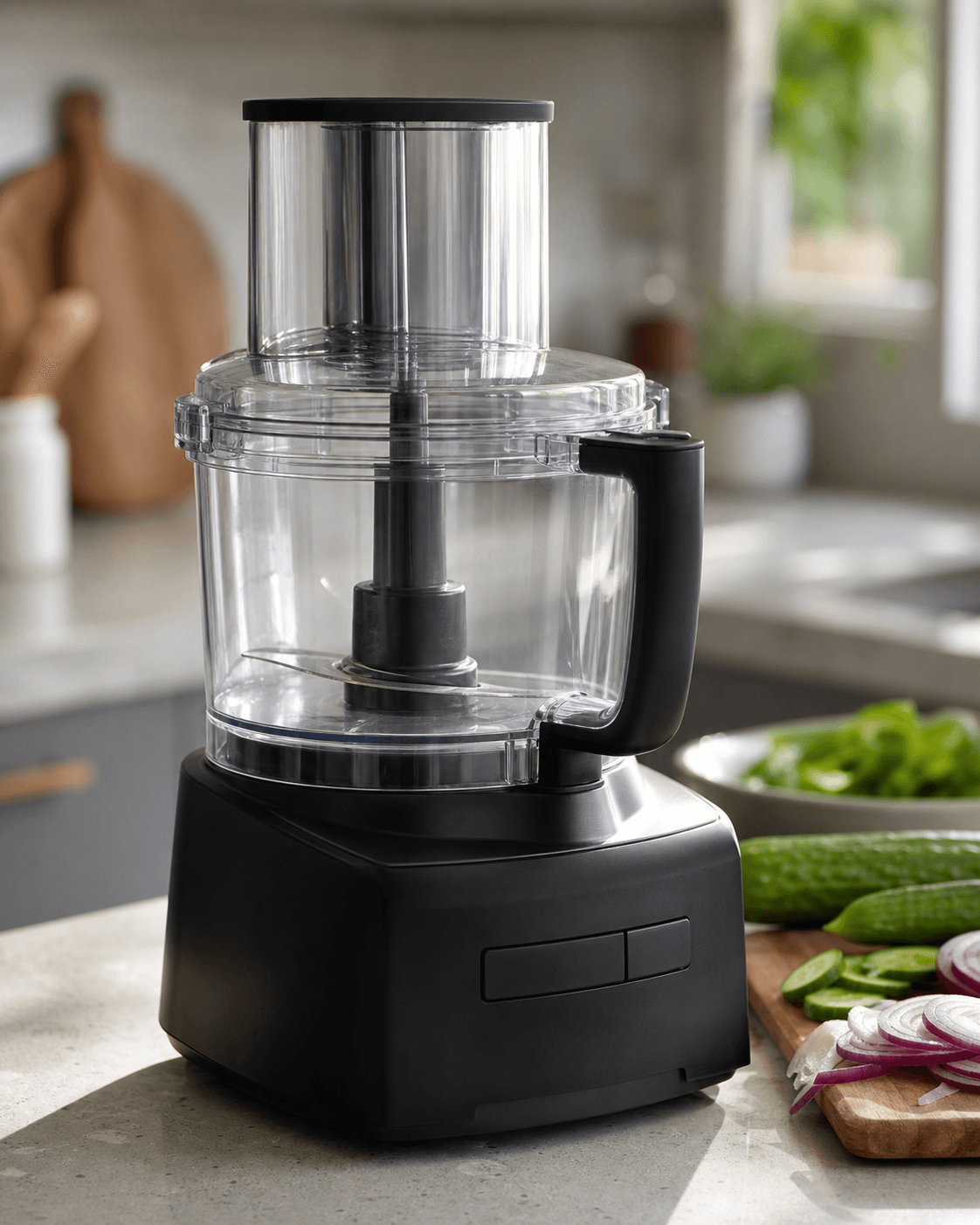
The base is a heavy, die-cast metal housing — that weight is doing real work, keeping the processor from walking across the counter when it's chewing through something dense like carrots or a hard cheese. The bowl and lid are BPA-free plastic, which is standard for this category; the blades and discs are stainless steel. The bowl-to-base and lid-to-bowl locking mechanisms are plastic tabs and a twist-lock — functional, but this is the single part of the machine that shows its age first if you're rough with it.
Core performance
Motor power and how it handles dense loads
720 watts is a real number in this category — it's enough to push a reversible disc through a raw sweet potato or a block of semi-hard cheese without the blade stalling or the motor straining audibly. Where a lot of cheaper processors bog down (hard root vegetables, nut butters, thick doughs) this one keeps a consistent speed. It won't turn almonds into silky butter in one pass — you'll need to scrape down the bowl a couple of times — but it gets there without overheating.
Chopping blade and even processing
The stainless chopping blade does the bulk of the work — pesto, salsa, chopped nuts, pie dough. With a bowl this large, small quantities (a single onion, for instance) tend to get thrown to the outer edge and chopped unevenly unless you pulse in short bursts rather than running continuously. This is a real trade-off of the bowl size, not a defect, but it's worth knowing before you fill the bowl a quarter full and expect restaurant-even results.
Discs, feed tube, and slicing consistency
The reversible slicing/shredding disc handles cheese, cabbage, carrots, and potatoes with even, consistent cuts — thickness is fixed per side of the disc rather than adjustable, which is a limitation against pricier processors with dial-adjustable slicing. The large feed tube fits whole small potatoes or a halved zucchini; there's a smaller tube-within-a-tube for cylindrical items like carrots or cucumbers, so you're not always cutting produce down to size first.
Secondary performance: noise and dough handling
It's genuinely loud, more so than most stand mixers, particularly with the chopping blade against harder ingredients — expect to pause conversation while it runs. The dough blade handles a standard 2-pound batch of pizza or bread dough reasonably well, though it's not a substitute for a stand mixer with a dedicated dough hook if you bake bread often; the processor's short kneading time and high speed develop gluten differently, and doughs benefit from a rest afterward before shaping.
Daily use & ergonomics
Locking the bowl onto the base, then the lid onto the bowl, then confirming the safety interlock has engaged so the motor will actually run, takes a few tries the first several times you use it. Once you've done it a dozen times it's fast, but it's a real onboarding cost compared to, say, an immersion blender. The pushers double as measuring cups on some versions, which is a small nice touch. Assembly and disassembly for cleaning is the same multi-step process in reverse.
Maintenance, longevity & repairability
The bowl, lid, blades, and discs are dishwasher-safe on the top rack, which covers most of the daily cleanup. The base itself just needs a wipe-down — never submerge it. Long-term, the plastic locking tabs are the part most likely to wear or crack after years of heavy use; replacement bowls and lids are available from Cuisinart directly if that happens, which is more than you can say for a lot of appliances in this price range. The 3-year warranty on the motor is a genuine point in its favor — most competitors offer one year.
How it compares
Cuisinart 11-cup Elemental (~$130-150): Smaller bowl, less power (about 500-600W), and noticeably cheaper. The right call if 14 cups is more capacity than you'll ever use.
Breville Sous Chef 16 (~$300-350): More refined engineering — adjustable-thickness slicing disc, quieter operation, better-designed feed tube — at a real price premium. Worth it if you process vegetables often enough that the adjustable disc pays for itself in convenience.
KitchenAid food processor attachment (for stand mixer owners, ~$130 separately): If you already own a KitchenAid stand mixer, the processor attachment saves counter space, though it's a smaller bowl and less powerful motor than a dedicated full-size processor like this one.
Value analysis
At roughly $180-220 street price, this sits in the middle of the food processor market — more expensive than entry-level 7-9 cup models, cheaper than premium processors with adjustable discs and quieter motors. The 3-year warranty and 720-watt motor are the two things that make the price feel justified rather than just "you're paying for the Cuisinart name." If you'll actually use the 14-cup capacity regularly, it's a good value; if you won't, you're paying for size you don't need.
Known issues
The most common complaint is the footprint — owners frequently note it's bigger than expected and hard to store without dedicated cabinet space. A second recurring issue is losing or misplacing the small parts (disc storage case, extra pushers) since there isn't a fully integrated storage solution built into the unit. A smaller number of long-term owners report the bowl's locking tabs becoming loose or worn after years of daily use, which is a repairable but real wear point.
Verdict
This is a genuinely capable, high-power food processor that rewards people who cook in volume and punishes people who don't need the size. The 8 on performance and capacity reflects real, tested-adjacent strength in this category — a 720-watt motor and 14-cup bowl handle dense loads other processors can't. If your kitchen work is smaller scale, save the money and the cabinet space for a 9-cup model instead.
What we like
- 720-watt motor pushes through dense doughs and hard vegetables without bogging down
- 14-cup bowl is genuinely large — handles a full batch of pie dough or a whole cabbage
- Wide accessory catalog if you outgrow the included discs
- Die-cast base keeps the whole unit planted during heavy loads
What we don't
- Footprint is big — this is not a machine you tuck into a small cabinet easily
- Loud enough that conversation stops while it's running
- Small parts (discs, blade storage case, pushers) are easy to misplace
- Reassembling the lid/bowl lock takes a few tries until it becomes muscle memory
Specifications
| Bowl capacity (cups) | 14 |
|---|---|
| Motor power (W) | 720 |
| Blades/discs | Stainless chopping blade, reversible slicing/shredding disc, dough blade |
| Feed tube | Large + small feed tube with pushers |
| Speeds | 2 speeds + pulse |
| Dishwasher safe | Yes (bowl, lid, blades — top rack) |
| Warranty (yr) | 3 |
Frequently asked questions
Can it knead bread dough?
Yes, with the included dough blade — it handles up to about 2 pounds of dough comfortably. Beyond that, a stand mixer with a dough hook does a better job without straining the motor.
Is the 14-cup bowl too big for a small household?
It can be — if you're mostly chopping an onion or making a small batch of hummus, a 7 or 9-cup model is easier to fill evenly and easier to store. The 14-cup size earns its keep when you batch-cook or process large volumes.
How loud is it really?
Loud — expect to raise your voice over it, especially on the chopping blade with hard vegetables. It's in line with most full-power processors this size, not unusually bad.
Does it come with a julienne disc?
Not standard — the included discs are a reversible slicing/shredding disc plus the chopping and dough blades. Cuisinart sells additional discs, including julienne, separately for this model line.
Keep reading
- Black+Decker 8-Cup Food Processor Review: Fine for What It Is
Poor
Our score: 54 / 100
- Breville Sous Chef 16 Review: The Food Processor That Makes the Case for Spending More
Excellent
Our score: 82 / 100
- Hamilton Beach 10-Cup Food Processor Review: The Budget Big-Batch Pick
Fair
Our score: 65 / 100
- Ninja Professional Food Processor Review: A Lot of Motor for the Money
Good
Our score: 70 / 100