Researched
Fellow Stagg EKG Review: The Gooseneck Kettle That Made Temperature Control Normal
It's a lot of money for a kettle, but the 1-degree temperature control and genuinely precise pour make a real, repeatable difference for pour-over coffee and tea.
On this page
A basic electric kettle costs $20 and boils water. This one costs $165 and also boils water — the entire case for the difference comes down to two things: how precisely it holds a temperature, and how precisely it pours. For pour-over coffee, both of those matter more than people expect until they've used a kettle that does them well.
Who this is for
If you make pour-over coffee, tea that actually cares about steep temperature (green and white tea especially), or you're the kind of person who's already invested in a burr grinder and a decent dripper, this kettle closes a real gap in the routine — water temperature and pour control are two of the biggest variables in manual brewing that a standard kettle simply can't manage.
Skip it if you're mostly boiling water for instant coffee, pasta, or a French press where a wide margin of temperature error doesn't change the outcome. A $25 basic electric kettle boils water just as reliably for those uses, and the extra $140 buys precision you won't use.
Design and build
The body is stainless steel with a brushed or matte finish depending on the colorway, sitting on a plastic base with the control electronics and heating element. The handle is plastic, which is the one part of the build that doesn't quite match the rest — it's fine, ergonomically sound, but it's the spot where you notice this isn't an all-metal kettle at this price point.
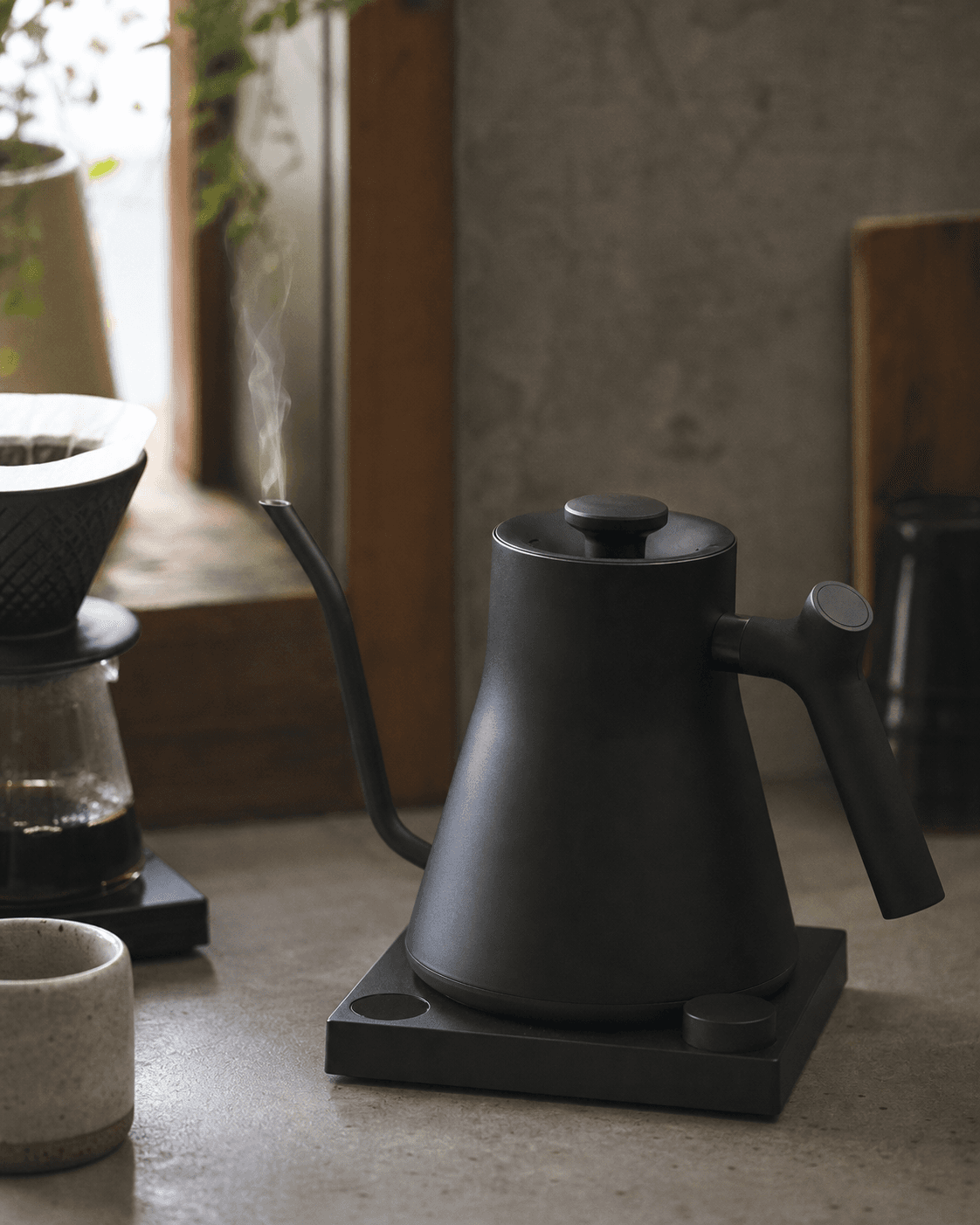
The gooseneck spout is the signature design element, and it's a genuinely thin, long spout rather than a token gesture toward the gooseneck shape. That narrow diameter is what gives you slow-motion control over pour rate — a wide-spout kettle physically cannot pour as slowly or as precisely, no matter how careful your hand is.
Temperature control precision
The dial-and-display combo lets you set a target temperature anywhere from 135°F to 212°F in 1-degree steps, and the kettle holds that number rather than just approximating "hot." For pour-over, this matters because roast level and grind size interact with water temperature — a lighter roast often wants water nearer boiling (200-205°F) to extract enough, while a darker roast can turn bitter and hollow at the same temperature and does better a few degrees cooler. Being able to dial in 202°F instead of guessing "just off the boil" is a real, repeatable variable you can now control.
Pour rate and flow control
This is the other half of the pitch, and it's less obvious until you've used a wide-spout kettle for pour-over and felt how hard it is to pour a thin, steady stream. The Stagg EKG's narrow gooseneck spout lets you go from a thin trickle (good for the bloom phase, where you want to wet grounds gently without disturbing the bed too much) to a stronger, controlled stream (for the main pour phases) just by tilting the kettle — the spout geometry does most of the work for you.
Boil speed
At 1200 watts, it's not the fastest kettle on the market — some basic kettles push 1500W and boil noticeably quicker — but it's fast enough that boiling a liter of water rarely feels like a bottleneck in a morning routine. The trade-off for the slightly lower wattage is likely deliberate: a lower-power heating element paired with the precision temperature sensor may be easier to control accurately than cranking maximum wattage.
Ease of use
The interface is a rotary dial plus a small digital display showing current and target temperature — simple enough to use without a manual, and precise enough that "set and forget until it beeps" is the normal workflow. The keep-warm mode is a nice touch for anyone brewing multiple cups back to back, holding your set temperature for up to an hour rather than making you reheat from scratch for cup two.
Maintenance and longevity
Being an electric kettle with a digital thermostat, there's more that can theoretically go wrong than a basic kettle's simple heating coil and mechanical switch — the sensor, the display, and the control board are all failure points a $20 kettle doesn't have. In practice, most owner complaints center on the base's electronic contacts over years of heavy daily use rather than the steel body itself, which holds up well. Descale periodically with a vinegar-water rinse if you're in a hard-water area — mineral buildup on the heating element is the main long-term care item for any electric kettle.
Known issues
The 1-year warranty is short given the price, and it's worth noting some owners report the base's contact pins wearing over years of daily lifting and setting the kettle back down — a normal wear pattern for this style of cordless kettle base, but worth being gentle with. The plastic handle, while comfortable, is the one component that reads as a cost-saving choice against an otherwise premium build.
How it compares
Cosori gooseneck kettle — meaningfully cheaper, similar gooseneck shape and basic temperature presets, but without the same precision (often preset temperature buttons rather than a full 1-degree dial) and without the same reputation for pour control refinement. A reasonable budget alternative if the Stagg EKG's price is the blocker.
Basic electric kettles (Cuisinart, Hamilton Beach, etc.) — far cheaper, boil water just as reliably, but have wide spouts that make pour-over technique genuinely harder and offer no real temperature precision beyond a few preset buttons at best.
Stovetop gooseneck kettles (Hario, Bonavita) — cheaper than the Stagg EKG and just as precise a pour, but you're eyeballing or thermometer-checking temperature yourself rather than dialing in a number, which adds a step and some inconsistency to the routine.
Value
$165 is a real amount of money for a kettle, and it's fair to balk at that sticker the first time. The honest value case is narrow but real: if pour-over or temperature-sensitive tea is a regular part of your routine, this kettle removes two variables (temperature guesswork and pour control) that otherwise limit how consistent your brewing can be. If it's not a regular routine, the price doesn't make sense.
Verdict
This is a kettle built around a specific, legitimate problem — inconsistent temperature and clumsy pours ruining otherwise good pour-over technique — and it solves that problem about as well as anything on the market. The price only makes sense if that problem is one you actually have.
What we like
- Precision temperature dial in 1-degree increments, genuinely useful for pour-over and tea
- Thin gooseneck spout gives real control over pour rate and placement
- Fast to boil for a gooseneck kettle at 1200W
- Counter-friendly design that doesn't look like a lab instrument
What we don't
- Costs multiple times what a basic electric kettle runs
- Plastic handle and base feel like a slight step down from the all-metal body
- 1-year warranty is short given the price
- Digital display and buttons add a failure point a basic kettle doesn't have
Specifications
| Capacity (oz) | 40 oz (1.2 L max fill) |
|---|---|
| Material | Stainless steel body, plastic handle and base |
| Temperature control | Precision dial, 135-212°F in 1° increments |
| Gooseneck | Yes |
| Keep-warm | Yes, adjustable up to 60 minutes |
| Wattage (W) | 1200W |
| Warranty (yr) | 1 |
Frequently asked questions
Why does a kettle need precise temperature control?
Different brew methods want different water temperatures — light roast pour-over often wants water closer to 205°F, while green tea wants water well under 180°F. A dial that holds a specific degree removes the guesswork.
Is the Fellow Stagg EKG faster than a basic electric kettle?
At 1200W it's competitive with most basic kettles, though not the fastest on the market — the value here is precision and pour control, not raw speed.
Does the Stagg EKG keep water at temperature?
Yes, there's an adjustable keep-warm mode that holds your set temperature for up to 60 minutes, useful if you're brewing multiple cups back to back.
Is the gooseneck spout hard to get used to?
There's a short learning curve for controlling pour rate, but most people find it intuitive within a few pours — and it's a big step up in control over a standard wide-spout kettle.
Keep reading
- Hamilton Beach 1.7L Electric Kettle Review — The Baseline Everyone Else Gets Compared To
Fair
Our score: 69 / 100
- Bonavita 1.7L Variable Temperature Kettle Review — Precision Without the Spout Everyone Expects
Good
Our score: 74 / 100
- Cosori Electric Kettle Review — The Value Pick That Doesn't Cut the Corner You'd Expect
Good
Our score: 72 / 100
- Breville Smart Kettle Review — Precision You Can Actually Trust
Excellent
Our score: 81 / 100