Researched
GE Opal Nugget Ice Maker Review: It Made Chewable Ice a Whole Personality
The ice itself is genuinely great — soft, chewable, restaurant-style nugget ice at home. The small storage bin and premium price are the real trade-offs.
On this page
Ice doesn't usually get a fan following, and then the Opal happened. This is a $500-plus countertop appliance that exists to make one specific thing — a small, soft, chewable pellet of ice — and it became something people plan kitchen space around. The reason isn't marketing. It's the ice.
Who this is for
If you or your household genuinely prefers soft, chewable ice — the kind sold at Sonic drive-ins or hospital cafeterias, sometimes called "nugget ice" or "sonic ice" — and you drink enough cold beverages daily to justify a dedicated appliance for it, this earns its keep. It's also a reasonable pick for anyone hosting regularly who wants a steady ice supply without bagging cubes from the freezer.
Skip it if you're mostly an occasional ice user, don't have a strong preference for nugget texture over standard cubes, or don't have consistent counter space to dedicate — this needs to stay plugged in and used regularly to perform well and avoid maintenance issues.
Design and build
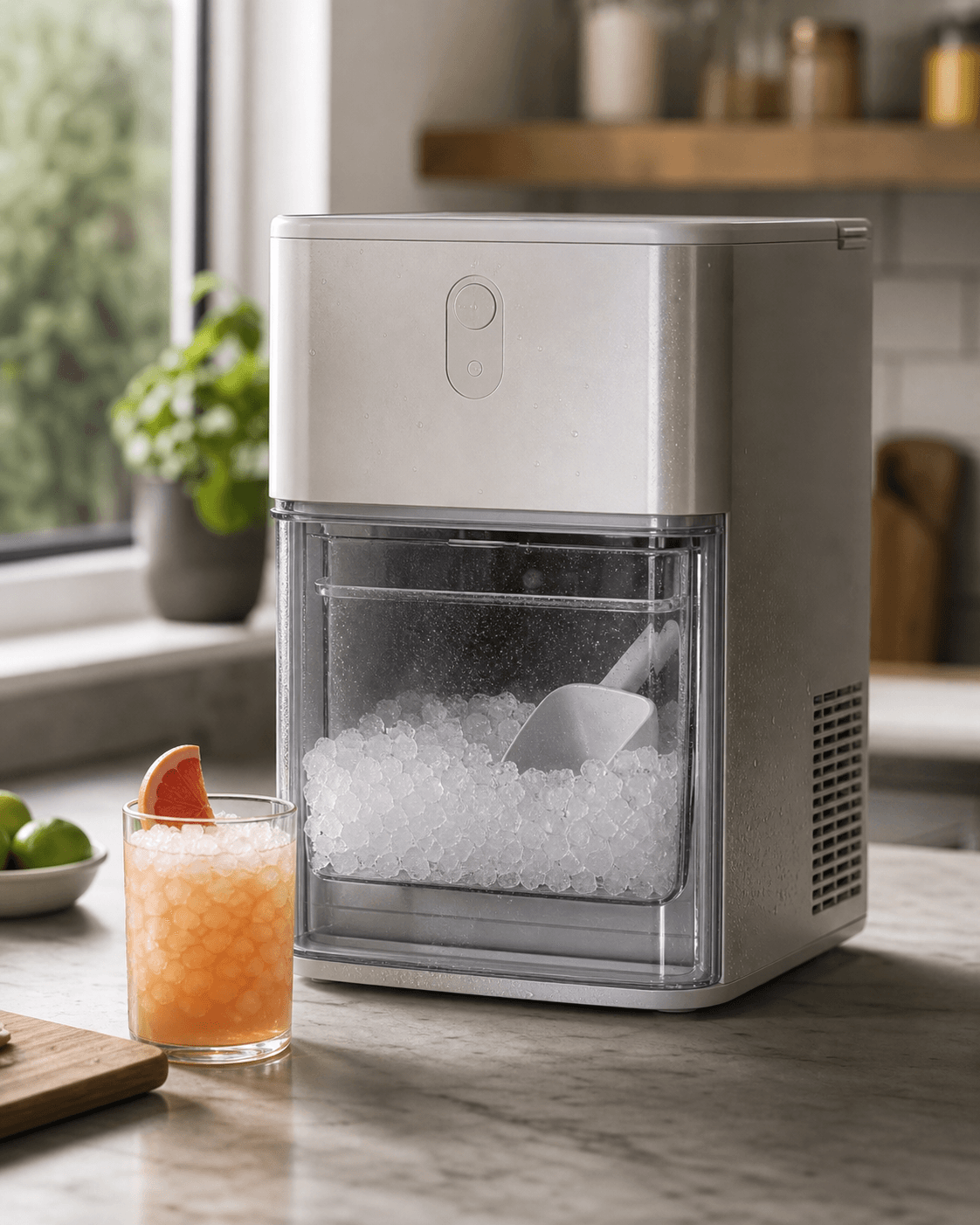
The Opal is a boxy, countertop-sized unit, roughly microwave-scale, with a top-loading ice bin lid and — on most models — a small side water reservoir you refill by hand, or a plumbed-in line on certain variants. The exterior finish (often a two-tone black-and-stainless or all-stainless look) is aimed squarely at looking intentional on a counter rather than hidden in a pantry, which is part of why it's become something of a status object in kitchen circles.
Internally, it's a more complex machine than a basic ice tray freezer: a compressor, a water pump, an auger-style mechanism that scrapes and compresses flake ice into the signature nugget shape, and (on the Wi-Fi-enabled variant) a connectivity board for remote status checks. That added mechanical complexity compared to a simple cube-ice maker is both the source of the appeal and the source of most long-term reliability complaints.
How the nugget ice is actually made
Unlike a standard ice maker that freezes water in molds, the Opal freezes a thin layer of ice onto a cold evaporator plate, then an auger scrapes off that flake ice and compresses it into small cylindrical pellets. That compression step is what gives nugget ice its softer, more porous, chewable texture — it's not one solid frozen mass but a compacted cluster of ice flakes, which is also why it melts faster and dilutes drinks more quickly than a dense clear cube.
Output and timing
The first batch after starting up cold takes around 20 minutes, and subsequent batches follow roughly every 15-20 minutes once the machine is in a steady rhythm — GE's commonly cited output figure is around 24 lb of ice in a 24-hour period, assuming the bin gets emptied along the way rather than filling up and pausing production.
Storage bin — the real limitation
At roughly 3 lb of storage capacity, the Opal cannot get far ahead of demand. A household that goes through a lot of iced drinks daily will find it keeping pace reasonably well since production continues in the background, but anyone expecting to fill the bin once and coast for a weekend of entertaining will be disappointed — you're topping off a large cooler from it over time rather than filling one in a single sitting.
Ease of use
Day to day, it's about as simple as an appliance this complex can be: keep the reservoir filled, empty the ice bin into a container or cooler as it fills, and let it run continuously. The Wi-Fi-connected variant adds app-based status checks and remote start, useful mainly for checking ice level before guests arrive rather than being a must-have feature.
Self-cleaning and maintenance
The self-clean cycle is a genuinely useful inclusion most competing ice makers skip — it runs a cleaning solution (or in some routines, a vinegar-water mix) through the internal water lines to clear mineral scale and reduce mold risk, which matters because standing water in a warm kitchen is exactly the environment where both can build up. That said, "self-clean" here means the machine runs the cycle for you once you start it — you still need to remember to do it periodically, generally every few weeks depending on water hardness and usage, and to keep the unit running regularly rather than letting water sit idle in the lines for extended stretches.
Known issues and longevity
The most consistent complaint across owner reports after a couple of years of heavy use centers on the water pump or the auger/gearbox mechanism — moving parts working continuously to scrape and compress ice do wear, and repair costs can be a meaningful fraction of the unit's price if it's out of the 1-year warranty window. Regular cleaning and using it consistently (rather than long idle stretches followed by heavy bursts) seems to correlate with fewer reported issues, though that's based on owner reporting rather than controlled data.
How it compares
Standard freezer ice makers (built into a fridge) — cheaper (already paid for), no counter space needed, but only make hard cube or crescent ice, not the chewable nugget texture that's the entire draw here.
Frigidaire and Costco-brand nugget ice makers — similar nugget-ice concept at a lower price point, generally with a smaller output and less refined build, positioned as budget alternatives once the Opal popularized the category.
Under-counter or commercial nugget ice machines — genuinely higher output and bigger storage bins, built for near-constant restaurant use, but require permanent installation, a drain line, and a much larger budget — overkill for a home kitchen.
Value
At $500-550 for a 3 lb-bin countertop appliance, the value case rests entirely on how much you want this specific ice texture. Compared to what a full ice-and-water fridge dispenser costs to add or upgrade, it's a relatively affordable way to get a genuinely different ice format — but compared to a basic countertop cube-ice maker at a third of the price, it's a premium purchase justified by preference, not need.
Verdict
The Opal succeeds at exactly the thing it set out to do — soft, chewable ice that's hard to replicate any other way at home — and that's why it built the following it has. The small bin and the price are real trade-offs, and the mechanical complexity means it's not maintenance-free, but if nugget ice is genuinely your preference, nothing else on the countertop delivers it this well.
What we like
- Produces genuinely chewable, soft nugget ice that's hard to find outside restaurant equipment
- Countertop footprint, no plumbing install required on most models
- Self-clean cycle simplifies a maintenance step most ice makers skip entirely
- Wi-Fi variant lets you check ice level and start cycles remotely
What we don't
- Small ~3 lb storage bin means it can't get far ahead of a thirsty household
- Higher price than most countertop ice makers for what's ultimately a small bin
- Needs regular use or periodic draining — leaving it idle for weeks invites mold/mineral buildup
- Some owners report water pump or gearbox failures after a couple years of heavy use
Specifications
| Ice type | Nugget/pellet (compressed 'sonic ice') |
|---|---|
| Output per day (lb) | ~24 lb |
| Storage capacity (lb) | ~3 lb bin |
| First ice time (min) | ~20 minutes for the first batch |
| Self-cleaning | Yes, periodic self-clean cycle (user-initiated) |
| Warranty (yr) | 1 |
Frequently asked questions
How long does the GE Opal take to make its first batch of ice?
Roughly 20 minutes for the very first batch after startup, with additional batches following every 15-20 minutes after that once it's running continuously.
Does the GE Opal need a water line?
No — most Opal models are countertop units you fill manually or connect to a small side tank, no plumbing installation required.
Why is the storage bin so small?
It's a genuine trade-off of the countertop nugget-ice format — the compact size that lets it sit on a counter without plumbing limits how much finished ice it can hold at once, generally around 3 lb before it needs emptying or the unit pauses production.
Is nugget ice actually different from regular ice?
Yes — it's made from compressed flake ice rather than frozen solid, giving it a softer, more chewable texture that's noticeably different from standard ice cube trays or clear ice.