Researched
KitchenAid 9-Cup Food Processor Review: Precision Over Power
The ExactSlice disc is the reason to buy this over a cheaper 9-cup processor — the 300-watt motor is not. Buy it for build quality and slicing consistency, not for grinding through tough jobs.
On this page
The short version
KitchenAid's name on a stand mixer means something specific: overbuilt, repairable, worth the premium. Put that same name on a food processor and the story gets more complicated. The 9-Cup Food Processor has the fit and finish you'd expect, plus a genuinely clever slicing system, but a motor that's noticeably weaker than competitors selling for less. This is a processor you buy for what it does precisely, not for what it can power through.
Who it's for — and who should skip it
Buy this if you slice a lot — cucumbers for pickling, potatoes for gratin, cabbage for slaw — and want consistent thickness without buying a separate mandoline. It's also the right call if you already trust KitchenAid's build quality from a stand mixer and want a processor that'll still be running in a decade of normal home use.
Skip it if you regularly make bread dough, grind nuts into butter, or process large batches for a big household. The 300-watt motor and 9-cup bowl aren't built for volume or dense loads, and there are processors at this exact price point — or less — with real power to spare.
Build & materials
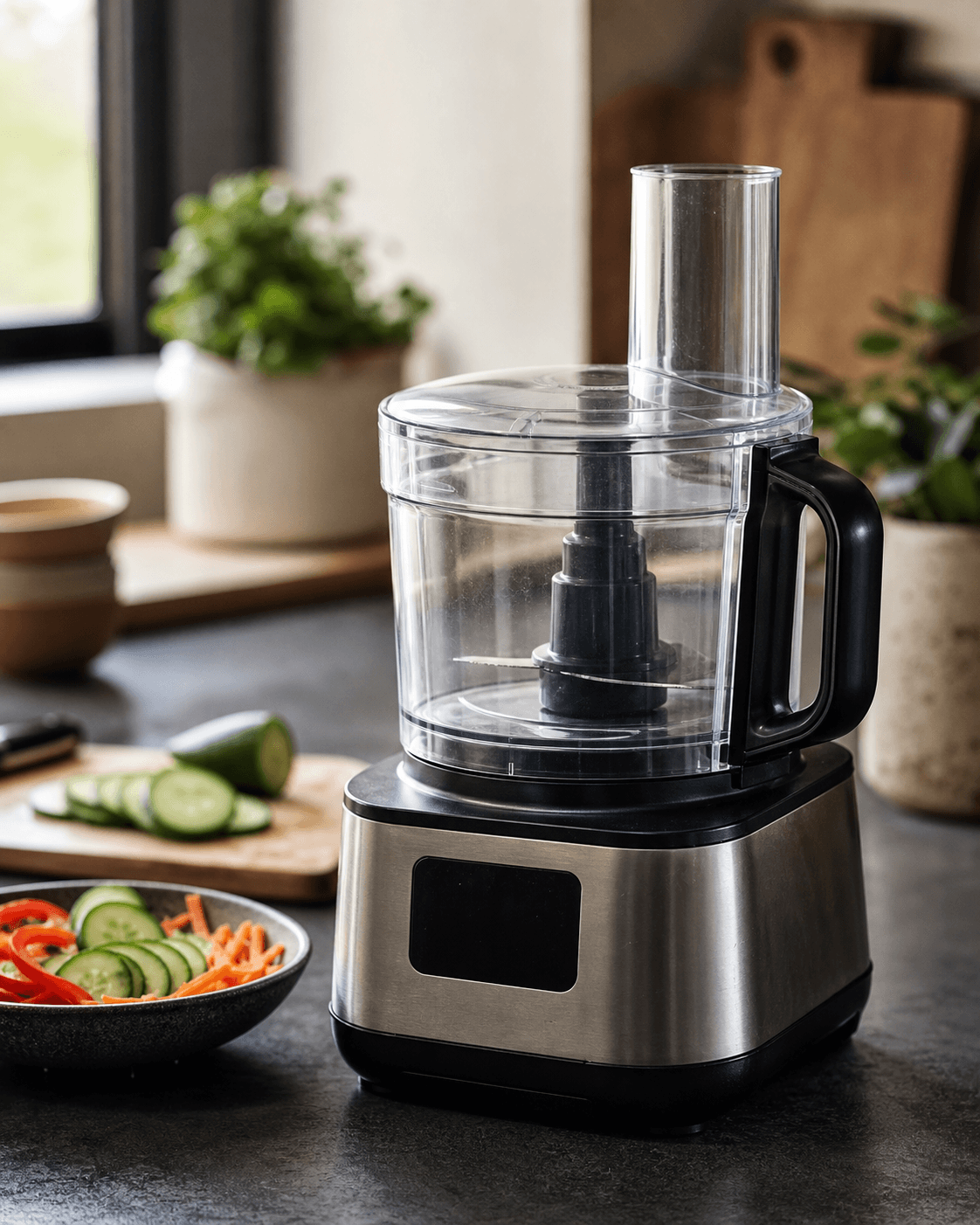
The base is a die-cast metal housing, heavier than it needs to be for a 9-cup unit, which keeps it planted on the counter during use. The work bowl is stainless steel rather than the tinted plastic most competitors use — it won't stain from turmeric or beet juice, and it won't scratch the way plastic bowls do after a few years of blade contact. The lid and feed tube are BPA-free plastic, standard for the category. Control is a simple rotary switch: off, low, high, pulse — no touchscreen, no digital timer, nothing to fail electronically.
Core performance
The ExactSlice adjustable disc
This is the feature that separates the 9-Cup from a generic processor at the same price. Instead of swapping between two or three fixed-thickness slicing discs, there's one reversible disc and a dial built into the pusher that adjusts thickness before the food goes through — thin for cucumbers, thicker for potato gratin, all without opening the lid. It's genuinely useful if slicing is a regular task in your kitchen, and the cut quality is even edge to edge.
Motor power and where it runs out
300 watts is the lowest rated motor power of any processor in this review batch, and it shows up first on dense bread dough — the machine will slow audibly and sometimes stall on a full 2-cup flour batch, where a 700-plus-watt processor barely notices. Hard root vegetables (raw beets, whole carrots) also take a bit longer and benefit from cutting into smaller pieces first rather than feeding whole.
Chopping and shredding consistency
Where the motor isn't being pushed to its limit — chopping onions, shredding cheese, making pesto — results are even and the stainless multipurpose blade does the job cleanly. The reversible shredding side of the disc handles cheese and vegetables without clogging, a common complaint on cheaper processors' shredding discs.
Secondary performance: capacity and noise
9 cups is genuinely on the smaller side; a big batch of coleslaw for a cookout or a double batch of pesto to freeze will mean running the bowl twice. Noise is moderate — quieter than the Ninja Professional or Hamilton Beach in this batch, likely a byproduct of the lower-power motor rather than better engineering.
Daily use & ergonomics
The two-speed-plus-pulse control is about as foolproof as processor controls get — there's no menu to navigate, no preset to guess at. Assembly is straightforward: bowl locks onto the base with a quarter turn, lid locks onto the bowl the same way, and the safety interlock is easy to feel engage. The stainless bowl is a small daily-use win — it doesn't hold onion or garlic smell the way plastic bowls can over time.
Maintenance, longevity & repairability
All the removable parts — bowl, lid, blade, and disc — are top-rack dishwasher safe. The die-cast base just needs a wipe; never submerge it. KitchenAid sells replacement blades and discs directly, and the stainless bowl in particular should outlast most plastic-bowl competitors without staining or scratching. The one-year warranty, though, is short for a brand that trades on longevity — Cuisinart's 14-cup processor offers three years for a similar price.
How it compares
Cuisinart 14-Cup Food Processor (~$180-220): More than twice the motor power and a much bigger bowl, at a similar or slightly higher price, plus a three-year warranty. The Cuisinart wins on raw capability if you don't specifically need the ExactSlice dial.
Ninja Professional Food Processor (~$100-130): Cheaper and rated for more peak wattage, better suited to dough and nut butter, but without the stainless bowl or the slicing precision — and Ninja's plastic components have more reports of long-term wear.
Breville Sous Chef 16 (~$300-350): A genuinely more capable machine across the board — bigger bowl, stronger motor, its own adjustable slicing disc with more thickness settings — at nearly double the price. Worth it only if you'll use the extra capacity.
Value analysis
At $150-180, you're paying for KitchenAid's build reputation and the ExactSlice mechanism specifically, not for motor power or bowl capacity — both of which lag the field at this price. If precise, repeatable slicing is a real use case in your kitchen, that's a fair trade. If you mostly chop, shred, and occasionally knead, a Cuisinart or Ninja gets you more raw capability for similar money.
Known issues
The most common owner complaint is the motor bogging down on dense dough or tough vegetables — several long-term reviews note it's simply not built for that kind of load and shouldn't be pushed there regularly. A second recurring note is the small bowl size feeling limiting for anyone who batch-cooks. A smaller number of owners mention the pulse switch position being a little stiff compared to the smooth detents on the low/high settings.
Verdict
This earns its 9 on build quality honestly — the stainless bowl and die-cast base are a cut above what most processors offer at this price. But the 6 on performance and value reflects a real trade-off: you're paying KitchenAid money for a motor that undersells the brand's reputation. Buy it for the slicing precision and the durability, and accept that a Cuisinart or Ninja will out-muscle it on anything dense.
What we like
- ExactSlice dial adjusts slice thickness on the fly without swapping discs
- Die-cast base and stainless work bowl feel built for the long haul
- Simple two-speed-plus-pulse control is nearly impossible to use wrong
- Compact enough to live on a counter next to a stand mixer without dominating it
What we don't
- 300-watt motor is modest for the price — it labors on dense doughs and hard root vegetables
- 9-cup bowl is on the small side for batch cooking or a big family
- Only one-year warranty despite a price closer to premium processors than budget ones
- No dicing kit or julienne option, even as an add-on
Specifications
| Bowl capacity (cups) | 9 |
|---|---|
| Motor power (W) | 300 |
| Blades/discs | Multipurpose stainless blade, dough blade, reversible ExactSlice adjustable slicing disc, reversible shredding disc |
| Feed tube | Wide feed tube with built-in ExactSlice thickness dial on the pusher |
| Speeds | 2 speeds + pulse |
| Dishwasher safe | Yes (bowl, lid, blades, discs — top rack) |
| Warranty (yr) | 1 |
Frequently asked questions
Is 300 watts enough for a food processor this size?
It's enough for chopping, shredding, and most slicing work, but it's the weakest motor of any processor in its price bracket. Dense bread dough and hard vegetables like raw sweet potato will slow it down noticeably.
What is the ExactSlice system?
It's a dial built into the pusher that lets you set slice thickness before you feed food through, instead of swapping between fixed-thickness discs. You still use the reversible disc for shredding.
Can it make nut butter?
Technically yes, but expect to stop and scrape the bowl several times and accept a coarser result than a more powerful processor gives you. It's not the machine's strong suit.
Does it come with a dough blade?
Yes, a plastic dough blade is included, and it handles small batches of pizza or bread dough reasonably well. For dough heavier than about a pound and a half, the motor starts to strain.
How is this different from the KitchenAid stand mixer food processor attachment?
This is a standalone full appliance with its own motor and controls. The attachment shares your stand mixer's power head, uses less counter space, but has a smaller work bowl and no ExactSlice dial.
Keep reading
- Black+Decker 8-Cup Food Processor Review: Fine for What It Is
Poor
Our score: 54 / 100
- Breville Sous Chef 16 Review: The Food Processor That Makes the Case for Spending More
Excellent
Our score: 82 / 100
- Hamilton Beach 10-Cup Food Processor Review: The Budget Big-Batch Pick
Fair
Our score: 65 / 100
- Ninja Professional Food Processor Review: A Lot of Motor for the Money
Good
Our score: 70 / 100