Researched
KitchenAid Artisan Stand Mixer Review: The Countertop Icon, Tested Against Its Own Hype
The mixer everyone pictures when you say 'stand mixer' — and it earns that reputation on build quality, not raw power. Buy it for cookies, cakes, and everyday baking; don't expect it to shrug off five pounds of bagel dough.
On this page
The short version
Everybody's grandmother has one, in a color that matched a kitchen that's been remodeled twice since. That's not nostalgia talking — it's the actual reason the KitchenAid Artisan is still the default answer to "what stand mixer should I buy." It's been essentially the same machine, with incremental tweaks, since the 1990s, and the core engineering underneath goes back even further to KitchenAid's original 1919 mixer. That kind of continuity means parts availability, a huge attachment catalog, and a repair network that most appliances never get close to.
None of that means it's the most powerful mixer you can buy. It isn't. The 325-watt motor is on the modest side compared to bowl-lift siblings and some competitors, and if you're a serious weekly bread baker, that number matters more than the color options. But for the person who bakes cookies on weekends, whips cream for a pie, and makes bread dough occasionally rather than as a hobby, it's still the mixer to beat.
Who it's for — and who should skip it
This is the mixer for someone who bakes a few times a month, wants a machine that will still be running in fifteen years, and cares about counter presence — the Artisan looks good sitting out, which matters more than people admit. It's also the right call if you think you'll eventually want the grinder, pasta roller, or spiralizer attachments, because nothing else has this depth of accessory support.
Skip it if you bake bread multiple times a week in large batches — the motor will become a bottleneck and you'll end up wishing you'd bought a bowl-lift model or a higher-wattage competitor. Skip it too if counter space is genuinely tight; between the tilt-head clearance and the mixer's own footprint, it wants about 14 inches of vertical room when the head is up. And if budget is the main driver, there are $150 hand mixers and even some off-brand stand mixers that will do 90% of what this does for half the money — you're paying a real premium for the badge and the ecosystem here.
Build & materials
The body is die-cast metal, not plastic, and that's the single biggest reason these mixers last. Open one up and the gears inside are metal too — KitchenAid uses a worm gear design where one gear is deliberately made of a slightly softer material so that if something jams badly, that gear strips before the motor burns out. It's a serviceable, intentional weak point, and any KitchenAid repair shop can replace it in about twenty minutes for under $30 in parts.
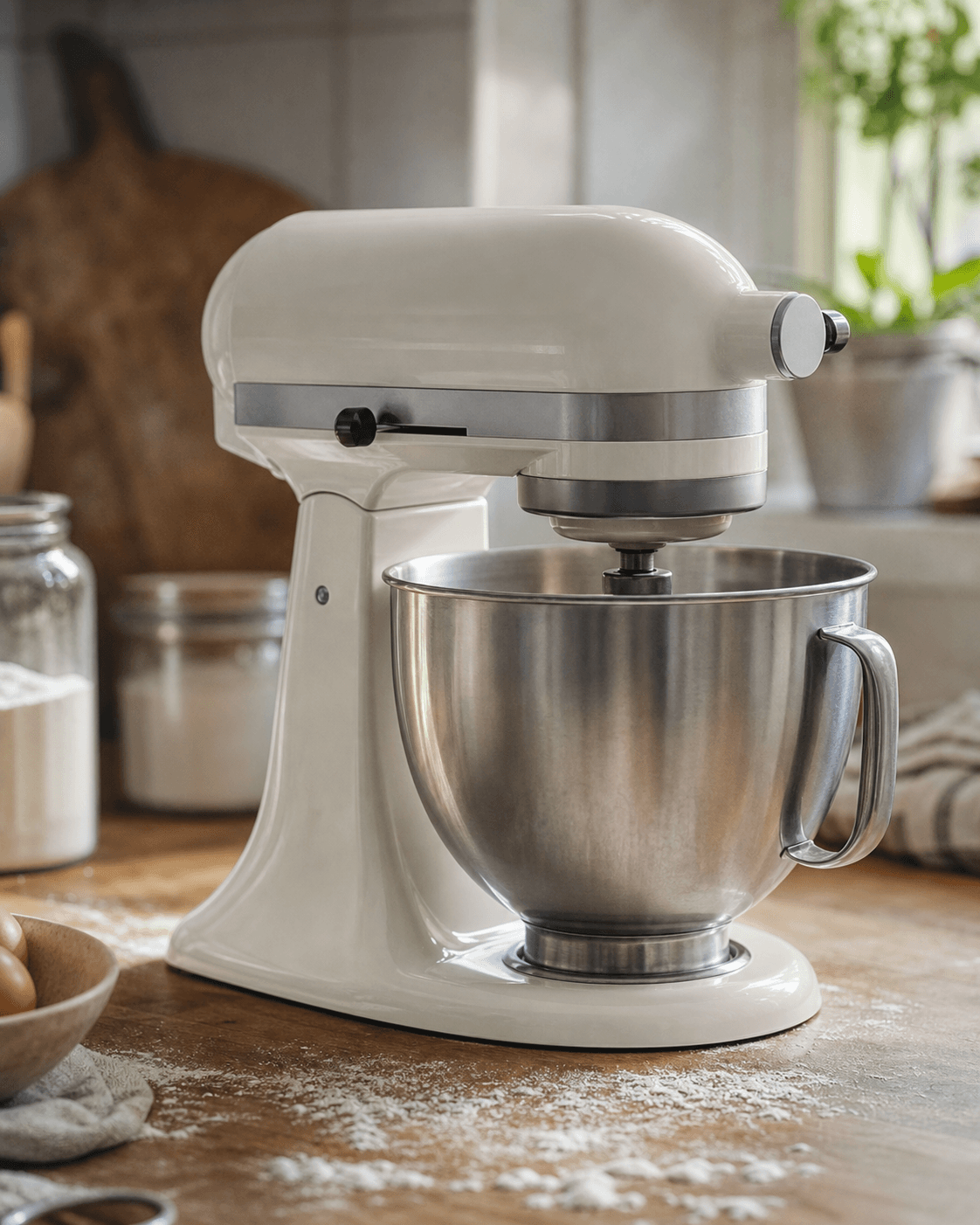
The bowl is stainless steel, 5-quart capacity, with a comfortable D-shaped handle. The flat beater, dough hook, and wire whip that come standard are all coated or stainless — no bare aluminum touching food. Weight is right around 25 pounds, which is a feature, not a bug: that mass is what keeps the mixer planted on the counter instead of walking during a stiff dough mix.
Core performance
Motor power vs real-world load
The rated 325 watts sounds low next to some competitors advertising 500-plus, and in absolute terms it is. What matters more in daily use is how that power gets applied — the planetary mixing action (the beater spins on its own axis while also orbiting the bowl) means the beater contacts nearly the entire bowl surface, so you're not fighting dead zones the way you do with some cheaper mixers. For cookie dough, cake batter, buttercream, and whipped cream, this is plenty and often better distributed than higher-wattage machines with worse geometry.
Where it gets exposed is stiff, low-hydration dough — bagels, pizza dough at 55% hydration or below, or anything you're kneading for 8-10 minutes straight. The motor will do it, but you'll hear it working, and if you're making a double batch, plan on letting the mixer rest for a few minutes partway through. This isn't a flaw so much as knowing the tool's limit.
Ten speeds, and why that number isn't padding
The speed range genuinely matters here. Speed 1-2 is for slow-stir tasks like folding in flour or starting to combine wet ingredients without flour going airborne. The middle speeds (4-6) are where most creaming and whipping happens. Speeds 8-10 are for actually whipping egg whites or heavy cream to stiff peaks quickly. Having that granularity means you're not choosing between "too slow" and "flour explosion," which is a real problem on cheaper 3-speed mixers.
Attachment ecosystem
This is where the Artisan pulls ahead of almost everything else on the market. The power hub on the front of the mixer accepts KitchenAid's full attachment line — meat grinder, pasta roller and cutter set, spiralizer, food processor attachment, ice cream maker bowl, grain mill, and more. None of these come in the box; all are sold separately, typically $50-150 each. But the fact that they exist at all, and that KitchenAid hasn't changed the hub design in decades, means a mixer bought in 2010 still accepts an attachment bought today. No other stand mixer brand comes close to this breadth.
Secondary performance: noise, splash guard, capacity in practice
It's a loud mixer on higher speeds — not painfully so, but you'll want to talk over it if it's running on 8 or above. The 5-quart bowl comfortably handles a standard 2-3 dozen cookie batch or a single loaf of bread dough; push much beyond that and you're scraping down the sides more than you'd like, since the tilt-head geometry leaves a slightly larger gap between beater and bowl wall than the bowl-lift models do. A splash guard isn't included standard on the base Artisan in most bundles — it's worth adding separately if you bake with flour regularly, because the open bowl at higher speeds will dust your counter.
Daily use & ergonomics
Living with this mixer day to day is mostly painless. Tilting the head back to swap attachments or scrape the bowl is a one-hand motion, and the beater/whip/hook attachments twist-lock into place quickly. The bowl has a comfortable handle and the pour spout on the beater shield (if you buy one) actually works. The tilt-head mechanism does mean you need clearance above the mixer — if it lives under a cabinet, measure before you buy, because the head needs to swing up a good 6-8 inches past the body.
The control dial is a simple mechanical knob, no digital display, no presets — which some people miss and others find refreshing. It means fewer things to break, but also no timer or auto shut-off.
Maintenance, longevity & repairability
This is the category where the Artisan actually justifies its price. The body and gearbox are designed to be opened and serviced — independent appliance repair shops handle these routinely, replacement parts (gears, grease, motor brushes) are cheap and widely stocked, and it's not unusual to see 15-20 year old units still running, sometimes after one gear replacement. That's a genuinely different proposition from most small appliances, which are effectively disposable once something fails.
Day-to-day maintenance is minimal: wipe the body, wash the bowl and attachments (most are dishwasher-safe, though hand-washing preserves the finish longer), and occasionally check that the beater-to-bowl clearance hasn't drifted — there's an adjustable screw under the head for exactly this, and it's a two-minute DIY fix with a screwdriver.
How it compares
KitchenAid Professional 600 (bowl-lift, ~$450-500): More powerful motor (575 watts) and a bowl-lift mechanism that's steadier under heavy dough loads, at the cost of being clunkier for quick small-batch jobs where you just want to tip the head and go. If bread is your primary use case, the Professional 600 is the better buy at a similar price.
Cuisinart Precision Master (~$230-280): Noticeably cheaper, similar bowl size, decent build — but the attachment ecosystem is a fraction of KitchenAid's, and long-term repairability is less proven. Fine if you'll never touch an attachment and just want a solid mixer for less money.
Ankarsrum Original (~$600-700): A completely different mixing mechanism (the bowl itself spins, not a planetary head) that many serious bread bakers prefer for handling large, wet doughs without the motor strain the KitchenAid shows. Worth considering if bread is genuinely your main hobby and budget isn't the constraint — otherwise it's overkill.
Value analysis
At $400-450 MSRP, you're paying for the badge, the attachment ecosystem, and long-term repairability — not for the most powerful motor in this price bracket. If you never plan to buy an attachment and only bake occasionally, a $150-200 mixer from another brand will genuinely do the job with less money on the table. But if you want a mixer you can still be running (and possibly still buying attachments for) in 2040, this is close to the only option with that track record. Watch for sales — it's routinely discounted $70-100 off list around major shopping holidays, and that's the smarter time to buy.
Known issues
The most common owner complaint isn't performance — it's the one-year warranty on a $400+ purchase, which feels short next to the mixer's reputation for lasting decades. Some owners of mixers made in the past 10-15 years report grease leaking from the vents onto the bowl or countertop after heavy use; this is a known, if inconsistent, issue tied to how much grease is packed at the factory, and it's cosmetic rather than functional in most cases. A smaller number of users pushing large bread batches report the mixer stalling or the safety gear stripping — which, again, is the gear doing its job of protecting the motor, but it does mean a repair visit.
Verdict
The KitchenAid Artisan earns its scores on build quality and ease of use, not raw mixing power — a 7 on performance and value reflects that it's a very good all-purpose mixer, not the most capable one you can buy at this price. If your baking is cookies, cakes, and the occasional loaf, it's still the sensible default. If you're kneading dense dough weekly, look at the bowl-lift Professional 600 instead — same brand, same repairability, more motor for the job you're actually doing.
What we like
- Die-cast metal body and all-metal gears that outlast the warranty by decades in most cases
- The largest attachment ecosystem of any home stand mixer, bar none
- Ten speeds are genuinely useful, not marketing padding
- Available in more colors than any appliance has a right to be
What we don't
- 325 watts is modest — stiff bread dough will make it work, and work loud
- One-year warranty is short for a $400+ purchase
- Tilt-head design means the motor head swings up and back, which eats counter clearance
- Flat beater and bowl don't fully self-clean the edges on thick batters
Specifications
| Motor power (W) | 325W (rated) |
|---|---|
| Bowl capacity (qt) | 5 |
| Speeds | 10 |
| Attachments | Hub-driven — 10+ official attachments sold separately (grinder, pasta roller, spiralizer) |
| Tilt/bowl-lift | Tilt-head |
| Weight (lb) | 25 |
| Warranty (yr) | 1 |
Frequently asked questions
Is 325 watts enough for bread dough?
For one or two loaves of a soft sandwich dough, yes — with the dough hook and a moderate hydration recipe. For stiff bagel or pizza dough in large batches, the motor bogs down and you'll smell warm plastic before the dough is fully developed.
What's the difference between the Artisan and the cheaper Classic?
The Classic has a smaller 4.5-quart bowl and a less powerful motor. The Artisan's 5-quart bowl and broader color range are the main upgrades — the internal gearing is similar across both.
Do I need the tilt-head or should I get bowl-lift?
Tilt-head is easier for everyday small batches — you just tip the head back. Bowl-lift (KitchenAid's Professional and Pro Line models) is steadier for heavy loads and is what commercial kitchens actually use.
Can it handle a double batch of cookie dough?
Yes, comfortably — that's exactly the load this mixer is built for. Double bread dough is where it starts to strain.
Is the attached pouring shield worth buying separately if it's not included?
If you bake with flour often, yes — it's a cheap accessory that solves the single biggest daily annoyance with this mixer, which is flour going everywhere on speed 2 and up.
Keep reading
- Cuisinart SM-50 Review: Slow-Start Solves the One Problem Every Mixer Has
Fair
Our score: 68 / 100
- Breville Bakery Chef Review: The Mixer That Thinks It's Also a Scale
Good
Our score: 75 / 100
- Hamilton Beach Eye Candy Stand Mixer Review: The Glass Bowl Isn't Just a Gimmick
Poor
Our score: 59 / 100
- Cuisinart Precision Master 5.5-Qt Review: The Artisan Alternative That Does the Math Right
Fair
Our score: 69 / 100