Researched
Subminimal NanoFoamer Review: Latte Art Without a Steam Wand
A $70 handheld whisk that gets closer to real microfoam than any other non-steam frother we've looked at. Buy it if you want latte art from a machine with no wand; skip it if you just want frothed milk fast with zero technique.
On this page
The short version
Steam wands are the best way to make microfoam and also the thing most home setups don't have — super-automatics and a lot of prosumer machines either skip a wand entirely or give you a weak one. The Subminimal NanoFoamer is a bet that a small, fast-spinning magnetic whisk can get close enough to real microfoam to matter for latte art, without any steam involved. It mostly wins that bet, with real technique dependency attached.
Where it sits
Subminimal is a smaller UK-based accessory brand built around solving specific espresso-adjacent problems rather than making machines, and the NanoFoamer (now in its second hardware revision) is their best-known product for exactly that reason — it targets the specific gap between "no steam wand" and "wants latte art anyway." It's priced above a basic battery frother wand (the kind sold for matcha or hot chocolate) and well below powered frothing pitchers with built-in heating.
Who it's for
- Anyone with a machine that lacks a steam wand — pod machines, some super-automatics, manual brewers — who still wants microfoam for pours, not just a topping of bubbles.
- People willing to spend a few sessions learning the whisking technique. This isn't a one-button appliance; it rewards practice.
- Anyone who wants a frother with zero counter footprint. It lives in a drawer between uses.
Who should skip it
If you have a working steam wand already, this doesn't beat it — a real wand aerates and heats simultaneously and gives more total control once you know how to use it. And if you want hot foam with no technique curve at all, a powered frothing pitcher with a heating element and auto-programs is a better fit, even though its foam is typically coarser.
Build and design
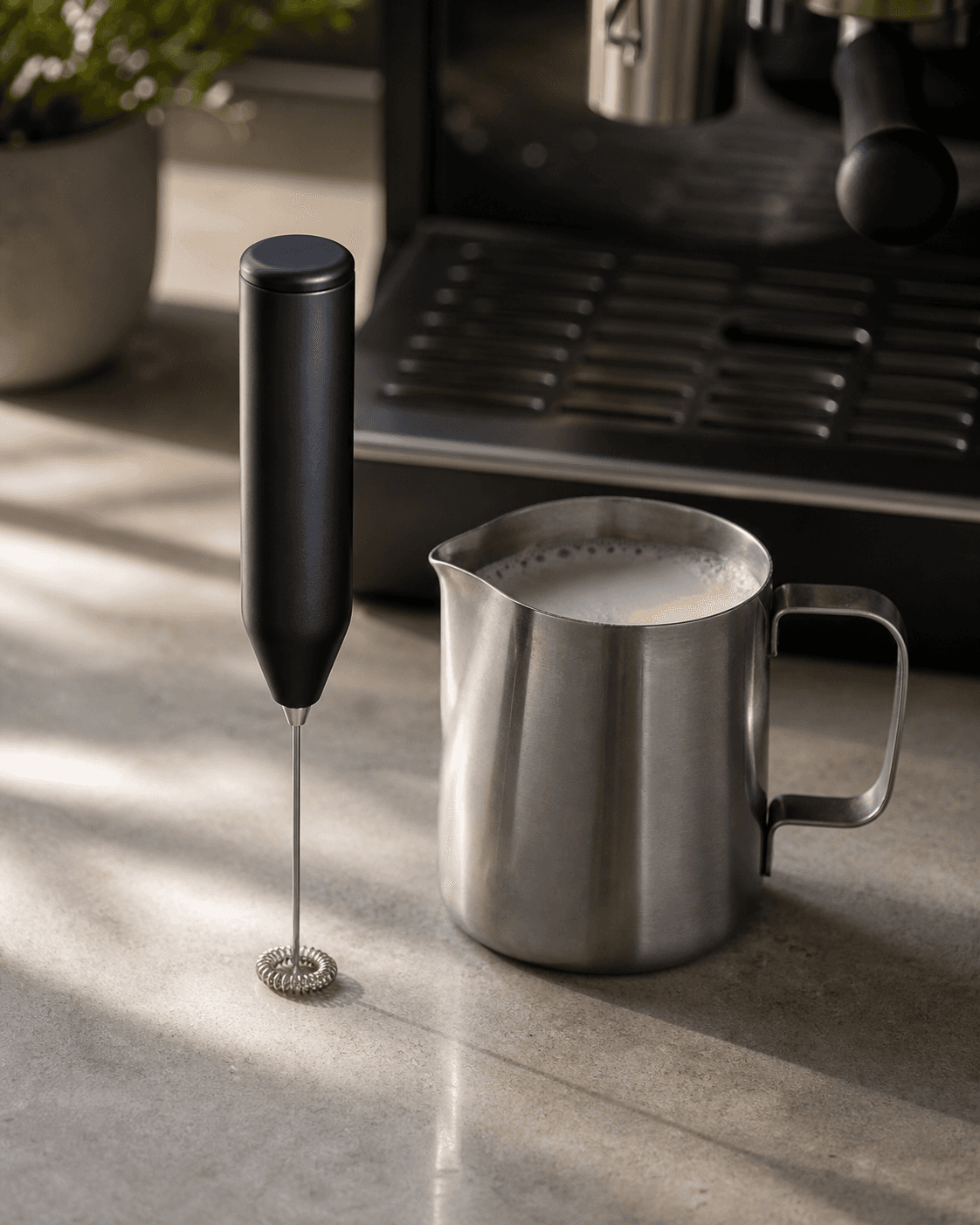
The device is a slim handheld wand with a small magnetic whisk head at the tip, powered by two AA batteries in the handle. There's no heating element anywhere in the design — it's purely a mechanical whisking tool. The magnetic drive is a real point of difference versus a basic motor-and-gear frother wand: it's quieter, and the whisk head detaches for cleaning rather than being a fixed part you have to wipe around.
Performance
Foam quality and the technique it takes
Held correctly — whisk head just below the milk surface at a slight angle, moved gradually deeper as foam volume builds — the NanoFoamer produces genuinely fine microfoam with small, uniform bubbles, the kind that pours into a rosetta rather than sitting on top like a cap of large bubbles. Held flat and static at the bottom of the pitcher, which is the instinctive first attempt for most people, it produces coarser foam closer to what a basic frother wand makes. The gap between "good" and "mediocre" results here is almost entirely technique, not the device.
The no-heat trade-off
Because there's no heating element, you're choosing between frothing cold milk (fine for iced drinks, or if you're heating the base espresso enough to compensate) or heating milk separately first and then whisking it while still hot — which is what most owners settle into for a hot latte. It's an extra step compared to an all-in-one frothing pitcher, and it's the single biggest functional limitation of the device.
Consistency across sessions
Once the technique clicks, results are reasonably repeatable session to session, though milk fat content and temperature both still matter — whole milk froths into finer, more stable microfoam than skim, which is true of every frothing method, not specific to this device.
Secondary performance
There's no capacity spec because there's no reservoir — it's a handheld tool used in whatever pitcher or cup you're frothing in, with better results in a narrower vessel that lets milk build vertical volume as you whisk, rather than a wide, shallow container.
Daily use and ergonomics
It's genuinely fast once you're comfortable with it — 15 to 20 seconds of whisking for a single drink's worth of foam — and the lack of any counter presence or cord is a real convenience for small kitchens. The lack of an auto shut-off means you're manually clicking it on and off, which is a minor thing but noticeable if you're used to appliances that stop themselves.
Maintenance and longevity
The detachable whisk head rinses clean under a tap in seconds, which is a real advantage over frother wands with fixed heads that trap milk residue in tight gaps. Battery replacement is the main ongoing cost and mild inconvenience — there's no charging dock included, so you're buying and swapping AA batteries rather than plugging in a cable.
Upgrades and what to pair it with
Not much of an ecosystem here — it's a standalone tool. Pairing it with a small milk thermometer helps hit a consistent starting temperature before whisking, since starting-temperature consistency is one of the bigger hidden variables in getting repeatable foam.
How it compares
Vs. a real steam wand: a wand still wins on total control and simultaneous heating, for anyone who already has one and knows how to use it. The NanoFoamer exists for the much larger group of people who don't.
Vs. a powered frothing pitcher (e.g. Breville Milk Café): the pitcher heats and froths in one motion with presets and largely removes technique from the equation, producing solid but generally coarser foam. The NanoFoamer asks more of you and, in a practiced hand, rewards that with finer, pour-capable microfoam.
Vs. a basic battery whisk frother (matcha-style): those are cheaper and froth fine for a quick cap of foam on a mug of coffee, but they're not built or marketed for latte-art-grade texture, and most produce noticeably coarser bubbles than the NanoFoamer's magnetic-drive design.
Value analysis
$70 is a fair price for what this solves — real microfoam without a steam system — but it's not a magic fix for someone unwilling to practice technique for a session or two. Buyers expecting café-quality foam on the first try, straight out of the box, tend to be the ones who leave disappointed reviews; buyers who treat it as a skill tool tend to be the ones who keep using it.
Known issues
Battery life and the lack of an included charger come up often in owner feedback, as does the no-heat limitation for anyone who assumed it worked like an all-in-one frother. Neither is a defect — both are inherent to what the device is — but they're worth knowing before buying.
Verdict
An 8 on performance reflects genuinely fine microfoam in a practiced hand, which is a real achievement for a battery-powered handheld tool. The 6 on ease of use is the honest counterweight — this isn't a one-button appliance, and the score reflects a real learning curve rather than instant results, which matters for anyone deciding whether they want a tool to master or an appliance to just use.
What we like
- Produces genuinely fine, pourable microfoam without a steam wand
- Magnetic drive whisk is quiet compared to typical motorized frothers
- Small enough to store in a drawer, no counter footprint
What we don't
- No heating element, so you're frothing cold or separately-heated milk only
- Result is technique-dependent, poor whisking angle gives large bubbles, not microfoam
- Runs on AA batteries with no included charging dock
Specifications
| Type | Battery-powered handheld magnetic whisk frother |
|---|---|
| Capacity | No built-in reservoir |
| Hot/cold | Both |
| Froth density | Fine |
| Auto shut-off | No |
| Warranty | Unknown |
Frequently asked questions
Can the NanoFoamer heat milk, or just froth it?
It only froths — there's no heating element in the device. For a hot latte, you either heat milk separately first (microwave or stovetop) and then whisk, or froth cold and accept a cooler drink. Most owners heat first, then froth.
Does it actually produce latte-art-quality microfoam?
It can, but it's genuinely technique-dependent — holding the whisk head at a slight angle near the surface, then gradually submerging it as foam builds, is what produces fine microfoam instead of large bubbles. The first few attempts for most people look more like whipped cream than latte foam.
How long do the batteries last?
Subminimal doesn't publish an exact cycle count, and real-world reports vary, but expect roughly a few weeks of daily single-drink use before AA batteries need replacing. It's worth keeping a spare set on hand rather than relying on the original ones lasting.
Is this better than a powered frothing pitcher, like a Breville Milk Café?
For foam texture specifically, yes, if you're chasing latte-art-capable microfoam — the handheld whisking action gives you more control over bubble size than a fixed-program frothing pitcher. For pure convenience and hot foam in one button press, a powered frothing pitcher wins.