Researched
Victorinox Fibrox 8-Inch Chef's Knife Review: The Knife Every List Recommends, and Why
The best chef's knife under $100 costs $45 and looks like a cafeteria knife — because it basically is one, in the best way. Buy it and skip the block set.
On this page
The short version
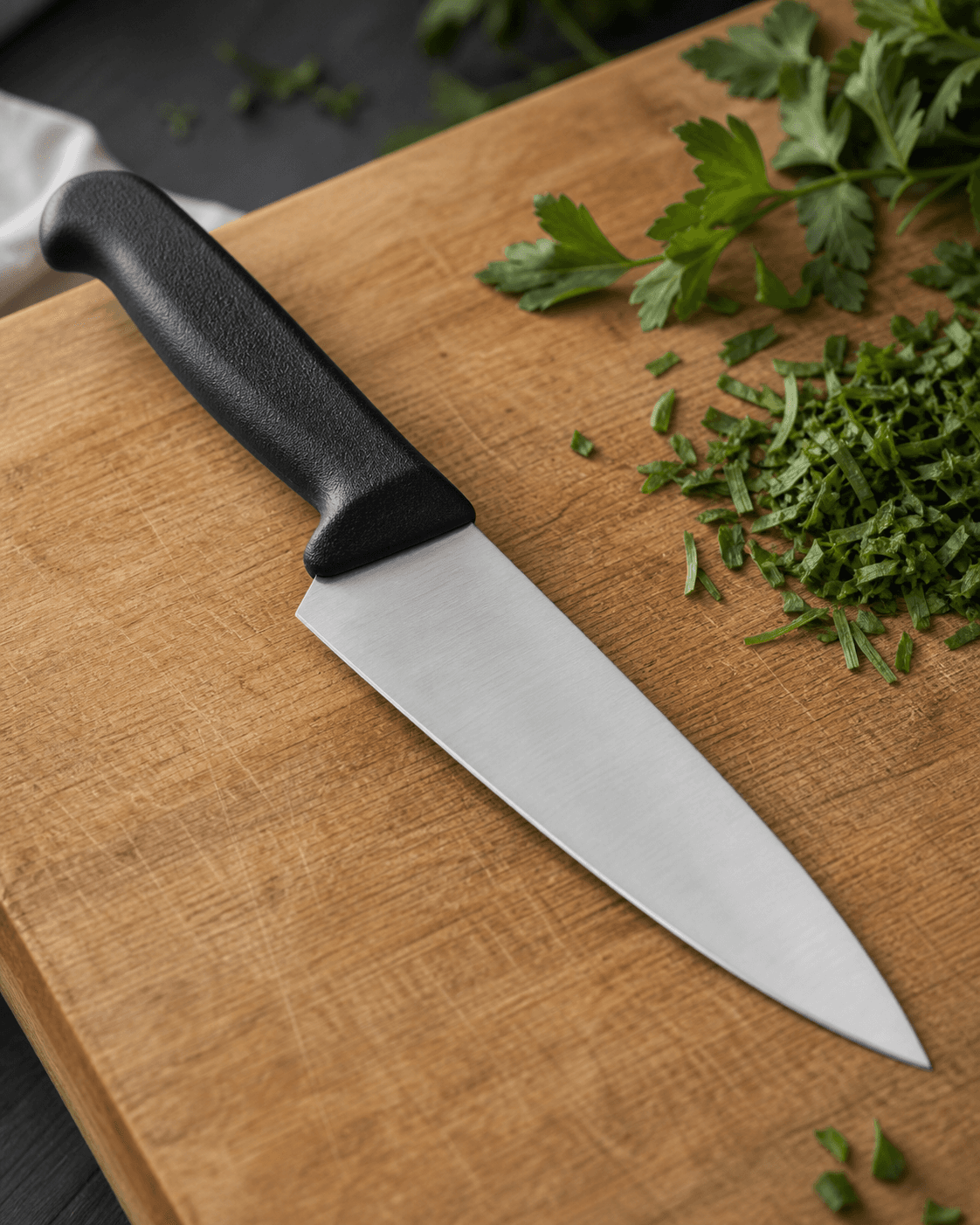
The best chef's knife under $100 costs $45 and looks like something out of a school cafeteria. That's not a knock — it's the entire point. Victorinox strips away everything that doesn't affect cutting performance (fancy handle materials, a forged bolster, a mirror polish) and puts the money into a genuinely good, if soft, stainless steel and a grippy, practical handle. Nearly every knife review on the internet lands on this one as the value pick, and the reason isn't groupthink — it's that nothing else at this price cuts this well.
Who it's for — and who should skip it
This is the knife for someone who cooks regularly, wants a reliable daily driver, and doesn't want to think about knife maintenance beyond a quick honing steel pass and an occasional sharpen. It's also the right call for a first "good knife" — if you've been cutting with a dull department-store set, this is a bigger upgrade in cutting feel than almost any amount of money spent on something fancier.
Skip it if you want a knife that looks the part on a magnetic strip or in a chef's kit bag — the molded plastic handle and stamped blade are purely functional, no visual flair. Skip it too if you're chasing edge retention above all else and don't mind sharpening less often in exchange for a harder, pricier steel — a Japanese gyuto in something like VG-10 or a harder powder steel will hold an edge meaningfully longer, at 3-5 times the cost and more careful handling required.
Build & materials
The blade is stamped, not forged — cut from a sheet of X50CrMoV15 stainless steel rather than hammered from a single heated billet. Stamped construction is why this knife is affordable, and it does mean the blade is thinner and flexes slightly more under lateral pressure than a forged blade of the same length. In practice, for normal chopping and slicing motions, that flex is not something you'll notice or that meaningfully hurts performance.
The Fibrox handle is a textured thermoplastic elastomer, essentially a firm rubber-like material, molded directly onto the tang. It's not attractive, but it's genuinely one of the better-gripping handles in this knife's price range even with wet or greasy hands — a real, practical advantage over wood handles that can get slick.
Core performance
Steel hardness and what HRC 56 actually means day to day
At roughly 56 on the Rockwell hardness scale, this is a softer steel than premium Japanese blades that often run 60-63 HRC. Softer steel dulls faster under heavy use, but it's also far easier to bring back to a sharp edge — a few passes on a basic whetstone or even a pull-through sharpener restore real sharpness in under a minute. Harder steels hold an edge longer but resist sharpening, often requiring more skill or a proper stone setup to correct once truly dull. For a home cook who won't invest in a full sharpening kit, the softer steel is arguably the more practical choice — it's forgiving of imperfect sharpening technique.
Edge geometry and cutting feel
The factory edge is thin and takes well to typical kitchen tasks — slicing onions, breaking down a chicken, mincing garlic, chopping herbs. It's not ground for the kind of hyper-thin, laser-precision slicing you'd get from a specialty Japanese blade, but for the range of tasks an actual home cook does in a week, the difference is mostly theoretical.
Balance and control
Without a full bolster (the thick metal collar some knives have between blade and handle), the balance point sits slightly further back toward the handle than a bolstered forged knife. Some cooks who are used to a heavier, blade-forward balance need a session or two to adjust; most people find the lighter, handle-weighted balance easier for extended prep sessions since the wrist tires less.
Secondary performance: weight and maneuverability
At around 180 grams, this is a notably light knife compared to premium forged options that often run 220-250 grams. That lightness helps with control during fast, repetitive tasks like mincing, and reduces wrist fatigue during long prep sessions — a real, underrated advantage for anyone doing meal prep for an hour at a stretch.
Daily use & ergonomics
The Fibrox handle is the standout here — the textured grip stays secure even with wet hands mid-prep, which matters more than people expect until they've had a knife slip in a soapy hand. The knife feels nimble rather than substantial, which some cooks read as "cheap-feeling" on first pickup and then come around on once they're actually cutting with it for a week.
Maintenance, longevity & repairability
Hand wash only, despite sometimes being marketed as dishwasher-safe — dishwashers dull edges faster and can damage the handle-to-tang bond over time regardless of what the label says. A honing steel before or after each session keeps the edge aligned between actual sharpenings, and a proper sharpening every few weeks with regular use maintains cutting performance. Because the steel is soft, this knife rewards someone willing to sharpen a bit more often rather than someone who wants to sharpen once a year and forget about it.
How it compares
Mac MTH-80 (~$140-160): Harder steel, better edge retention, a more refined handle — a genuine step up in performance, at three times the price. Worth it once you know knife care and want to reduce sharpening frequency.
Wüsthos Classic 8-inch (~$150-170): Forged, full-tang, heavier and more substantial in hand, with a traditional German profile. A different cutting feel — more rocking-motion oriented — and a real step up in materials, at a real step up in cost.
Mercer Culinary Millennia (~$25-35): Similar concept — stamped blade, textured handle, restaurant-grade value pick — at an even lower price point, though most side-by-side comparisons still give the edge to the Victorinox on steel quality and overall fit and finish.
Value analysis
At $45-55, this is close to the floor for what a genuinely good, sharp, comfortable chef's knife costs — and the ceiling of what "good enough" cutting performance actually requires for most home cooking. You could spend 3-5 times more and get a meaningfully sharper, longer-edge-holding knife, but the jump from a dull department-store knife to this one is a bigger practical improvement than the jump from this one to a $150 knife.
Known issues
The most consistent complaint, if it can be called one, is aesthetics — this knife does not look premium, and some buyers are visibly disappointed by the plastic handle despite knowing the price going in. A smaller number of owners note the blade can develop minor surface staining over time if not dried promptly after washing, which is typical of this steel family and doesn't affect performance. Long-term owners occasionally report the handle-to-tang seam collecting grime, which needs an occasional focused clean.
Verdict
A 10 on value isn't grade inflation — this is genuinely one of the best dollar-for-dollar purchases you can make in a kitchen. It won't hold an edge as long as a premium steel, and it won't look good on a countertop knife block, but it cuts as well as knives triple its price for everyday tasks, and it's the knife nearly every serious knife reviewer eventually recommends to someone asking where to start.
What we like
- Extraordinary value — commercial kitchens buy these by the case for a reason
- Softer steel sharpens back to a working edge in under a minute on a basic system
- Fibrox handle grips well even when wet or greasy
- NSF-certified and used across restaurant kitchens, not just a home-cook curiosity
What we don't
- Edge doesn't hold quite as long between sharpenings as harder premium steels
- No bolster means less finger protection and a slightly different balance than forged knives
- Looks purely utilitarian — no one's buying this one to display
- Thin stamped blade flexes more than a forged blade of the same length
Specifications
| Blade length (in) | 8 |
|---|---|
| Steel | X50CrMoV15 high-carbon stainless |
| Hardness (HRC) | 56 |
| Handle | Fibrox — textured thermoplastic elastomer |
| Bolster | None (no full bolster) |
| Weight (g) | 180 |
| Warranty (yr) | Lifetime (limited) |
Frequently asked questions
Why is it so cheap compared to "real" chef's knives?
It's stamped from a sheet of steel rather than forged from a single billet, and the handle is molded plastic instead of wood or micarta. Those manufacturing choices cut cost without hurting cutting performance much — the steel itself is decent, just softer than premium options.
How often does it need sharpening?
More often than a harder premium steel — expect to hone it every few uses and put it on a whetstone or pull-through sharpener every few weeks with regular use. The upside is it sharpens back to a working edge quickly, unlike harder steels that resist both dulling and sharpening.
Is this really what restaurants use?
Yes — it's one of the most common knives in commercial kitchens, largely because it's cheap to replace, NSF-certified for food service, and easy for line cooks to keep sharp themselves rather than sending out for professional sharpening.
What's the difference between this and Victorinox's rosewood-handled version?
Same blade and steel — the rosewood handle version is a wood grip instead of the Fibrox thermoplastic, mostly a look and feel preference, at a similar or slightly higher price.
Keep reading
- Dalstrong Gladiator Series 8-Inch Review: Good Knife, Loud Marketing
Good
Our score: 70 / 100
- Global G-2 Review: The Knife That Looks Nothing Like the Others on This List
Good
Our score: 75 / 100
- Zwilling Pro 8-Inch Review: Wüsthof's Closest Rival, and Arguably the Better Handle
Good
Our score: 76 / 100
- Wüsthof Classic 8-Inch Review: The Knife Everyone Pictures When You Say Chef's Knife
Good
Our score: 78 / 100