Best Chef's Knives Under $100 (2026)
Steel hardness numbers and blade geometry talk can make picking a chef's knife under $100 feel more complicated than it needs to be. At this price tier, the honest reality is that one knife has been the default recommendation across nearly every knife review for years, and the reasons are specific and repeatable, not just consensus for its own sake.
We're going deep on one pick rather than padding a list, because at this budget the differences between the handful of genuinely good options are small enough that understanding what actually matters — steel type, edge retention realism, handle ergonomics — serves you better than a ranked table of five knives you'll never compare side by side anyway.
Our top picks
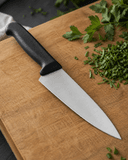 Best Overall Under $100Victorinox Fibrox 8-Inch Chef's Knife
Good
Our score: 78 / 100
Victorinox Fibrox 8-Inch Chef's Knife
Good
Our score: 78 / 100
A softer, easy-to-sharpen stainless steel in a stamped blade, paired with a genuinely grippy molded handle, for around $45-55. It's the knife commercial kitchens buy by the case, and the knife nearly every serious reviewer eventually points beginners toward.
How we chose
We weighted real cutting performance and sharpenability over brand prestige or aesthetics, since a knife under $100 lives or dies on whether an average home cook can keep it sharp without a dedicated sharpening setup. We also considered handle ergonomics under realistic kitchen conditions — wet or greasy hands — rather than just dry-grip feel in a showroom.
What to look for
Steel type and what "harder" actually costs you
Cheaper knives usually use softer stainless steels (in the HRC 54-58 range), while premium knives use harder steels (60-63+ HRC), often Japanese blends like VG-10 or powder metallurgy steels. Harder steel holds an edge longer between sharpenings, but it's also more brittle and genuinely harder to sharpen without proper stones and technique. For someone without a dedicated sharpening setup, a softer steel that's easy to bring back to sharp with basic tools is often more practical day to day than a harder steel that dulls slower but resists correction.
Edge retention realism
Don't expect any knife under $100 to hold a razor edge for weeks of daily use without touch-ups. The realistic expectation at this price is: honing steel maintenance every few uses, and a real sharpening (whetstone or quality pull-through) every few weeks with regular cooking. Judge a budget knife by how easily it returns to sharp, not by how long it stays sharp untouched.
Handle ergonomics under real conditions
A handle that feels fine dry in a store can turn slick and unsafe the moment your hands are wet or oily mid-prep — which is the actual condition you'll be using it in. Textured, rubber-like grips (like Victorinox's Fibrox) generally outperform smooth wood or polished handles for retained grip in real kitchen use, even if they look less premium.
Bolster or no bolster
A full bolster (the thick metal collar between blade and handle) adds weight toward the front, shifts balance forward, and protects fingers slightly during heavy chopping — but it also makes full-length sharpening harder since it can block the heel of the blade against a stone. No-bolster knives are lighter, easier to sharpen edge-to-edge, and often preferred once cooks get used to the different balance.
Stamped vs. forged blades at this price
Nearly everything genuinely good under $100 is stamped (cut from a steel sheet) rather than forged (hammered from a heated billet) — forging adds cost that pushes a knife out of this price bracket almost automatically. Stamped blades flex slightly more and feel lighter, which isn't a defect so much as a different, still perfectly functional, cutting feel.
Frequently asked questions
Is a $45 knife really as good as a $150 one?
For the range of tasks an average home cook does in a week — slicing, dicing, mincing, breaking down a chicken — the practical difference is small. The $150 knife pulls ahead mainly in edge retention over weeks of use and slightly better fit and finish, not in raw everyday cutting ability.
How do I know when it actually needs sharpening, not just honing?
If a honing steel no longer restores a clean, biting edge — if the knife is tearing rather than slicing through a tomato skin, for example — it's time for an actual sharpening, not just a hone. Honing realigns an edge; sharpening removes metal to create a new one.
Do I need a full knife set, or just one good chef's knife?
One good chef's knife handles the overwhelming majority of kitchen tasks. A paring knife and a serrated bread knife round out a genuinely useful set — most of what comes in boxed knife block sets goes unused.
Should I avoid stamped blades entirely?
No — under $100, nearly every genuinely good option is stamped. Forging at this price point typically means cost cuts elsewhere, like poor steel quality, that hurt performance more than stamping construction does.