Best Electric Gooseneck Kettles
A gooseneck kettle solves a problem most people don't know they have until they've made pour-over coffee with a regular wide-spout kettle and watched water glug out in an uncontrollable splash. The thin, curved spout is the entire point — it lets you pour a slow, steady, aimable stream instead of fighting the kettle's shape while you're also trying to time a bloom and watch a scale.
Electric versions add the other half of the equation: precise, repeatable temperature. Between the two, a good electric gooseneck kettle removes two of the biggest sources of inconsistency in home pour-over brewing, and it's genuinely one of the highest-impact upgrades available for the money — if you already brew pour-over regularly.
Our top picks
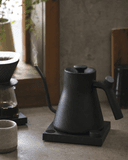 Best OverallFellow Stagg EKG
Excellent
Our score: 80 / 100
Fellow Stagg EKG
Excellent
Our score: 80 / 100
The Stagg EKG set the template other electric gooseneck kettles get compared against — a 1-degree precision dial from 135-212°F, a genuinely thin gooseneck spout that gives real control over pour rate, and a keep-warm mode for back-to-back brewing. At $150-170 it's not cheap, but for anyone brewing pour-over regularly, the temperature and pour control pay for themselves in more consistent cups.
How we chose
We're naming a single headline pick here rather than padding the list with weaker alternates, because the category genuinely has a clear standout for anyone serious about pour-over precision. Rather than pad this guide with three additional gooseneck kettles that don't match the Stagg EKG's temperature precision or pour control, we're using the space to explain what actually makes a gooseneck kettle worth the premium over a standard electric kettle — so you can evaluate any option against the right criteria, including ones we haven't reviewed yet.
What to look for
Why the gooseneck spout shape matters
A standard electric kettle has a wide, short spout built for one job — dumping water quickly into a mug or teapot. That's exactly the wrong shape for pour-over, where you want to control both the rate of flow (thin trickle during the bloom, steadier stream during the main pour) and where the water lands (spiraling evenly over the grounds, not blasting a hole in the center of the bed). A gooseneck's long, narrow, curved spout gives you both — the narrow diameter limits flow rate even when you tilt aggressively, and the length and curve let you aim precisely without hovering awkwardly over the dripper.
Why temperature control is the other half
Water temperature interacts directly with roast level and grind size. Lighter roasts are denser and need water closer to the boil (often 200-205°F) to extract fully; darker roasts extract faster and can turn bitter or hollow-tasting if brewed at the same temperature, often doing better a few degrees cooler. A basic kettle gives you one option — boiling, then however much it's cooled by the time you pour — which means your water temperature changes depending on how quickly you moved between kettle and dripper. A kettle with a real temperature dial removes that variable entirely: set 202°F, wait for the beep, pour.
Precision versus presets
Some gooseneck kettles offer a handful of preset temperatures (for green tea, black tea, coffee, etc.) rather than a full adjustable dial. Presets are fine if your brewing is fairly routine, but a 1-degree adjustable dial gives you room to dial in a specific number for a specific bean or brew method and remember it, rather than rounding to the nearest preset.
Wattage and boil speed trade-offs
Higher wattage generally means faster boiling, but the fastest kettle isn't always the best pour-over kettle — what matters more is how precisely the unit holds your target temperature once it gets there, and whether the spout gives you the control the rest of the process depends on. Don't over-index on boil speed alone.
Keep-warm modes
If you're brewing more than one cup in a session — for yourself and a guest, or a second cup after the first — a keep-warm mode that holds your set temperature for 30-60 minutes avoids reheating from a cold start each time, which both saves time and avoids temperature drift between cups.
Build materials
Stainless steel bodies handle daily heating and cooling cycles well and don't retain odors or stains the way lower-grade materials can. Plastic handles and bases are common even on premium kettles and aren't a red flag on their own — just be aware it's rarely an all-metal build at this price point.
Frequently asked questions
Do I really need an electric gooseneck kettle for pour-over, or will a stovetop one do?
A stovetop gooseneck kettle gives you the same pour control for less money — you're trading away the built-in digital temperature precision and having to check temperature yourself with a thermometer or by timing off the boil.
What temperature should I use for pour-over coffee?
It depends on the roast, but a common starting range is 195-205°F — lighter roasts toward the higher end, darker roasts a bit cooler. Dial in from there based on taste.
Is a gooseneck kettle useful for anything besides coffee?
Yes — tea benefits just as much from precise, lower temperatures (especially green and white tea), and the controlled pour is handy for anything requiring a slow, steady stream, like tempering eggs.
How much faster is an electric gooseneck kettle than boiling water on the stove?
It depends on wattage and stove type, but most electric kettles in this category are competitive with or faster than a stovetop kettle, with the added benefit of an automatic shutoff at your target temperature.