Best Pour-Over Coffee Makers (2026): Three Drippers, Three Personalities
Pour-over gets recommended as one monolithic category, which is a little misleading — a Hario V60, a Chemex, and a Fellow Stagg X all use gravity and a paper filter, and they still produce meaningfully different experiences and cups. I've spent time with all three, and the honest answer to "which pour-over should I buy" depends entirely on how much you want the process itself to be part of the appeal.
This isn't a ranked "number one pick" list, because these three aren't really competing for the same buyer. One rewards practice, one forgives it, and one engineers around needing it at all. Here's how to figure out which lane you're actually in.
Our top picks
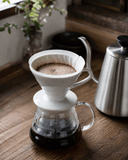 Best for Learning the CraftHario V60 02
Excellent
Our score: 82 / 100
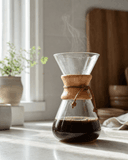 Best for Serving a GroupChemex 6-Cup
Good
Our score: 78 / 100
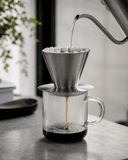 Best for Consistency Without PracticeFellow Stagg X Pour-Over Dripper
Excellent
Our score: 81 / 100
Hario V60 02
Excellent
Our score: 82 / 100
Cheap, ceramic, and completely unforgiving of a bad pour — which is exactly why it's the best dripper to actually get good at pour-over on. A single large hole hands you all the flow control, so every pour teaches you something about pace and pattern.
Chemex 6-Cup
Good
Our score: 78 / 100
A one-piece glass carafe you brew into and serve straight from, with a thick filter that traps sediment and forgives a slightly uneven pour. The pick if you regularly make coffee for more than yourself and want one vessel that does both jobs.
Fellow Stagg X Pour-Over Dripper
Excellent
Our score: 81 / 100
A ring of small holes instead of one big one, engineered to self-regulate flow rate so an imprecise pour still produces a fairly even cup. Costs about three times a V60, and buys you a much shorter learning curve, not a higher ceiling.
How we chose
We picked these three because each represents a genuinely different answer to the same design question: how much should the dripper itself control extraction, versus leaving it entirely to the person pouring? The V60's single giant hole hands nearly all control to you. The Chemex's thick filter takes some of that control back through sheer filter density. The Stagg X's engineered hole ring takes even more control back, correcting for pour inconsistency directly.
We didn't include drippers that are essentially minor variations on one of these three designs — the goal here is covering the real range of what pour-over can be, not listing every SKU on the market.
What to look for
Hole design. This is the single biggest driver of how forgiving a dripper is. A single large hole (V60) puts flow control entirely in your hands. Multiple holes or a flow-restricting design (Stagg X, and to a lesser extent the Chemex's thick filter) build in some self-correction.
Material and heat retention. Ceramic holds heat the longest once pre-warmed, glass sits in the middle, steel and plastic vary depending on wall thickness. A pre-brew hot water rinse matters more for materials that lose heat fast.
Filter cost and availability. Chemex filters are proprietary and cost more per brew than generic cone filters. V60 and Stagg X both use widely available cone-shaped filters, which keeps the ongoing cost lower.
Batch size. The Chemex is the only one of these three built around brewing and serving multiple cups from one vessel. The V60 and Stagg X are built for single-to-modest servings and need a separate mug or carafe underneath.
How much you actually want to practice. Be honest with yourself here. If the ritual and the skill-building are part of why you want a pour-over in the first place, the V60's learning curve is a feature. If you just want a great cup with minimal fuss, the Stagg X or Chemex will get you there faster.
Frequently asked questions
Which pour-over dripper makes the "best" coffee?
In skilled hands, the V60 and Stagg X produce essentially comparable clarity, and the Chemex produces a slightly heavier, less delicate cup due to its thicker filter. The real differentiator isn't peak quality — it's how much skill each one demands to get there.
Do I need a gooseneck kettle for all three?
It helps with all three, but it matters most for the V60, where pour precision is doing almost all the work. The Stagg X's flow-correcting holes make it somewhat more tolerant of a regular kettle, and the Chemex's thick filter offers a bit of the same forgiveness.
Can I brew more than one cup with the V60 or Stagg X?
The V60 02 size handles two to four cups' worth in one brew, and the Stagg X similarly brews up to about 20 ounces — neither matches the Chemex's full-carafe serving format, but both go beyond a single mug.
Is the Fellow Stagg X worth three times the price of a V60?
If you want V60-level clarity without the practice required to consistently pour one well, yes — you're paying for a shorter learning curve and premium steel construction. If you're happy to practice, the V60 gets you most of the way there for a fraction of the cost.