Eureka Mignon Specialita vs DF64
Buy the Eureka Mignon Specialita if…
You make espresso daily, want a hopper-fed grinder you load once and forget about for days, and you're willing to pay a real premium for Italian build quality and dosing polish.
Buy the DF64 if…
You want the best grind quality per dollar available, don't mind a barebones out-of-box experience, and are open to a small aftermarket purchase or two to get the full experience.
Side by side
| Specification | 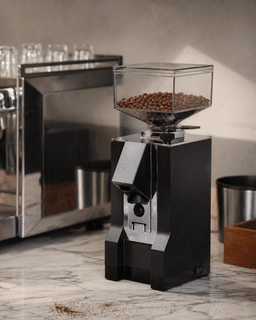 | 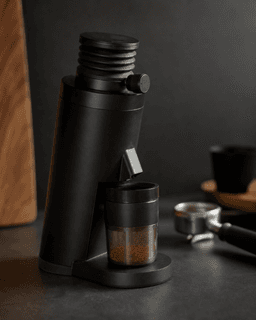 |
|---|---|---|
| Our score | 81Best | 75 |
| Burr type | Flat | Flat |
| Burr size | 55 mm | 64 mm |
| Burr material | Steel | Steel (stock 'DF' burr; commonly upgraded to SSP or Turin sets) |
| Grind settings | Stepless | Stepless — no numbered indicator on base models |
| Adjustment | Stepless collar with digital-timer dosing | Stepless external collar |
| Single-dose | No — hopper-fed; single-dose conversion possible with aftermarket funnel | Yes |
| Hopper capacity | 10.5 oz (300 g) | N/A — single-dose funnel/bellows, ~18-20 g per load |
| Retention | ~1-3 g depending on grind setting | <0.5 g with bellows agitation |
| Motor | 220 W, ~1,400 RPM, with anti-clumping vibration (ACE) | 250 W AC motor, ~1,400 RPM |
| Warranty | 2 yr | 1 yr, varies by importer/seller |
At a glance
The Specialita and the DF64 sit at very different price points for a reason that has less to do with grind quality and more to do with finish, support, and daily-use philosophy. The Specialita is a hopper-fed, dosing-timer-equipped Italian grinder built for someone pulling multiple espressos a day without reloading. The DF64 is a single-dose, barebones chassis built by and for an enthusiast community that treats the base unit as a starting point rather than a finished product.
Where they differ
Out-of-box completeness. The Specialita arrives ready for daily use exactly as shipped — digital dosing timer, anti-clumping vibration, a refined chassis. The DF64 is functional stock, but many owners add a bellows attachment or an aftermarket numbered dial within their first few weeks to close usability gaps the base unit leaves open.
Daily workflow. The Specialita's hopper-fed design and dosing timer are built around loading beans once and pulling dose after dose across a morning — genuinely the smoother routine if you're making multiple drinks. The DF64's single-dose workflow means weighing beans before every grind, more deliberate but also more precise about exactly what goes into each shot.
Price and what it buys. The Specialita costs meaningfully more, and that premium buys Italian manufacturing pedigree, a 2-year warranty, and daily-use refinements like the anti-clumping vibration motor. The DF64's lower price buys you access to an enormous aftermarket that can, with a modest additional investment, close much of the remaining performance gap.
Burr size versus burr geometry. The DF64's 64mm flat burr set is larger in diameter than the Specialita's 55mm set, which sometimes gets read as an automatic advantage. In practice, the Specialita's controlled low RPM and manufacturing precision produce particle consistency that competes with the DF64 despite the smaller burr — diameter alone doesn't decide the outcome.
Support and warranty. Eureka's established distribution and 2-year warranty offer more predictable support than the DF64, whose warranty terms vary depending on which importer or retailer you purchase from. This matters more the longer you plan to own the grinder.
Retention approach. The Specialita retains a real one-to-three grams as a hopper-fed design, addressable only through an aftermarket single-dose conversion funnel. The DF64 is single-dose by default and gets close to negligible retention once paired with a simple bellows attachment, without needing a separate conversion product.
Which should you buy?
If your mornings involve more than one espresso back to back, and you'd rather load beans once and not think about it again until the hopper runs low, the Eureka Mignon Specialita is worth its premium — it's the more finished, more repeatable daily-use tool, backed by a longer warranty and a company with decades of commercial-grinder experience behind it.
If you're chasing the best possible grind quality for your money and don't mind spending a little extra time — and possibly a little extra cash on a bellows or aftermarket dial — getting there, the DF64 is very hard to beat. Its ceiling, once set up the way the enthusiast community typically configures it, rivals grinders costing considerably more, even if the box it ships in doesn't look the part.
If you're still undecided, ask yourself how many drinks you actually make per session and how much you enjoy — or tolerate — research and small upgrades. Multiple drinks and zero interest in tinkering points toward the Specialita. One drink at a time and a willingness to spend a bit more effort points toward the DF64.
Frequently asked questions
Is the Specialita's grind quality actually better than the DF64's, or just its finish?
Mostly finish and daily-use polish — the DF64's stock 64mm flat burrs are genuinely competitive on raw particle consistency, especially once upgraded. The Specialita's edge is in dosing speed, anti-clumping vibration, and a more repeatable daily routine, not a dramatically better grind ceiling.
Which has lower retention?
Neither is a clean win here — the DF64's single-dose design with an aftermarket bellows typically edges out the hopper-fed Specialita, though the Specialita's anti-clumping vibration reduces static-related mess in its own way.
Is the DF64's upgrade path worth the extra research and cost?
For enthusiasts who enjoy tinkering, yes — the aftermarket burr and accessory ecosystem around the DF64 lets a budget grinder approach or match pricier competitors. If you'd rather not research anything, the Specialita's finished, hopper-fed design asks nothing extra of you.
Which is the better long-term investment?
Depends what you're optimizing for. The Specialita's 2-year warranty and Eureka's commercial-grinder pedigree suggest strong long-term reliability out of the box. The DF64's value comes from how cheaply and effectively it can be upgraded over time, which is its own kind of long-term investment.