KitchenAid Artisan vs KitchenAid Professional 600
Buy the KitchenAid Artisan Stand Mixer if…
You bake cookies, cakes, and occasional bread — everyday home baking that never really pushes a motor to its limit.
Buy the KitchenAid Professional 600 if…
You bake bread regularly, double batches as routine, or have already felt an Artisan bog down on stiff dough.
Side by side
| Specification | 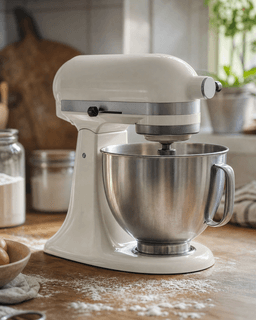 | 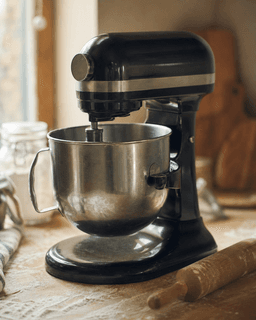 |
|---|---|---|
| Our score | 74 | 76Best |
| Motor power | — | — |
| Bowl capacity | — | — |
| Speeds | 10 | 10 |
| Attachments | Hub-driven — 10+ official attachments sold separately (grinder, pasta roller, spiralizer) | Hub-driven — same 10+ attachment ecosystem as the Artisan (grinder, pasta roller, spiralizer) |
| Tilt/bowl-lift | Tilt-head | Bowl-lift |
| Weight | — | — |
| Warranty | — | — |
| Motor power (W) | 325W (rated) | 575W (rated) |
| Bowl capacity (qt) | 5 | 6 |
| Weight (lb) | 25 | 29 |
| Warranty (yr) | 1 | 1 |
Same badge, two different mixers wearing it
KitchenAid sells the Artisan and the Professional 600 close enough in price that a shopper standing in an aisle — or two browser tabs — genuinely has to think about which one to buy. That's not an accident. Both wear the same red KitchenAid logo, both use the same attachment hub, and both will make you a very good batch of cookies. Underneath, they're built around different priorities: the Artisan is a tilt-head mixer optimized for everyday baking and shelf appeal; the Professional 600 is a bowl-lift mixer built for people who push a mixer harder than a dozen cookies a week.
At a glance
The Artisan: 5-quart bowl, 325-watt motor, 10 speeds, tilt-head, 25 pounds, available in dozens of colors, roughly $350-450 street price. The Professional 600: 6-quart bowl, 575-watt motor, 10 speeds, bowl-lift, 29 pounds, available in about six finishes, roughly $400-500 street price. On paper, the Professional 600 wins almost every spec. In practice, most of that advantage goes unused by most buyers.
Where they actually differ
Tilt-head vs bowl-lift
This is the core engineering difference, and it matters more than the wattage gap. The Artisan's motor head hinges back on a pivot to expose the bowl — simple, fast, and fine for anything short of a heavy, unbalanced load. Push a stiff dough hard enough and you can feel a slight give in that hinge; it's not a defect, just the nature of a tilting joint under strain.
The Professional 600 skips the hinge entirely. The bowl racks up into a fixed motor head on a lever arm, the same basic approach commercial mixers use at much larger scale. A heavy or lopsided load doesn't rock the assembly, because there's no pivot to rock on. For light-to-moderate baking, you will genuinely never notice this difference. For heavy bread dough, it's the single biggest reason to prefer the Professional 600.
Motor power and what it changes
325 watts against 575 is a real gap, and it shows up specifically under stress — a stiff, low-hydration bread dough, a large batch of dense cookie dough, anything that makes the motor work rather than coast. For cake batter, whipped cream, and standard cookie dough, both mixers have power to spare and perform close to identically; the wattage number only starts to matter once you're pushing past what most home bakers actually bake.
Bowl capacity in real use
5 quarts versus 6 sounds like a modest jump, but it's the difference between "comfortable single batch, tight double batch" and "comfortable double batch, no problem." If you routinely bake for a crowd, host, or batch-and-freeze, the extra quart of headroom is a real convenience. If you bake for a household of two or three, you'll rarely fill either bowl.
Size, weight, and where it lives
The Professional 600's bowl-lift frame adds real bulk — it's deeper front-to-back and four pounds heavier than the Artisan, and the lift mechanism means it often doesn't clear a standard upper cabinet with the bowl raised. If counter space and storage are tight in your kitchen, that's a genuine downside independent of performance.
Warranty and price
Both carry KitchenAid's standard one-year warranty, so that's a wash between them — the real gap is price, where the Professional 600 typically runs $50-150 more depending on sales and finish.
Which should you buy
Buy the Artisan if you're a typical home baker: cookies most weekends, a cake for a birthday, bread dough occasionally rather than as a habit. It does everything the Professional 600 does for these tasks, at a lower price and in a smaller footprint, and its bigger color selection means it can double as the kitchen's showpiece appliance without looking out of place.
Buy the Professional 600 if you already know why — you've felt an Artisan strain on a double batch of bagel dough, you bake bread weekly rather than occasionally, or you're outfitting a kitchen that needs to handle volume regularly. The bowl-lift stability and stronger motor are real, not marketing, and they show up exactly where a serious bread baker would feel them.
If you're not sure which camp you're in, that's itself useful information: buy the Artisan. It's the mixer built for the ambiguous middle, and stepping up later — with all your existing attachments carrying over unchanged — is a much easier move than discovering you overspent on capacity you never use.
Frequently asked questions
What's the real difference between the KitchenAid Artisan and the Professional 600?
The Artisan is a 5-quart tilt-head mixer with a 325-watt motor; the Professional 600 is a 6-quart bowl-lift mixer with a 575-watt motor. The bowl-lift design keeps the bowl locked and level under heavy loads, where the Artisan's tilt-head hinge can flex slightly.
Is the Professional 600 worth the extra money over the Artisan?
Only if you actually hit the Artisan's limits — regularly kneading stiff bread dough, doubling batches, or noticing the bowl rock under a heavy load. For everyday cookie and cake baking, the two perform almost identically, and the Artisan costs less.
Do KitchenAid attachments work on both mixers?
Yes — both use the same hub-driven attachment system, so a grinder, pasta roller, or spiralizer bought for one works on the other without modification.
Which one takes up more space?
The Professional 600, by a noticeable margin. Its bowl-lift frame is deeper front-to-back to accommodate the lift mechanism, and at 29 pounds versus the Artisan's 25, it's also less convenient to store away between uses.
Which one is better for bread baking specifically?
The Professional 600, clearly. Its stronger motor handles stiff, low-hydration dough with less strain, and the bowl-lift frame keeps a heavy dough load from rocking the way it can on the Artisan's tilt-head hinge.