Victorinox Fibrox 8-Inch Chef's Knife vs Mac MTH-80
Buy the Victorinox Fibrox 8-Inch Chef's Knife if…
You want a genuinely capable daily driver for around $45 and don't yet sharpen your own knives regularly enough to benefit from a harder, pricier steel.
Buy the Mac MTH-80 if…
You already own a decent chef's knife, notice its edge dulling too fast or unevenly, and want a real, felt performance upgrade rather than just a bigger price tag.
Side by side
| Specification | 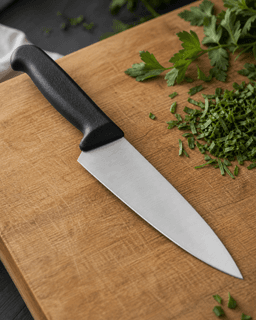 | Mac MTH-80 |
|---|---|---|
| Our score | 78 | 83Best |
| Blade length | — | — |
| Steel | X50CrMoV15 high-carbon stainless | MAC proprietary molybdenum-vanadium high-carbon stainless |
| Hardness (HRC) | 56 | 58Best |
| Handle | Fibrox — textured thermoplastic elastomer | Pakkawood — resin-laminated wood composite |
| Bolster | None (no full bolster) | Small integrated bolster, no full guard |
| Weight | — | — |
| Warranty | — | — |
| Blade length (in) | 8 | 8 |
| Weight (g) | 180 | 170 |
| Warranty (yr) | Lifetime (limited) | Limited lifetime |
At a glance
There's a roughly $115 gap between these two knives, and it's tempting to read that gap as "how much better" the Mac MTH-80 is. That's the wrong way to think about it. These two solve different problems for different cooks: the Victorinox is the best pure value chef's knife most people will ever need, and the Mac is what you buy once you've outgrown that and can actually feel the difference a harder, thinner blade makes.
The Victorinox is a stamped blade in a soft, forgiving stainless steel with a textured rubber handle — no bolster, no frills, extremely easy to sharpen. The Mac is a thinner, harder-steel Japanese-style knife with a hollow-ground dimpled blade and a pakkawood handle, aimed at someone who already knows their way around a cutting board.
Where they differ
Steel and edge retention
The Victorinox uses a softer stainless steel, roughly 56 HRC, that dulls faster under regular use but sharpens back to a working edge in under a minute on basic equipment — a real advantage for anyone who isn't yet sharpening with much consistency. The Mac's proprietary molybdenum-vanadium steel runs about 58 HRC, holding a working edge noticeably longer between sharpenings, at the cost of taking a bit more care and time to correct once it finally does need attention.
Blade geometry and cutting feel
Both are thinner than a typical German knife, but the Mac takes it further, with a genuinely thin profile and a hollow-ground dimpled lower blade that measurably reduces sticking on starchy vegetables like potato and squash. The Victorinox's stamped blade is thin for its price point but doesn't have that dimpled feature, so dense, starchy cuts are more prone to clinging to the blade face.
Weight and balance
The Victorinox weighs around 180 grams with no bolster, balancing slightly toward the handle. The Mac is a bit lighter still at roughly 170 grams, with a small integrated bolster that shifts the balance point marginally forward of the Victorinox's. Both are considerably lighter than a full-bolster German knife like a Wüsthof, and the difference between the two of them is small enough that most people wouldn't notice it blind.
Handle and ergonomics
This is one of the more noticeable differences in actual use. The Victorinox's Fibrox handle is a textured rubber-like thermoplastic — grippy, forgiving, easy for almost any hand size to hold securely even wet or greasy. The Mac's pakkawood handle is thinner and less contoured, which some cooks — particularly those with larger hands or those used to a fuller Western grip — need a session or two to adjust to.
Build and construction
The Victorinox is stamped from a sheet of steel, which keeps costs down and the blade slightly more flexible under lateral pressure. The Mac is also stamped rather than forged, but uses higher-grade steel and tighter tolerances that show up in the fit and finish, and in how the hollow-ground dimples are executed.
Price and what the gap actually buys
At roughly $45 versus $160, you're not paying for a fundamentally different knife-making process — both are stamped blades, not forged. You're paying for a better steel formula, a harder edge, and the dimpled anti-stick feature on the Mac. It's a real upgrade, just a smaller one in practice than the price gap alone suggests.
Which should you buy
Buy the Victorinox if this is your first genuinely good chef's knife, if you cook regularly but don't yet sharpen your own knives with much consistency, or if $45 versus $160 is a meaningful difference for your budget — it remains one of the best pure value picks in the entire category, not just an entry-level compromise.
Buy the Mac MTH-80 if you already own a decent chef's knife and have started to notice its edge going dull unevenly or too quickly for your liking, if you cook a lot of starchy vegetables and want the dimpled anti-stick blade specifically, or if you've already got a sharpening routine in place and want a steel that rewards it with longer intervals between full sharpenings.
The honest middle ground: if you're not sure which camp you're in, buy the Victorinox first. It's cheap enough that "trying it and deciding you want more" isn't an expensive mistake, and there's a real chance it turns out to be all the knife you actually need.
Frequently asked questions
Is the Mac MTH-80 really three times better than the Victorinox for three times the price?
No — the relationship between price and performance isn't linear here. The MTH-80 is a real, noticeable upgrade in edge retention and slicing feel, but the Victorinox already covers most of what a home cook needs day to day. You're paying the extra money for a smaller, harder-to-quantify improvement.
Which one is easier to sharpen at home?
The Victorinox, by a clear margin. Its softer steel comes back to a working edge in under a minute on a basic pull-through or whetstone. The Mac's harder steel holds an edge longer but takes more time and slightly more careful technique to correct once it does dull.
Can a beginner use the Mac MTH-80, or is it wasted on them?
A beginner can use it without issue, but its main advantage — longer edge retention — only pays off if you're already sharpening and honing with some consistency. A beginner gets more practical value learning technique on the more forgiving Victorinox first.
Do they feel similar in the hand?
Not really. The Victorinox has a fatter, rubberized handle with no bolster, and the Mac has a slimmer pakkawood handle with a small integrated bolster. Both are lighter than a full-bolster German knife, but the grip shapes themselves are noticeably different.
Is there a knife between these two in price and performance?
The Global G-2, at roughly $100-130, sits between them in price with a lighter, one-piece metal handle design — a reasonable middle option if neither the Victorinox's plastic handle nor the Mac's price feels quite right.