Wacaco Minipresso vs Nanopresso
Buy the Wacaco Minipresso if…
You want the smallest
Buy the Wacaco Nanopresso if…
You want the better daily-use experience and are willing to pay more and carry a slightly bigger device for it
Side by side
| Specification | 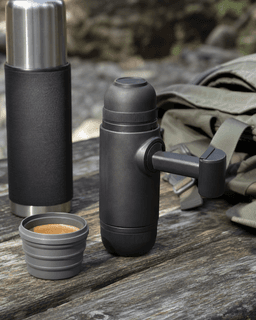 | 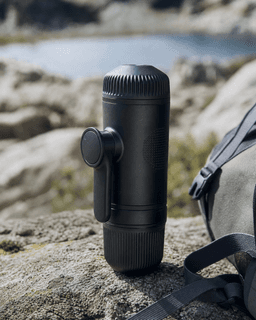 |
|---|---|---|
| Our score | 71 | 74Best |
| Type | Manual pump | Manual pump |
| Pressure | Up to 8 bar | Up to 18 bar |
| Weight | About 12.5 oz (354 g) | About 12.7 oz (360 g) |
| Water capacity | About 2.4 oz (70 mL) | About 2.7 oz (80 mL) |
| Power source | None — manual hand pump | None — manual hand pump |
| Warranty | 1 yr limited | 1 yr limited |
At a glance
Both are fully manual, battery-free portable espresso makers from the same company, built around the same core idea — a hand pump forcing hot water through ground coffee under real pressure. The difference isn't the concept, it's the execution. The Nanopresso came second, and Wacaco used the extra years to fix the two things people complained about most on the Minipresso: the pump felt like a workout, and the pressure ceiling left little room for a sloppy attempt to still turn out okay.
If you've used one and are wondering whether the other is worth it, here's the short version: the Nanopresso is meaningfully nicer to use, the Minipresso is meaningfully smaller and cheaper, and neither is a bad choice — they're just tuned for slightly different priorities.
Where they differ
Pump mechanism and arm effort
This is the single biggest practical difference. The Minipresso's piston requires more force per stroke, and a full shot takes close to a minute of consistent, deliberate pumping — noticeable arm and hand fatigue if you're not used to it, more so if your technique is inconsistent. The Nanopresso's redesigned pump geometry needs less force per stroke, which in practice means it's easier to maintain a steady rhythm through the whole extraction. That steadiness matters beyond comfort — consistent pump pressure is directly tied to consistent extraction, so the easier pump often produces a more even shot too, not just a less tiring one.
Pressure ceiling
Minipresso is rated up to 8 bar; Nanopresso up to 18 bar. Neither number is a guarantee — both are ceilings reached only with good technique — but the Nanopresso's much higher ceiling means there's more headroom when your pump session isn't perfect. A slightly rushed or uneven pump on the Nanopresso is more likely to still land in a range that produces visible crema than the same imperfect session on the Minipresso, where there's simply less margin to work with.
Size and weight
The gap here is smaller than people expect — the Nanopresso weighs about 360 grams against the Minipresso's 354, and both are genuinely pocketable. The Nanopresso's body is a bit larger overall to accommodate the improved pump internals, which matters more for people optimizing for absolute minimum pack size (ultralight backpackers, for instance) than for general travel use where either fits fine in a daypack or jacket pocket.
Accessories and long-term flexibility
Wacaco's accessory lineup — larger water tanks, a protective case, and notably the NS adapter for Nespresso-compatible pods — is built primarily around the Nanopresso. The Minipresso has some accessory support too, but if you think you'll want to expand your setup down the line (bigger water capacity for multiple shots, pod compatibility for convenience), the Nanopresso is the more future-proof base to build from.
Price
The Minipresso typically runs $60 to $70; the Nanopresso $70 to $90 depending on configuration and bundled accessories. It's not a massive gap in absolute terms, but it's a meaningful percentage difference for what's fundamentally a single-purpose travel gadget, and it's the main thing keeping some buyers on the Minipresso side.
Which should you buy?
Buy the Minipresso if you want the lowest-cost, smallest-footprint way into real portable espresso and you're the kind of traveler who'll use it occasionally rather than daily — a couple of camping trips a year, the odd long flight. The arm effort is a real tradeoff, but it's not a dealbreaker for occasional use, and the money saved is meaningful if this is a once-in-a-while gadget for you.
Buy the Nanopresso if you expect to use a portable espresso maker regularly — daily van life, frequent work travel, a genuine coffee habit you don't want to compromise on the road. The easier pump and higher pressure ceiling turn this from "a fun trick a couple times a year" into something you'd actually reach for every morning without dreading the arm workout. For most people asking which one to buy without a strong reason to go cheaper, this is the better long-term pick.
Either way, you're choosing between two versions of the same honest idea — real, hand-generated pressure, no battery required. You can't go seriously wrong; you're just picking how much convenience you want to pay for.
Frequently asked questions
Is the Nanopresso just a bigger Minipresso?
Not really — it's a redesigned pump mechanism, not a scaled-up version of the same one. The Nanopresso's pump takes less effort per stroke and reaches a higher pressure ceiling, which are functional upgrades, not just a size change. It is a bit larger and heavier, but that's a side effect of the redesign, not the point of it.
Which one makes a better-tasting shot?
The Nanopresso, on average, mainly because its higher pressure ceiling gives you more margin for error — a slightly imperfect pump session is more likely to still produce visible crema than the same session on a Minipresso. Both depend heavily on grind size, dose, and your own pump technique either way.
Can I upgrade a Minipresso to Nanopresso-level performance with accessories?
No — the pump mechanism itself is different between the two models, and that's not something an accessory changes. Wacaco's accessory ecosystem, like larger water tanks and the NS pod adapter, is built primarily around the Nanopresso, which is part of why it's the more flexible long-term choice.
Is the price difference between them worth it?
For anyone who'll use a portable espresso maker regularly, most owners who've tried both say yes — the reduced arm fatigue and higher pressure ceiling add up over dozens of uses. For occasional travel use a few times a year, the Minipresso's lower price is easier to justify.