Explainer
Arabica vs Robusta: What's Actually the Difference?
On this page
The short answer
Arabica and robusta are two different coffee plant species, not two grades or roast styles of the same bean. Arabica (Coffea arabica) makes up the large majority of the world's specialty and premium coffee — it's more aromatically complex, generally sweeter, and more acidic. Robusta (Coffea canephora) is hardier to grow, contains roughly double the caffeine, and tastes more bitter and heavier-bodied on its own — which is exactly why it shows up in bold, high-caffeine products like Death Wish Coffee and in crema-focused espresso blends like Lavazza Super Crema, rather than in delicate single origins.
Neither species is objectively "better." They're suited to different jobs, and a lot of the confusion around robusta's bad reputation comes from low-grade robusta used as a cheap filler, not from robusta itself being incapable of contributing something useful.
Where the two species actually differ
Growing conditions and cost
Arabica plants are finicky — they need higher elevation (often 2,000 to 6,000 feet), cooler temperatures, and more careful cultivation, and they're more vulnerable to pests and disease. That fragility drives up production cost and limits where arabica can be grown well, which is part of why quality arabica commands a price premium.
Robusta plants are, true to the name, tougher. They grow at lower elevations, tolerate heat and pests better, and produce higher yields per plant. That resilience is exactly why robusta is cheaper to produce at scale — it's not a quality shortcut, it's a genuinely different set of agricultural tradeoffs.
Caffeine content
This is the difference most people have actually heard of, and it's real: robusta beans contain roughly twice the caffeine of arabica beans. Caffeine is a natural pest deterrent for the coffee plant, so the more pest-resistant robusta variety having more of it isn't a coincidence. It's the direct reason a brand built around a high-caffeine claim, like Death Wish Coffee, blends robusta into its recipe rather than relying on arabica alone or simply using more coffee grounds.
Flavor and aroma
Arabica generally carries more sugar and a more complex mix of aromatic compounds, which is why single-origin specialty coffees — the kind that get described in terms of florals, citrus, or berry notes, like Volcanica's Ethiopian Yirgacheffe — are almost always 100% arabica. Robusta, on its own, tends to taste more bitter, sometimes described as woody, rubbery, or grain-like, with a heavier, thicker body and less acidity.
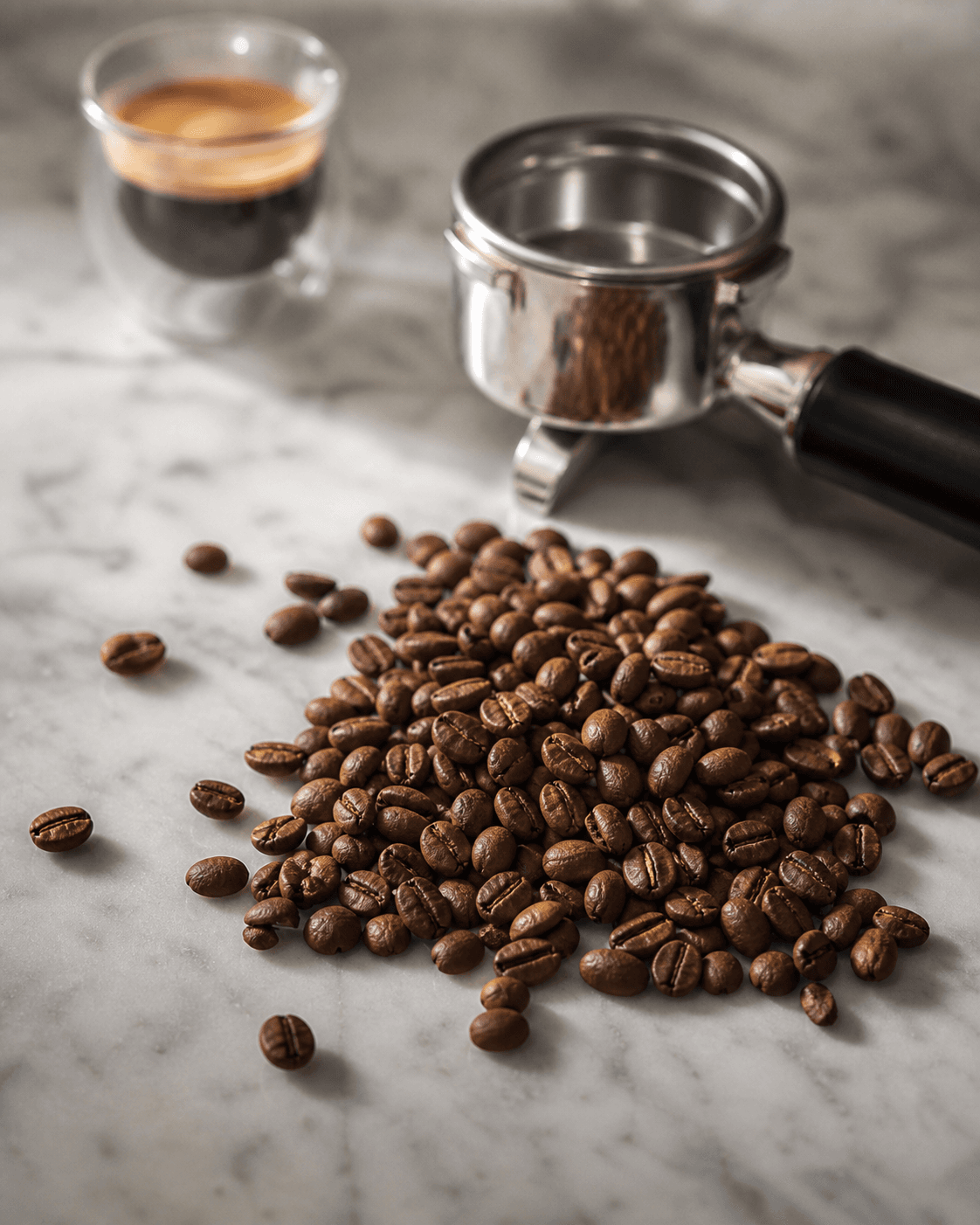
That heavier body is actually a genuine asset in the right context — it's a major reason robusta shows up in espresso blends. Crema, the reddish-brown foam on top of a well-pulled shot, forms more readily and persists longer with some robusta in the mix, which is why a classic Italian espresso blend like Lavazza Super Crema uses a deliberate arabica-robusta ratio rather than going all-arabica.
Where each typically ends up in your cup
Specialty coffee — single origins, light and medium roasts sold on tasting notes and origin story — is almost always 100% arabica. Mass-market and budget coffee, particularly instant coffee and some grocery-store blends, often contains a higher percentage of robusta to control cost. Traditional Italian espresso blends occupy a middle ground, using robusta deliberately and in controlled proportion for body and crema rather than as a cost-cutting measure.
The blend question, and why it's not automatically a red flag
A lot of coffee marketing treats "100% arabica" as shorthand for quality and any robusta content as a mark of cheapness. That's an oversimplification. A carefully balanced blend — Lavazza Super Crema's roughly 60/40 arabica-to-robusta split is a good example — uses robusta deliberately to achieve a specific result (crema, body) that pure arabica doesn't deliver as reliably. The problem isn't robusta's presence; it's low-grade robusta dumped into a blend purely to cut costs, with no attention to balance.
On the other end, Death Wish Coffee uses robusta for an entirely different reason — caffeine content, not crema — and that changes the flavor tradeoff. Their blend leans into a bolder, more bitter profile because that's a byproduct of prioritizing caffeine over refinement.
Practical takeaway
If you're shopping for coffee and see "arabica" or "robusta" on a label, don't treat it as an automatic quality signal either way. Ask what job you're buying the coffee for. Chasing complex, origin-driven flavor — pour-over, drip, a single-origin bean — favor 100% arabica. Building a home espresso setup where crema and body matter, a well-balanced arabica-robusta blend can genuinely outperform an all-arabica option. Wanting maximum caffeine and you don't mind a bolder, more bitter cup, a robusta-forward blend is doing exactly its intended job.
Frequently asked questions
Can arabica and robusta be blended together, and is that a bad thing?
Not at all — many well-regarded espresso blends, Lavazza Super Crema among them, deliberately combine both species to balance arabica's sweetness and aroma with robusta's crema and body. The quality of a blend depends on how well it's balanced, not on whether robusta appears in the ingredient list at all.
Does robusta always taste worse than arabica?
On its own, robusta tends to taste harsher, more bitter, and less aromatically complex, which is why it's rarely sold as a standalone specialty product. But well-integrated into a blend, in the right proportion, it contributes body and crema without dominating the flavor.
Which has more caffeine, and by how much?
Robusta beans generally contain roughly double the caffeine of arabica beans — one of the main reasons brands marketing high-caffeine products, like Death Wish Coffee, include a robusta component in their blend.
Can I tell which species I'm drinking just by taste?
With practice, yes — arabica tends to read as sweeter, more aromatically complex, and more acidic; robusta reads as more bitter, heavier-bodied, and sometimes slightly rubbery or earthy, especially when it's not well-roasted or well-blended.