Researched
Barista Space WDT Tool Review: The Fifteen-Dollar Fix for Channeling
A cheap needle tool that does one specific thing — break up clumps before tamping — genuinely well. Buy it if your shots channel unevenly; skip it only if you've already ruled out distribution as your problem.
On this page
The short version
Fifteen to twenty dollars is not a lot of money in a hobby where a grinder alone can run past a thousand, and the Barista Space WDT Tool is proof that the cheapest accessory in your setup can still be one of the most functionally important. It does one narrow thing — stir coffee grounds before tamping — and that one thing addresses a real cause of uneven extraction that grind, dose, and tamp force alone don't fix.
Where it sits
WDT — Weiss Distribution Technique — comes from John Weiss, a home barista whose needle-stirring method spread through online coffee forums well before commercial accessory brands caught on and started selling purpose-built tools for it. Barista Space, a Polish accessory brand known for affordable, well-made prep tools, is one of several companies now making dedicated WDT tools; theirs sits at the budget end of dedicated (non-DIY) options, competitive with tools like Normcore's needle distributors.
Who it's for
- Anyone seeing inconsistent shot times or visible fast channeling — water blasting through one spot of the puck early — despite a good grinder and consistent dose.
- Anyone using a single-dose grinder, where retained grounds and static clumping are common and a quick stir before tamping meaningfully evens things out.
- Espresso hobbyists building a full prep kit, since it's cheap enough to add without a real budget decision.
Who should skip it
If your shots already pull evenly and your times are consistent, you don't have the problem this solves — adding a step to a routine that isn't broken is just extra time for no benefit. It's also not going to fix bad grind consistency or an old, dull burr set; those problems live upstream of distribution.
Build and design
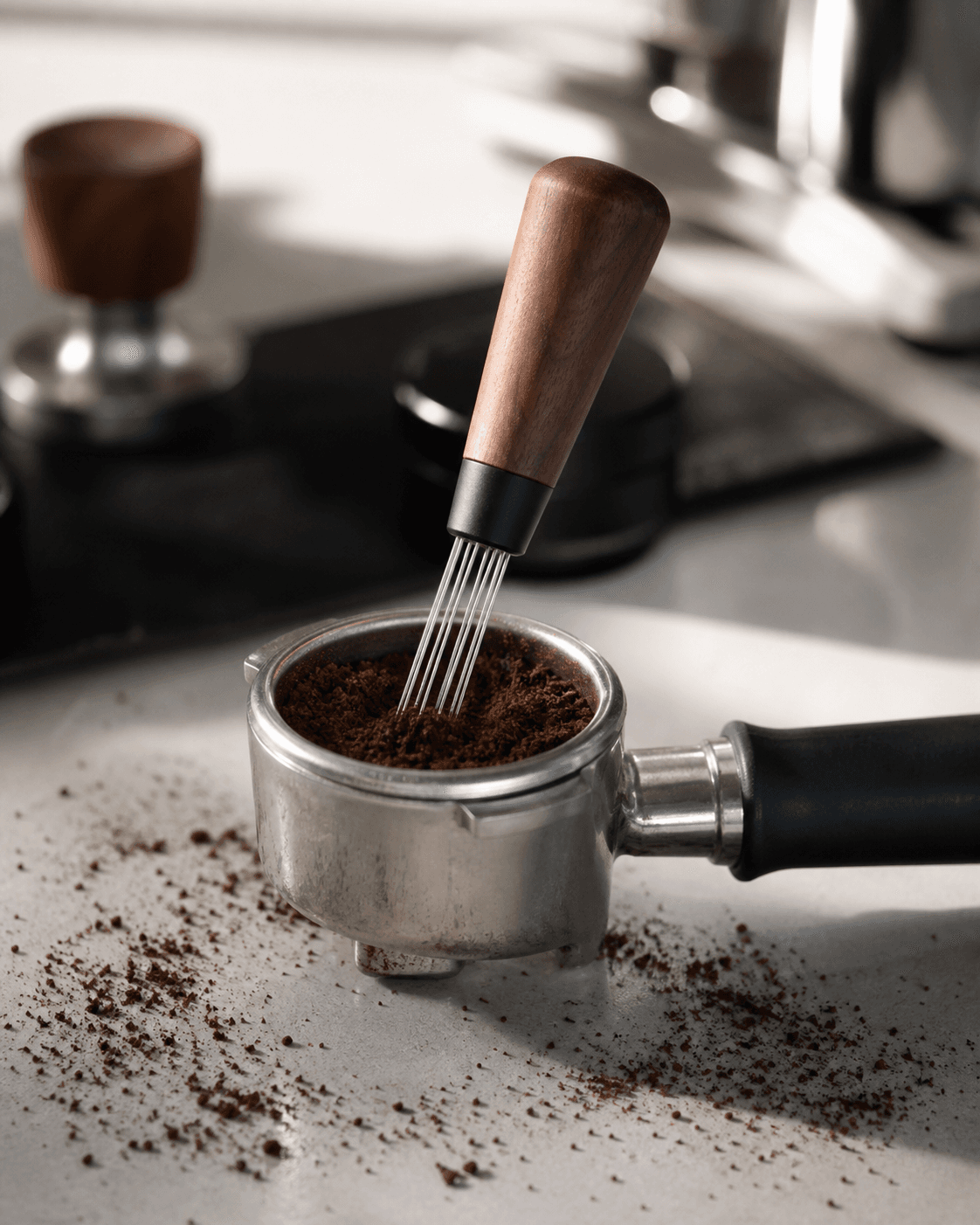
The tool is a cluster of fine stainless steel needles — typically six to eight — mounted in an adjustable collar so you can set how deep they sit, matched to your basket depth and dose. The handle is usually resin or wood, and some versions (including certain Barista Space configurations) add a magnetic base so the tool sticks to the side of the espresso machine for quick access between shots rather than getting lost in a drawer.
Performance
What WDT actually fixes
Ground coffee, especially from burr grinders with any static buildup, tends to clump — small balls of compacted grounds that a hand tamp presses flat but doesn't actually break apart. Those clumps create dense spots and gaps in the puck, and water finds the path of least resistance through the gaps, extracting that section faster and unevenly — the classic cause of channeling, where you see a thin fast stream or spurt from one side of the portafilter spout instead of an even flow. Stirring with fine needles before tamping breaks those clumps into loose, evenly distributed grounds, which tamps into a much more uniform puck.
How much it actually improves a shot
For grinders and beans prone to clumping — often single-dose grinders, oily dark roasts, or anything ground on a humid day — the improvement in shot consistency and reduced channeling is real and often immediately visible in how evenly water flows during the shot. For a grinder that already produces loose, non-clumping grounds and a bean that isn't oily, the improvement is smaller, though most baristas still use it as cheap insurance.
Technique matters
Light, circular or up-and-down stirring motion across the full basket surface is the goal — jabbing straight down repeatedly or dragging the needles hard against the basket wall is both less effective at evenly breaking up clumps and the main way needles end up bent.
Secondary performance
Being handheld rather than basket-specific, it works across any basket size or depth simply by adjusting how deep you set the needles and how you angle the stir — a real advantage over tools sized to one specific basket diameter.
Daily use and ergonomics
It adds maybe 10 to 15 seconds to a shot routine, which is trivial in isolation but is the kind of extra step that some baristas skip when rushed, undercutting its own benefit through inconsistent use. The magnetic-base versions solve part of that friction by keeping the tool within arm's reach instead of buried in a drawer.
Maintenance and longevity
Coffee oils build up between the needles over repeated use and need a regular wipe-down or occasional soak to keep the tool working cleanly — neglect this and you end up smearing old coffee oil into fresh grounds, which defeats the purpose. The needles themselves are the fragile part; they're thin by design; and pressing too hard into a basket wall or floor is a common way to bend one, after which the stirring motion becomes less even.
Upgrades and what to pair it with
A calibrated tamper is the natural next step — distribute with the WDT tool first, then tamp with consistent force, addressing both halves of puck prep. A small dosing funnel that clips onto the portafilter also helps keep loose grounds from spilling over the basket edge while you stir.
How it compares
Vs. DIY options (toothpicks, paperclips, sewing needles): free, and genuinely functional in a pinch, but a single point covers the basket surface far more slowly and unevenly than a multi-needle cluster does in one pass.
Vs. pricier dedicated WDT tools (e.g. Normcore): the core mechanism — needle cluster, adjustable depth — is the same across most of the category. Higher-priced tools tend to differ in handle materials, needle count, and finish quality rather than fundamentally different function, which is a big part of why the Barista Space tool is easy to recommend at its price.
Vs. skipping distribution and just tamping harder: tamping harder does not fix clumping — it compresses clumps into place rather than breaking them apart, which is exactly the misconception WDT corrects.
Value analysis
At $15 to $20, this is one of the easiest "yes" purchases in an espresso setup — the cost of being wrong about whether you need it is close to nothing, and the upside for anyone actually dealing with channeling is real and immediate.
Known issues
Bent needles from over-aggressive stirring against the basket are the most common complaint, followed by oil buildup between needles for anyone who skips regular cleaning. Neither is a design flaw so much as a normal consequence of a thin, functional tool used carelessly.
Verdict
A 9 on value is about as easy a call as this category gets — a cheap accessory that measurably addresses a real, common cause of uneven extraction. The 8 on performance reflects genuine impact for the buyers who actually have the clumping problem it solves, tempered slightly by how much of that impact depends on using it consistently and gently rather than skipping it when rushed.
What we like
- Breaks up clumps a hand tamp alone can't fix, at a genuinely low price
- Adjustable needle depth suits different basket depths and dose sizes
- Magnetic base variant sticks to the machine for quick access between shots
What we don't
- Fine needles bend if you press too hard or hit the basket wall
- Coffee oil residue builds up between needles and needs regular cleaning
- Adds a full extra step to your routine that some baristas decide isn't worth it
Specifications
| Type | Needle-cluster distribution tool |
|---|---|
| Compatible basket size | Universal |
| Material | Stainless steel needles |
| Weight | Unknown |
| Warranty | Unknown |
Frequently asked questions
What does WDT actually stand for?
Weiss Distribution Technique, named after John Weiss, an Australian home barista who popularized using fine needles to stir and break up coffee clumps before tamping, aiming to prevent the water channeling that clumps cause during extraction.
Do I need an expensive WDT tool, or does a cheap one work fine?
A cheap one works fine — the needle-cluster design is simple, and the Barista Space tool at under 20 dollars does the same core job as tools costing three or four times as much. The main differences at higher price points are handle materials and needle count, not fundamentally better function.
Can I just use a toothpick or paperclip instead?
You can, and plenty of people do as a free starting point — but a multi-needle cluster covers the basket surface in one stirring motion instead of one thin point at a time, which is faster and more thorough in practice.
Will WDT damage my portafilter basket?
No, as long as you're gentle and keep the needles away from the basket walls — light stirring motion, not jabbing. Pressing hard into the basket floor or walls is what bends needles and is the main way people damage the tool itself, not the basket.