Researched
Espro Calibrated Tamper Review: Consistent Tamping, Automated
It solves exactly one problem — inconsistent tamping force — and solves it completely. Buy it if your shots vary shot to shot for no reason you can diagnose; skip it if your hand tamp is already dialed in and repeatable.
On this page
The short version
Tamping consistency gets blamed for a lot of bad shots that were actually caused by uneven distribution, stale beans, or a wandering grind setting. But it is a real variable, and if you've ever pulled the same dose through the same basket and gotten a noticeably different shot time with no other change, inconsistent tamp force is a legitimate suspect. The Espro Calibrated Tamper removes that one variable completely, whether or not it was your actual problem.
Where it sits
Espro built its reputation on the Ward press and its calibrated coffee presses before moving into espresso accessories, and the calibrated tamper line applies the same basic idea — remove a variable that depends on human feel and replace it with a fixed mechanical target. It sits in the mid-tier of tamper pricing: well above a basic $15-20 flat tamper, below fully automated tamping stations like a Puqpress that mount to the counter and tamp with the pull of a lever.
Who it's for
- Anyone who's measured real shot-to-shot inconsistency and ruled out grind, dose, and distribution as the cause. This tamper exists specifically for that remaining variable.
- Beginners building technique. Learning "what does correct tamp pressure feel like" is a real skill; a calibrated tamper skips that learning curve entirely.
- Multi-barista environments — cafés or households where more than one person pulls shots — where hand-tamp force naturally varies person to person.
Who should skip it
If you already tamp consistently and your shot times are stable day to day, this solves a problem you've already solved by hand, for free. And if your actual inconsistency is coming from uneven distribution rather than tamp force — a common misdiagnosis — a WDT tool will move the needle more than a calibrated tamper will.
Build and design
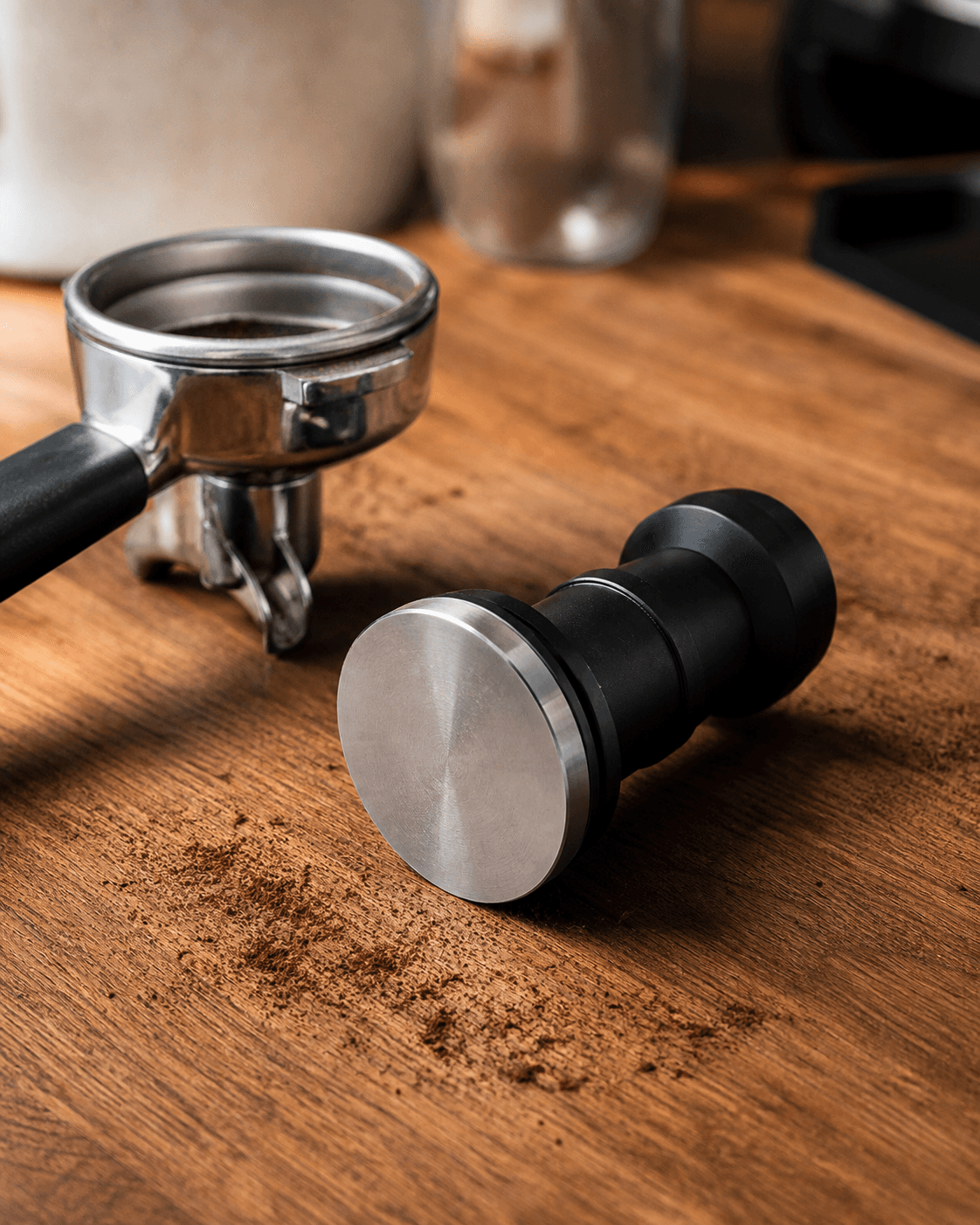
The base is precision-machined stainless steel, flat (convex options exist from Espro too, matched to specific basket geometries), and the fit against a 58 mm basket rim is snug with minimal wobble. The spring mechanism lives inside the handle assembly — press down, and resistance builds smoothly until it hits the calibrated limit, at which point the tamper gives a distinct mechanical click and stops transmitting additional force to the puck even if you keep pushing. That click is the whole point: it's an unambiguous, repeatable endpoint that doesn't depend on your sense of "that felt about right."
Performance
The calibration mechanism
Espro sets the spring to release at a fixed force — commonly cited around 30 pounds — and once you hit that threshold, additional downward pressure just compresses the spring further without adding force to the puck. In practice this means a heavy-handed press and a light, careful press produce the same result, which is the entire value proposition condensed into one sentence.
How much this actually changes your shots
For an experienced barista with a genuinely consistent hand tamp, the difference is often negligible — you were already hitting a repeatable force, just without a mechanism enforcing it. For anyone whose tamp force wanders — tired at the end of a shift, distracted, new to the technique — it removes an entire axis of shot-to-shot variation, which shows up as tighter, more repeatable extraction times across a session.
What it doesn't fix
Distribution. Tamping a badly-distributed puck at exactly 30 pounds every time still tamps the unevenness into place rather than correcting it — you get consistent pressure applied to an inconsistent pile of grounds, which still channels. This tamper is a puck-pressing tool, not a puck-preparation tool.
Secondary performance
The 58 mm version fits standard commercial portafilters cleanly; Espro also sells 51 mm and 53 mm versions for prosumer machines that use smaller baskets, so check your basket size before buying rather than assuming 58 mm fits everything.
Daily use and ergonomics
At 460 g it has real heft without feeling unwieldy, and the handle (available in a few finishes) is comfortable for repeated daily use. The learning curve is really an unlearning curve for experienced baristas — pressing past the click feels wrong at first if you're used to a firm, deliberate hand tamp, since the spring gives noticeably before you'd normally stop pressing by feel. It takes a few sessions to trust the click rather than fighting it.
Maintenance and longevity
There's no lubrication or adjustment required, and the spring mechanism is sealed inside the handle, which is good for simplicity but means it's not user-serviceable if the spring eventually loses tension after years of daily compressions — a slow, hard-to-notice failure mode rather than a sudden one. Cleaning is just wiping the base after use like any tamper.
Upgrades and what to pair it with
A WDT tool is the natural pairing — distribute first to break up clumps and even the grounds, then tamp with the Espro to lock in consistent pressure on top of that even distribution. Together they address both halves of puck prep that hand technique alone struggles to nail every time.
How it compares
Vs. a standard flat tamper: a standard tamper is cheaper and gives you full control, which is exactly the problem if your control isn't consistent yet. The Espro trades that control for a guaranteed floor of consistency.
Vs. a Puqpress or other tamping station: those mount to the counter, tamp with a lever pull, and add self-leveling in some models — genuinely more capable, and priced accordingly at several hundred dollars plus counter space and machine compatibility requirements. The Espro is the portable, no-installation middle ground.
Vs. other calibrated hand tampers (e.g., some Normcore models): functionally similar concept — several brands now sell spring-calibrated tampers at comparable prices. Espro's reputation and finish quality are a level up for some buyers; the underlying mechanism across brands does the same basic job.
Value analysis
$79 for a tamper is a real number next to a $15 flat tamper that does the mechanical job of pressing coffee just fine. The value case rests entirely on whether force consistency was actually costing you shot quality — for someone who's diagnosed that specific problem, it's a clean fix; for someone buying it speculatively hoping it "improves espresso" broadly, the return is smaller than the price suggests.
Known issues
The most common complaint isn't a defect — it's the fixed, non-adjustable calibration, which some experienced users find slightly light or slightly firm relative to their personal preference and can't tune. A smaller number of long-term owners report the click becoming less crisp after a few years of heavy daily use, consistent with normal spring wear.
Verdict
An 8 on performance is earned by doing its one job — eliminating tamp-force variation — completely and repeatably. The 6 on value reflects a real but narrow use case: this is a precise fix for a specific, diagnosable problem, not a general espresso-quality upgrade, and buyers should be honest with themselves about which one they're solving before spending the money.
What we like
- Removes tamping-force inconsistency between shots entirely
- Audible and tactile click makes the endpoint unmistakable, even for beginners
- Flat, precisely machined base seats evenly against the basket rim
What we don't
- Fixed calibration means you can't dial in a different target force yourself
- Feels noticeably "softer" than a firm hand tamp, which throws off experienced baristas at first
- No self-leveling — uneven distribution before tamping still produces uneven pucks
Specifications
| Type | Spring-loaded calibrated tamper |
|---|---|
| Compatible basket size | 58 mm (51 mm and 53 mm also sold) |
| Material | Stainless steel base |
| Weight | 460 g |
| Warranty | 1 yr |
Frequently asked questions
Does tamping force actually matter for espresso quality?
Less than most people think, within a reasonable range — anywhere from about 15 to 30 pounds of force generally extracts fine. What matters far more is consistency shot to shot, since a puck tamped inconsistently channels water unevenly regardless of the average force applied. That consistency is exactly what a calibrated tamper delivers.
What force is the Espro calibrated to?
Around 30 pounds of force, which is on the firmer end of the commonly recommended range and isn't user-adjustable — the spring mechanism is fixed at the factory to that target.
Does it replace the need for good distribution before tamping?
No — a calibrated tamper only standardizes the pressing step. If the grounds are unevenly piled in the basket before you tamp, you'll still get an uneven puck and channeling, calibrated force or not. Pair it with a distribution tool like a WDT for the full fix.
Is it worth it over just practicing a consistent hand tamp?
If you already tamp consistently by feel, no — you're paying for a problem you don't have. It earns its price for people who've measured real force variation shot to shot, or beginners who haven't built that feel yet.