Researched
Fellow Atmos Vacuum Canister Review: Worth Twisting For
A $50 canister that actually pulls a vacuum instead of just claiming to be airtight. Buy it for beans you've already let degas for a few days; skip it as a first stop for freshly roasted coffee.
On this page
The short version
Most coffee canisters that call themselves "airtight" just mean the lid clips down snugly — which is fine, but it's not the same thing as actively removing air. The Fellow Atmos does something different: every twist of the lid pushes a little more air out through a one-way mechanical seal, and you can feel it working. That's a real point of difference in a category mostly full of glorified Tupperware.
Where it sits
Fellow made its name with the Stagg gooseneck kettle and later the Ode grinder, both aimed at people who already care more than average about their coffee routine. The Atmos, launched in 2020, extended that into storage — a category that had mostly been split between cheap clip-lid canisters and a handful of premium one-way-valve bags borrowed from commercial coffee roasting. The Atmos sits at the premium end of consumer canisters, priced above basic options but well under specialty vacuum-sealing systems built for restaurant kitchens.
Who it's for
- Anyone buying whole-bean coffee in 12 oz to 1 lb bags who wants it to taste the same on day 10 as day 2. This is the exact use case the twist mechanism is built around.
- People who go through a bag in one to two weeks. The vacuum effect matters most in that window before the beans would naturally stale out anyway.
- Anyone tired of clip-lid canisters that let coffee smell fill the whole cabinet. The gasket seal genuinely contains aroma better than a snap-lid design.
Who should skip it
Anyone buying coffee that's less than a few days off the roast should hold off using the Atmos immediately — see the CO2 issue below. And if you're the kind of buyer who finishes a bag in three or four days, you frankly don't need a $50 canister at all; a clipped bag or a $10 canister will do the job over that short a window.
Build and design
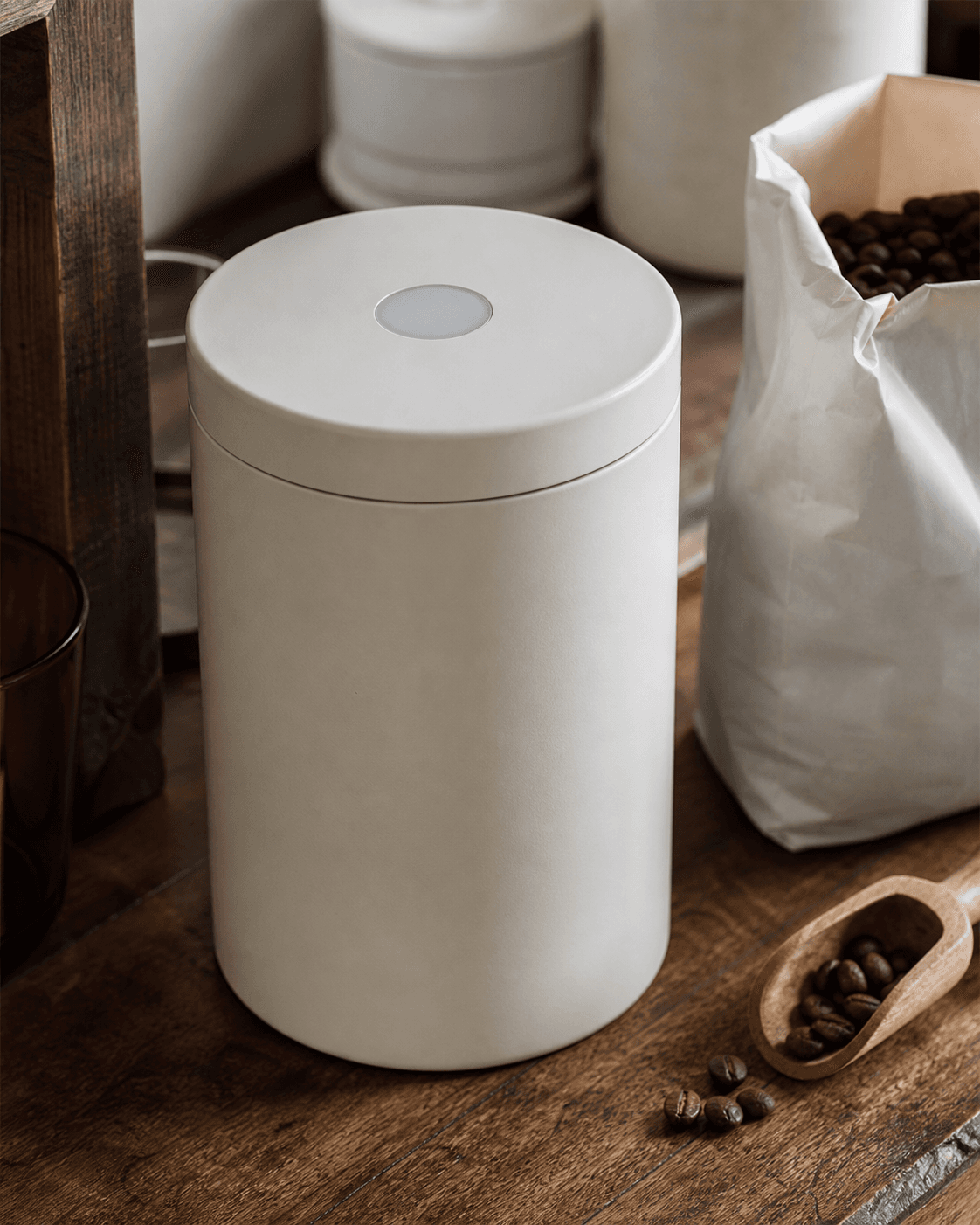
The steel version is double-walled and fully opaque, which blocks light completely — a genuine freshness advantage that's easy to underrate, since UV and even ambient light degrade coffee oils over time just as oxygen does. The glass version trades that light-blocking for visibility, letting you see fill level and bean color without opening the lid, at the cost of some UV exposure. Both versions use the same twist-lid mechanism: turning the lid clockwise compresses a spring-loaded plate downward, which forces air out through a one-way silicone gasket, and turning it further seats the lid with a noticeably firm, sealed resistance.
Performance
The vacuum mechanism itself
Twist the lid and you feel the resistance ramp up in real time, plus a faint hiss as air escapes — genuinely satisfying, and unlike anything a clip-lid canister does. It's not a lab-grade vacuum chamber; it's a mechanical pump built into the lid, and it pulls a partial vacuum that measurably slows the two things that stale coffee fastest — oxygen exposure and moisture ingress.
How much it actually helps
Coffee's biggest enemy after roasting is oxygen reacting with the oils on the bean surface, a process that accelerates once beans are ground but happens slowly to whole beans too. Cutting oxygen exposure via a real vacuum seal measurably slows that oxidation compared to a snap-lid container, though it doesn't stop it — coffee in the Atmos still declines over weeks, just more slowly than the same beans in an open bag or basic canister.
The CO2 problem
This is the one real design limitation. Freshly roasted beans continue releasing CO2 for days after roasting — that's why bags from good roasters have a one-way valve built in, letting gas escape without letting oxygen in. The Atmos has no equivalent valve. Seal beans that are actively degassing and you're fighting the canister's own vacuum action, which can make the lid harder to reseal correctly or, in some reports, cause a slight bulge. The fix is simple — rest beans 3 to 5 days after roast date before transferring them in — but it's a real caveat that undercuts the "throw beans in immediately" convenience some buyers expect.
Secondary performance
The 0.7 L size holds roughly 12 oz of whole bean coffee comfortably, which lines up with a standard bag; the 1.2 L and 2 L sizes exist for bulk buyers or households going through more coffee at once. None of the sizes include a built-in scoop, which is a minor omission at this price.
Daily use and ergonomics
The twist action takes a bit more effort and a bit more time than popping a lid — maybe three to five seconds per open-and-reseal cycle, which is a real if small tax on a container you're opening daily. It becomes second nature quickly. The steel version's lack of a viewing window means you're opening it to check how much coffee is left, which is a mild inconvenience compared to the glass version.
Maintenance and longevity
The silicone gasket is the wear part — it's what makes the vacuum seal work, and like any gasket it loses some elasticity over years of daily compression, making the twist feel looser and the seal less effective. Fellow doesn't widely sell replacement gaskets as a standalone part, which means a degraded gasket after several years of heavy use is closer to end-of-life for the canister than a five-minute fix. Otherwise it's dishwasher-unfriendly (hand wash recommended to protect the mechanism) but low-maintenance day to day.
Upgrades and what to pair it with
Not much is needed alongside it — it's a complete solution on its own. If you're buying coffee in bulk (2 lb bags or more), the 2 L size avoids needing multiple smaller canisters. Pairing it with a good kitchen scale for dosing rounds out a basic serious-coffee setup without adding much cost.
How it compares
Vs. Airscape canisters: Airscape uses a press-down inner lid that expels air via a valve as you push it down, rather than a twist mechanism — similar goal, different action, and generally a bit cheaper. The Atmos's seal generally feels more positive and the twist is easier to do one-handed than pressing down evenly on Airscape's plunger lid.
Vs. one-way-valve storage bags: the resealable bags some roasters sell (or that you can buy separately) handle the fresh-roast CO2 problem the Atmos doesn't, since they're built with a true one-way valve. They're worse at long-term storage and don't feel as premium day to day, but they're the better choice in the first week after a roast date.
Vs. a basic $10-15 clip-lid canister: the cheap option is airtight in the loose sense — it keeps bugs and humidity out reasonably well — but does nothing active to remove oxygen already inside. The Atmos's vacuum action is the actual functional upgrade you're paying the price difference for.
Value analysis
At $50 for the steel 0.7 L, the Atmos costs more than most people think a coffee canister should, and the honest case for it rests entirely on whether you actually finish bags slowly enough for the freshness difference to matter. If you're buying coffee weekly and finishing it before staleness sets in regardless of container, you're paying for a feature you won't use. If you buy in larger batches or go through beans over two-plus weeks, the price gap closes fast against how much stale coffee actually costs you in wasted beans.
Known issues
The CO2/fresh-roast interaction is the most consistently reported friction point, followed by gasket wear reducing seal quality after a few years of daily use. A smaller number of owners note the opaque steel version's lack of a viewing window as an ongoing minor annoyance rather than a flaw.
Verdict
An 8 on performance reflects a canister that does something meaningfully different from a snap-lid box — a real, felt vacuum action that slows staling rather than just claiming to. The 7 on value acknowledges that $50 is a real ask for a storage container, justified specifically for buyers who keep beans around long enough to benefit, and less so for anyone who burns through a bag in days regardless of how it's stored.
What we like
- Genuinely satisfying vacuum click when you twist the lid closed
- Steel version fully blocks light, a real freshness factor most canisters ignore
- Comes in three sizes so you can match it to how much coffee you actually buy at once
What we don't
- No one-way valve, so it's a poor choice for beans still actively degassing
- Twist mechanism effort increases as the internal gasket ages
- Opaque steel version means no at-a-glance level check without opening it
Specifications
| Capacity | 0.7 L (also sold in 1.2 L and 2 L) |
|---|---|
| Seal type | Twist-to-vacuum spring-loaded lid |
| Material | Stainless steel (glass version also available) |
| Vacuum/CO2 valve | Vacuum seal only |
| Warranty | 1 yr |
Frequently asked questions
Is the Fellow Atmos actually airtight, or just marketed that way?
It genuinely pulls a partial vacuum with each twist of the lid — you can feel the resistance increase and hear a faint hiss as air is pushed out through the seal. It's not a marketing claim without mechanism behind it, unlike a lot of clip-lid canisters that just call themselves airtight.
Should I use it for coffee straight out of the roaster?
Not immediately — freshly roasted beans release CO2 for the first several days, and a sealed vacuum container with no pressure-release valve can bulge or, in rare cases, struggle to reseal properly under that pressure. Give beans 3 to 5 days to rest first, or store loosely for the first few days.
Steel or glass version — which should I buy?
Steel blocks light completely, which matters more for long-term freshness than most people assume — go steel if you're optimizing purely for shelf life. Glass lets you see fill level and bean color at a glance, which is a real convenience if you're storing more than one bag at a time.
How long does the vacuum actually hold?
Realistically a few days before it fully equalizes back to ambient pressure through the seal, which is normal for any canister at this price point — it's not a permanent vacuum chamber. The point is slowing oxygen exposure during that window, not eliminating it forever.