Researched
Timemore Airtight Canister Review: The Case for Simple, Cheap Coffee Storage
A straightforward, inexpensive canister that does the basics well without pretending to be more than it is — buy it if you want reliable everyday storage and don't need vacuum-level preservation.
On this page
The short version
Not every coffee storage problem needs a mechanism. Most of the staling that actually happens to beans on your counter comes from light, heat, and how often you open the bag — not from the last 2% of oxygen a passive seal fails to keep out. The Timemore Airtight Canister leans into that reality: it's a gasket-sealed steel container with no pump, no valve, and no pretense of being a vacuum chamber, priced accordingly.
Timemore is better known for grinders and scales, but this canister fits the same practical, value-focused approach — solid materials, a simple mechanism, and a price that doesn't ask you to justify a premium feature you might not need.
Who it's for, who should skip it
This is for someone who goes through a bag of beans in one to three weeks and just wants a container that keeps air, light, and countertop odors away from the coffee in the meantime. It's also a smart pick if you regularly have two or three different roasts open at once — buying a few of these to dedicate one per bag costs less than one premium vacuum canister.
Skip it if you buy beans in bulk and need them to stay fresh for a month or longer between grinds, or if you specifically want the reassurance of a mechanism that's actively removing air rather than just excluding it. That's a real use case, and a passive gasket seal isn't built for it the way a vacuum canister is.
Design and build
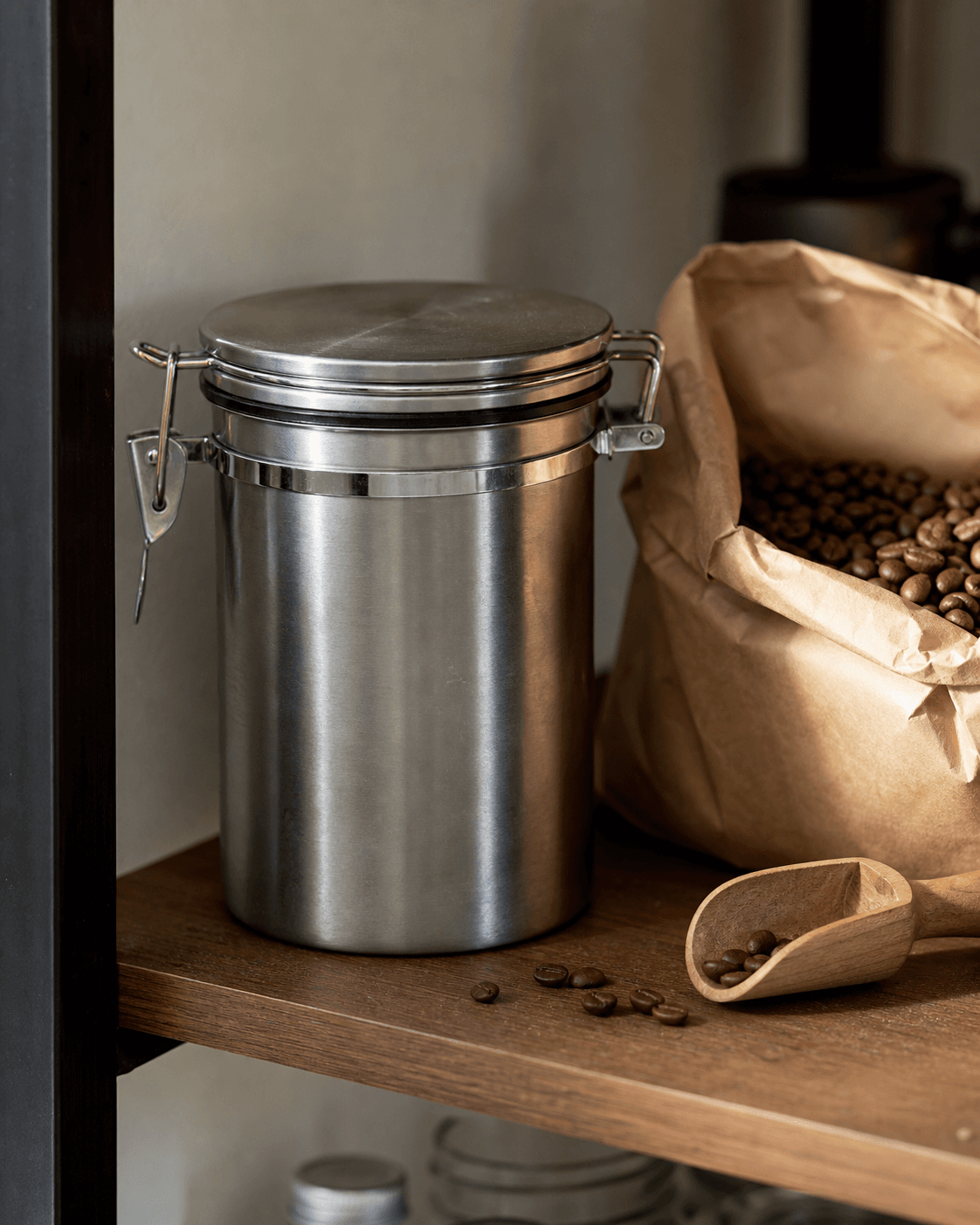
The body is stainless steel, which resists denting and doesn't pick up coffee odor the way some plastics do over time. The lid, depending on the specific version, is glass or acrylic with a silicone gasket that compresses against the rim when closed — a simple, well-understood sealing method that's been used in food storage for decades because it works and rarely fails outright.
There's genuinely nothing to break here in the way a pump or a spring-loaded valve can break. That simplicity is a real durability advantage, even if it comes at the cost of a more sophisticated seal.
Core performance
How well it actually preserves freshness
A gasket seal keeps out ambient air exchange reasonably well — better than a bag with a fold-over clip, roughly comparable to a well-sealed jar. What it doesn't do is actively remove the oxygen already inside the container when you close the lid, and it has no one-way valve to vent CO2 that fresh-roasted beans continue to release for days after roasting. In practice, that means beans stored here stale at a normal, unremarkable rate — noticeably better than an open bag on the counter, noticeably worse over several weeks than a true vacuum canister.
Capacity and fit
Sizing varies by the specific version you buy, and it's worth checking the stated capacity against your typical bag size before ordering — some sizes comfortably swallow a full 12-ounce bag with room to spare, while smaller versions are better suited to partial bags or a single dose's worth at a time.
Daily use and ergonomics
This is where the canister earns its best marks. There's no learning curve, no pump handle to remember to press, no valve to check. You pour beans in, press the lid down until the gasket seats, and you're done. Opening it for a daily scoop is just as simple — no resealing ritual, no pump to reset. For anyone who's used a vacuum canister and found the daily pump routine mildly annoying, this is a relief.
Maintenance
Cleaning is genuinely easier than any canister with moving parts. Wipe out oil residue with a cloth, or rinse the whole thing under water and let it air dry — there's no valve seat to worry about clogging with coffee dust, which is a real maintenance point of failure on more elaborate vacuum canisters over time.
How it compares
Fellow Atmos Vacuum Canister is the natural comparison, and it's a genuine step up in preservation for beans you're keeping several weeks — its vacuum-style seal actively removes air rather than just excluding it, which measurably slows staling for whole beans over that longer window. The trade-off is a higher price, a more involved mechanism to keep clean, and — per Fellow's own guidance — a design better suited to whole beans than ground coffee, since the vacuum mechanism gets messier to clean with fine grounds in the mix. If you're storing beans for the long haul and don't mind an extra cleaning step, the Atmos is worth the upgrade. If you're going through beans within a few weeks and want the simplest possible container, the Timemore is the more sensible buy.
A standard mason jar, the default cheap option a lot of people already own, is worth naming honestly: it seals reasonably well and costs less, but lacks the light-blocking material and purpose-built gasket fit of a canister designed specifically for coffee, and clear glass lets light degrade beans faster if left on an open counter.
Value
At $15-25, the Timemore canister is inexpensive enough to buy multiples without feeling like a splurge, which is genuinely useful if you rotate through more than one roast at a time. It doesn't out-preserve a dedicated vacuum canister, but it comfortably beats an open bag or a generic jar, and the price makes it an easy yes for most everyday storage needs.
Known issues
The most common owner note is that smaller sizes fill up faster than expected against a standard 12-ounce bag, which is more a sizing-awareness issue than a flaw. A second recurring point is that seal quality depends on keeping the gasket and rim clean — a buildup of coffee oil or stray grounds on the sealing surface can weaken the seal over time if it's never wiped down. No notable complaints about the steel body or lid durability show up with any frequency.
Verdict
The honest takeaway here is that no container — this one, a vacuum canister, or anything else — keeps coffee fresh forever. Roast date, how much light the beans see, and how often the lid gets opened all matter more than the storage mechanism itself. Within that reality, the Timemore's mid-pack performance score (6) reflects a passive seal doing a passive seal's job competently, while its value (9) and ergonomics (8) scores reflect a container that's cheap, simple, and pleasant to use every single day. For most people finishing a bag within a few weeks, that's the right trade to make.
What we like
- Cheap enough to buy two or three and dedicate one per roast without a second thought
- No mechanism to disassemble or fail — a gasket seal is about as simple as coffee storage gets
- Genuinely easy to wipe out and reuse compared to canisters with valves or pumps built in
What we don't
- No active vacuum or one-way CO2 valve, so it doesn't slow staling as aggressively as vacuum-sealed options over long stretches
- Smaller sizes fill up fast if you buy beans in full 12-ounce or larger bags
- Seal quality depends on keeping the gasket clean — grounds or oil buildup on the rim can weaken it over time
Specifications
| Capacity | Multiple sizes, roughly 12-20 oz beans |
|---|---|
| Seal type | Airtight silicone gasket |
| Material | Stainless steel body |
| Vacuum/CO2 valve | No |
| Warranty | 1 yr |
Frequently asked questions
Does the Timemore Airtight Canister use a vacuum seal?
No — it uses a passive airtight gasket seal, not an active vacuum mechanism or a one-way CO2 valve, so it limits air exposure but doesn't actively pull air out the way a vacuum canister does.
Is the Timemore canister good for long-term coffee storage?
It's fine for the timeframe most people actually store coffee — a few weeks between roast and finishing the bag — but for beans you want to keep fresh over a month or more, a vacuum-sealing canister will slow staling more effectively.
How many bags of coffee fit in one Timemore canister?
It depends on the size you buy, but most versions hold roughly 12 to 20 ounces of whole beans — check the specific size against your typical bag before assuming a full 12-ounce bag fits with headroom.
Is the Timemore canister easy to clean?
Yes — because there's no valve or pump mechanism, you can wipe it out or rinse it directly, which is simpler than cleaning canisters with moving parts.