Researched
NutriBullet Pro Review: A One-Person Smoothie Machine, Nothing More
It does exactly one job — a fast, strong single-serve smoothie — and does it well. Ask it to be a real blender and it shows its limits fast.
On this page
There's a specific kind of person this blender was built for: someone making one smoothie, once a day, who doesn't want to wash a pitcher afterward. If that's not you, keep reading before you buy — the NutriBullet Pro is genuinely narrow in what it's good at.
Who this fits
If your blending life is "one smoothie, one person, most mornings," this format makes sense in a way a full-size blender doesn't — you blend directly in the cup, twist off the blade base, and drink straight from it. Fewer dishes, smaller counter footprint, done in under a minute including cleanup.
It's the wrong pick if you regularly blend for a family, want to make soup or nut butter, or need texture control beyond "blended" and "more blended." There's no speed dial here — you get one setting, and it's strong.
Design and build
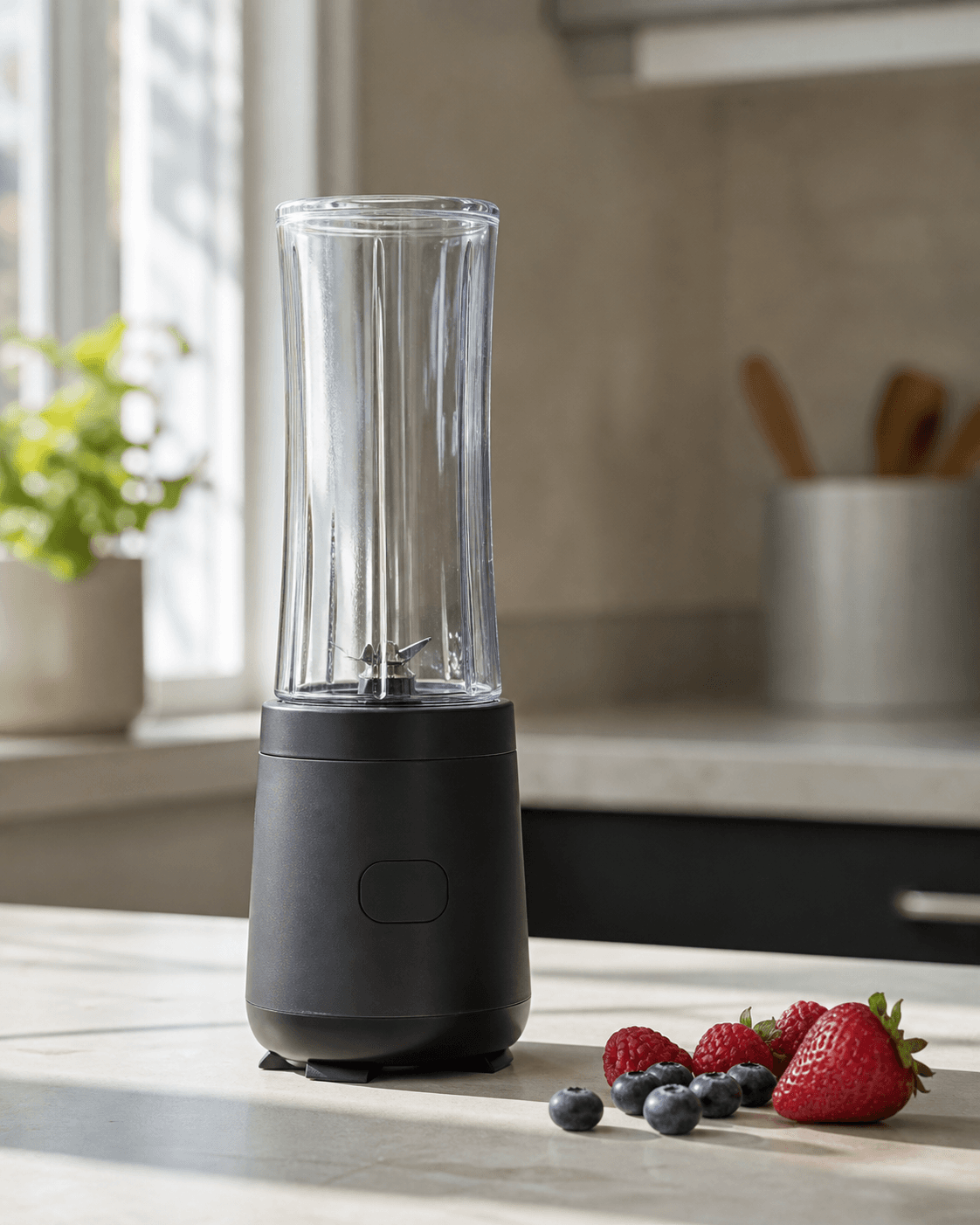
The whole system is built around cups rather than a pitcher: a 900W motor base and screw-on cup-and-blade combos in a couple of sizes (commonly 24 oz and 32 oz). You load ingredients into the cup, screw the blade assembly on top, flip it upside down onto the motor base, and twist down to activate. Release the twist and it stops — there's no button, no dial, just torque-activated blending.
That design has real upsides: fewer parts to lose, nothing to leak if the seal's intact, and a genuinely compact footprint compared to any pitcher blender. The trade-off is durability of the small stuff — the rubber gasket that seals the cup to the blade base is the first thing to wear out, typically within a year or two of daily use, and a worn gasket means smoothie leaking out around the threads mid-blend.
Motor power in a small format
900 watts is a lot of power to cram into a personal-blender chassis, and it shows — this isn't an underpowered gadget. It pulls frozen fruit and ice into a smooth texture faster than most people expect from something this size, generally in 30-45 seconds per cup.
The single-speed limitation
There's no in-between setting. That's fine for smoothies, where "blend it thoroughly" is the only real goal, but it means zero control for anything that benefits from a gentler touch — you can't pulse-chop, can't fold in delicate ingredients, can't back off the power to avoid over-liquifying something. It's a smoothie tool first and a general-purpose blender a distant second.
Handling greens and fibrous ingredients
Whole kale leaves or celery stalks dropped in raw tend to wrap around the blade edges rather than shred cleanly, especially without enough liquid in the cup. Pre-chopping fibrous vegetables into smaller pieces and always blending with the liquid layer at the bottom (so the blades have something to grab immediately) solves most of this — but it's a step you have to know to take, since there's no guidance built into the machine.
Noise
Loud, but shorter in duration than a pitcher blender — most single-serve blends finish in under a minute, so the noise window is brief even if the peak level (commonly cited in the mid-to-high 80s dB) is comparable to bigger blenders.
Daily use and cleaning
This is the category's actual selling point. Rinse the cup, maybe run a quick soap-and-water spin in the cup itself, and you're done — there's no pitcher, no separate blade assembly to hand-wash, no lid gasket beyond the one on the cup itself. For a daily-use appliance, that low cleaning friction is a real quality-of-life win, and it's the main reason these sell as well as they do.
Maintenance and longevity
The motor base tends to outlast the accessories. Most wear shows up in the cup gaskets and occasionally in the blade sharpness after a couple years of ice-heavy use. Replacement cups and gaskets are inexpensive and widely available, which keeps the system usable well past when a pitcher blender's jar might crack and force a full replacement — you're just budgeting for small parts along the way rather than one big failure.
How it compares
Ninja Professional Plus — bigger jar, actual speed control, better suited to anyone blending for more than themselves. If you regularly make smoothies for a household, the Ninja's 72 oz jar does that in one pass; the NutriBullet doesn't.
Vitamix 5200 — different league on power and durability, but overkill and inconvenient for single servings — you'd be running a 64 oz jar for a 12 oz smoothie and scraping corners every time.
NutriBullet Blender Combo (NutriBullet's own step-up line) — adds a full pitcher alongside the cups, useful if you want the personal-blender convenience most days but occasionally need to blend a bigger batch.
Value
At around $99, this is an easy, low-risk purchase for exactly one use case. You're not paying for versatility — you're paying for a fast, strong, low-cleanup single-serve smoothie machine, and on that narrow metric it delivers reliably.
Verdict
Judge the NutriBullet Pro on what it's actually built to do and it holds up well — a strong motor, an easy cleanup routine, and a shape that fits a one-person morning routine. Judge it as a general-purpose blender and the missing speed control and small capacity will frustrate you fast.
What we like
- 900W motor is genuinely strong for a personal-blender format
- Cup-based design means you blend, unscrew the blade, and drink from the same vessel
- Small footprint — stores easily in a cabinet or on a crowded counter
- Cheap enough that replacing a cracked cup isn't a big deal
What we don't
- No speed control at all — it's full power or nothing
- Not built for jugs, soups, or blending for more than one person
- Single 1-year warranty, and rubber gaskets wear out faster than the motor
- Leafy greens and fibrous stalks need pre-chopping or you'll get stringy bits
Specifications
| Motor power (W) | 900W |
|---|---|
| Jar capacity (oz) | 24 oz (32 oz cup also included on most kits) |
| Jar material | BPA-free Tritan plastic |
| Speeds | 1 — single-speed, twist-to-activate |
| Preset programs | None |
| Noise level | ~85-88 dB |
| Warranty (yr) | 1 |
Frequently asked questions
Can the NutriBullet Pro crush ice?
In small amounts mixed with liquid, yes. A cup full of solid ice cubes with no liquid is a rougher ride and can leave chunks — add liquid first.
Does the NutriBullet Pro have multiple speeds?
No — it's single-speed. You twist the cup down onto the base and it runs at full power until you release it.
Can I make soup in a NutriBullet Pro?
Not really — the cups are sized and shaped for single smoothie servings, not the volume or friction-heating window a hot-soup blend needs.
How long do NutriBullet cups last?
The plastic itself holds up well, but the rubber gasket rings wear out and can start leaking after a year or two of daily use — they're cheap to replace separately.