Researched
Vitamix 5200 Review: The Blender People Still Talk About a Decade Later
It's loud, it's basic, and it costs more than it looks like it should — but the 5200 is the blender that made 'buy it for life' a real category, and it still earns that.
On this page
Here's a number that tells you most of what you need to know about the Vitamix 5200: it's basically unchanged since the early 2000s, and it's still the blender other blenders get compared to. Not the newest. Not the quietest. Not the one with the app. Just the one that keeps working.
Who this is actually for
Buy the 5200 if you blend often enough that "durability" is a real line item in your decision — daily smoothies, weekly soup batches, regular nut butter or nut milk runs, the occasional frozen margarita for a crowd. The variable-speed dial and pulse switch give you real control over texture, and the motor doesn't bog down when you load the jar with ice and frozen mango at 7 a.m.
Skip it if you blend once a week for a protein shake and mostly want something that lives in a cabinet between uses. A $40 personal blender does that job fine, and the 5200's 64 oz jar is genuinely inconvenient to store if you don't have deep counters or open shelving.
It's a borderline call if you're blending for one person — the 64 oz container is a lot of jar for a single 12 oz smoothie, and you'll spend real time scraping the corners with a tamper-free rocking motion to get everything into the blades.
Design and build
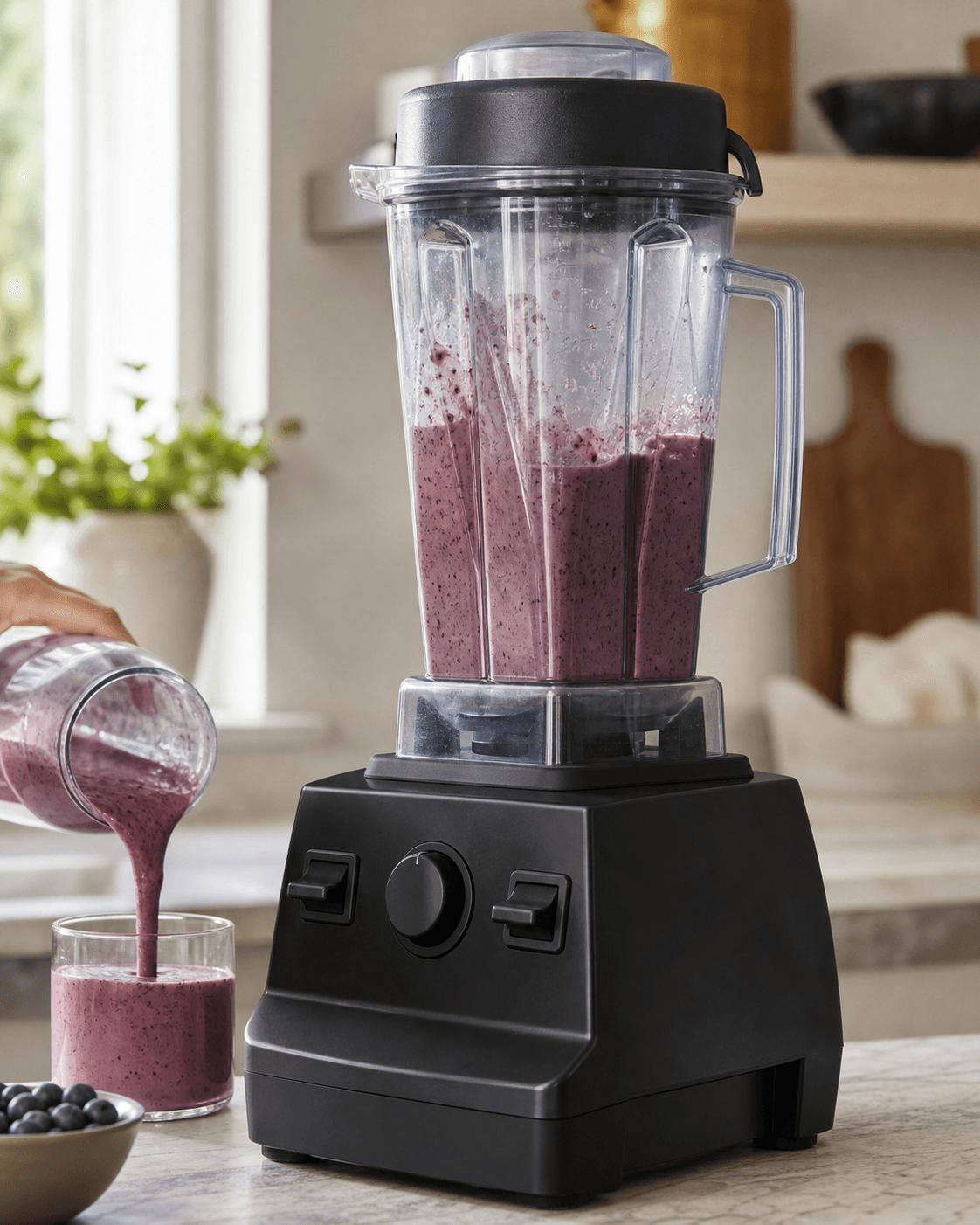
The base is a chunky rectangular block of a machine — not sculptural, not "kitchen decor," just a motor housing with a dial on it. That's not an insult. The plastic housing is thick, the dial has real resistance instead of a mushy click, and the whole unit weighs enough (about 10 lbs) that it doesn't walk across the counter at high speed the way lighter blenders do.
The 64 oz jar is Eastman Tritan copolyester, a BPA-free plastic that resists scratching and, more importantly, resists the yellowing and clouding you see in cheaper blender jars after a year of turmeric smoothies and tomato soup. The blade assembly is a fixed, non-removable stainless steel design bonded into the jar base — you can't unscrew it for deep cleaning the way you can on some rivals, which matters later in the maintenance section.
There's no digital display, no touch panel, no Bluetooth. The dial goes from 1 to 10, there's a separate pulse toggle, and that's the entire interface. If you want your appliances to feel like 2026, this one won't. If you want an interface that will still work exactly the same way in 2036, this is it.
Motor and jar durability
Vitamix doesn't publish a clean wattage spec the way most blender brands do — they talk in peak horsepower, which the 5200 rates at around 2.0 HP, translating to roughly 1200 continuous watts in most third-party measurements. What that buys you in practice: the motor doesn't stall on a jar packed with frozen banana and ice, and it doesn't need babying with slow speed ramps the way a 300W bargain blender does.
The real durability story is less about peak power and more about thermal management and bearing quality. Vitamix motors are known for running hot-soup cycles and back-to-back smoothie batches without the motor housing getting alarmingly warm to the touch, which is where cheap motors tend to fail first.
Texture control across speeds
The 10-speed dial isn't just marketing — there's a genuinely usable range between "barely moving" (good for folding dry ingredients before ramping up) and "tornado" (speed 10, which is what clears ice in seconds but also produces the loudest, most unpleasant sound the machine makes). Speeds 4-6 are the sweet spot for most smoothies; you get full puree without turning fruit into foam.
Hot soup and nut butter
This is the party trick that convinces skeptics. Load in chopped vegetables and stock, run on high for 5-6 minutes, and friction heat brings it to steaming without ever touching a stove. It's not a substitute for actual cooking (raw starches don't cook through this way), but for pureed soups where everything's already cooked, it works and it works every time. Nut butter is the other stress test — the 5200 will turn a jar of roasted almonds into smooth almond butter in about 3-4 minutes with some tamper-free scraping breaks, something a lot of cheaper blenders simply can't finish without the motor overheating or stalling.
Noise — the honest downside
At speeds 1-4, it's a normal blender. At speeds 8-10 with ice, it's loud enough that you'll want to warn anyone else in the house first. Independent measurements commonly put it around 90 dB at full tilt, which is in the range of a garbage disposal or a loud vacuum. If you live in a thin-walled apartment, have a baby who naps during your smoothie window, or work from home on video calls near the kitchen, this is a legitimate reason to look elsewhere — the newer Vitamix Ascent and Quiet series exist partly because of complaints like this.
Daily use and cleaning
Because the blade assembly doesn't come apart, cleaning is "add warm water and a drop of dish soap, run on high for 30-60 seconds, rinse." It works, and it's genuinely fast — faster than hand-washing a blade assembly you can remove. The trade-off is you can't get in there with a brush for the rare stuck-on bit at the very base of the blade housing, though this is rarely an actual problem in practice.
The jar's lid has a smaller removable cap for adding ingredients mid-blend, which is handy for oil emulsification (salad dressings, mayo) — pour slowly while the blades run.
Maintenance and longevity
There's very little to maintain. No belts, no gaskets to replace, no filters. The main long-term failure point across the blender category is motor burnout from running underpowered units too hard for too long — the 5200 mostly avoids this by having motor headroom to spare. Vitamix's 7-year warranty is unusually generous for a countertop appliance and, per widely reported owner experiences, the company's service department genuinely repairs or replaces units rather than stonewalling.
How it compares
Vitamix Ascent A3500 — same DNA, quieter running, a digital timer, and pre-programmed settings, for meaningfully more money (often $200+ more). If the 5200's noise or lack of presets is the dealbreaker, the Ascent line fixes both — you're just paying for it.
Ninja Professional Plus — a fraction of the price, a 72 oz jar, and Auto-iQ presets on some variants, but nowhere near the same motor headroom or long-term durability reputation. Fine for someone who wants smoothies without the investment; not a real substitute if you want the 5200's specific strengths.
NutriBullet Pro — different category entirely (single-serve, cup-based), better for one person's daily smoothie and worse for soups, nut butters, or blending for a group. Choose based on how many people you're actually blending for.
Value
$549 is a real number to spend on a blender, and it's fair to be skeptical. The case for it isn't "it blends better than a $100 blender on day one" — plenty of blenders make a fine smoothie the first month. The case is what happens in year four, when a cheaper motor has burned out or the jar has cracked, and the 5200 is still on the counter doing the same job it did on day one. If you blend several times a week, that math works in the 5200's favor. If you blend occasionally, you're paying for durability headroom you won't use.
Verdict
The 5200 earns its reputation the boring way — no dramatic feature, just a motor and jar that keep working long after cheaper blenders have quit. It loses points for noise and for shipping with zero modern conveniences, which is why the score isn't a perfect one. But if daily blending is actually part of your life, this is still one of the safest purchases in the category.
What we like
- Motor and jar are both built to survive a decade of daily abuse
- Handles ice, frozen fruit, hot soup, and nut butter in the same container
- Simple analog dial — nothing to update, pair, or reset
- 7-year warranty from a company known to actually honor it
What we don't
- No presets, no timer, no smart anything — you run every blend by hand
- Genuinely loud, especially on speeds 8-10 with ice in the jar
- 64 oz jar is tall and doesn't fit under a lot of upper cabinets
- Costs more upfront than most blenders people consider "nice"
Specifications
| Motor power (W) | ~1200W (2.0 peak HP) |
|---|---|
| Jar capacity (oz) | 64 oz |
| Jar material | Eastman Tritan copolyester (BPA-free) |
| Speeds | 10-speed variable dial + pulse |
| Preset programs | None — manual dial only |
| Noise level | ~90 dB at top speed |
| Warranty (yr) | 7 |
Frequently asked questions
Is the Vitamix 5200 loud?
Yes — it's one of the louder blenders you can buy, especially at speeds 8-10 with ice. Expect conversation to stop while it's running.
Can the Vitamix 5200 make hot soup?
Yes. Blade friction alone brings soup to a steaming temperature in roughly 5-6 minutes of continuous blending, no heating element involved.
Does the Vitamix 5200 come with a tamper?
No. The tall, narrow 64 oz jar lets you rock the blender base to clear air pockets instead — Vitamix reserves tampers for its wider-jar models.
How long does a Vitamix 5200 actually last?
Plenty of owners report 10-plus years of near-daily use. Vitamix backs the motor with a 7-year warranty, which is long for this category.
Is the Vitamix 5200 worth it over a $100 blender?
If you blend daily and hate replacing appliances, yes — the math works out over years. If you blend twice a month, probably not.