Researched
Takeya Cold Brew Maker Review: The One Most People Should Actually Buy
Twenty-some dollars, a mesh filter, an airtight lid, and nothing else to think about. It's not the cleanest cold brew you can make at home, but it's the least friction for the money by a wide margin.
On this page
The short version
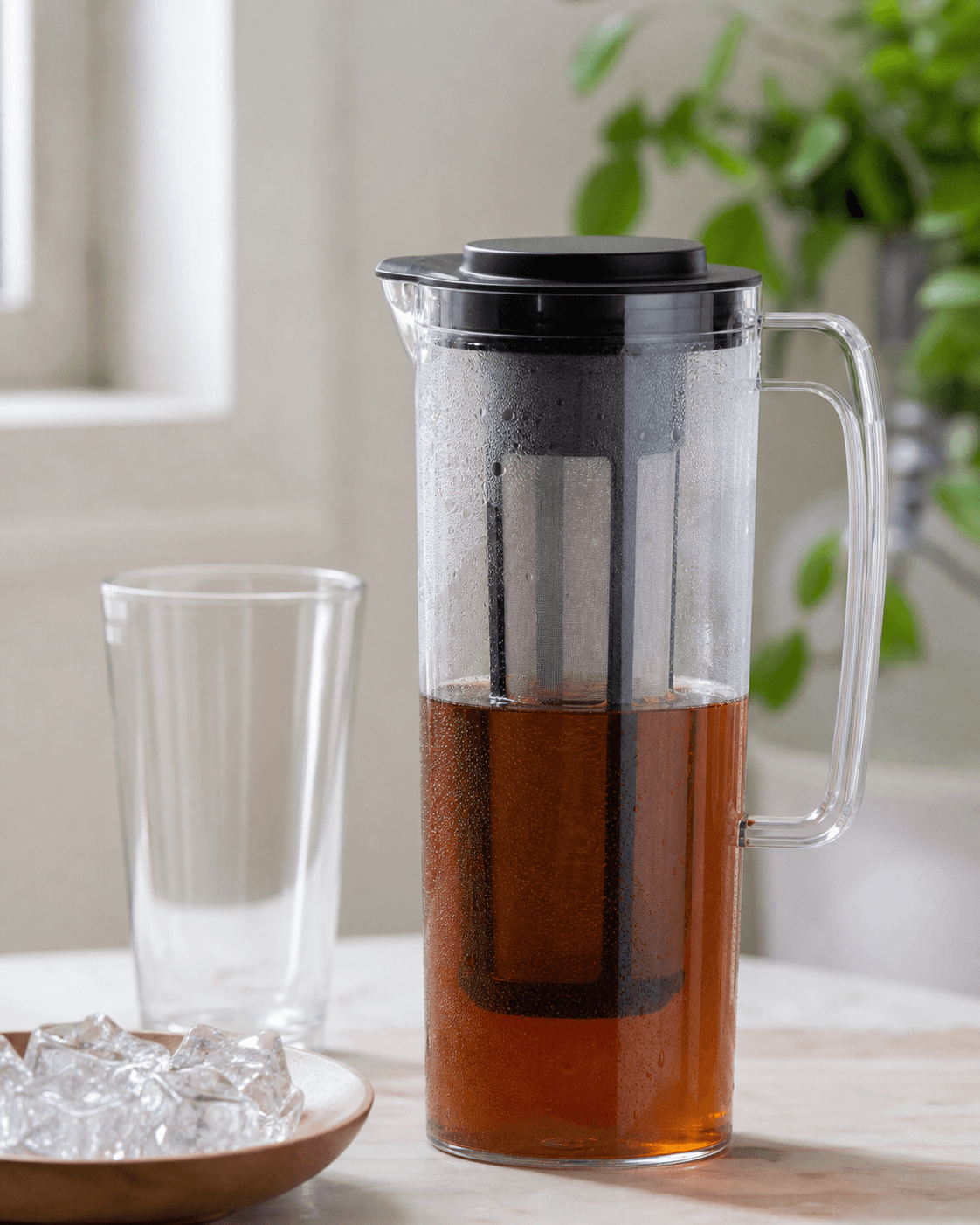
Twenty-two dollars gets you a plastic pitcher, a mesh filter insert, and a lid that actually seals. That's it. No felt to maintain, no glass to worry about, no rainmaker disc to disassemble. I've had one of these rattling around a camp kitchen box for longer than I'd like to admit, and it's survived being packed wrong, left in a hot car, and run through a dishwasher more times than the manual probably recommends. It still works exactly the same as day one.
That durability-through-simplicity is the whole story with the Takeya. It's not the best cold brew maker in this roundup on brew quality — the mesh filter lets more fine sediment through than felt does, full stop. But it's the one with the least to go wrong, and for most people starting out or just wanting cold brew without ceremony, that trade is the right one.
Who it's for — and who should skip it
This is the pick for someone who wants to try making cold brew at home without committing real money or counter space to it — a college kid, someone testing whether they even like cold brew before buying something nicer, or anyone who just wants coffee in the fridge without turning it into a project. It's also genuinely good for camping or a small apartment kitchen, since the airtight lid means you can toss it in a cooler without leaking.
Skip it if sediment bothers you — if you've had cleaner cold brew before and noticed the grit at the bottom of your glass, you'll notice it here too, more than with a felt-filtered system. Skip it also if you're brewing for more than two regular drinkers; the standard 1-quart size runs out fast, though the 2-quart Deluxe version helps if you go that route instead.
Build & materials
The pitcher is Tritan plastic — BPA-free, dishwasher safe, and reasonably resistant to staining and retaining coffee smell compared to cheaper plastics, though it will pick up some tint over months of heavy use like most light-colored plastic pitchers do. The handle is silicone-wrapped, which sounds like a small detail but matters once the pitcher's full and cold and you're lifting it one-handed out of the fridge — no cold, slippery bare plastic to worry about.
The filter is a fine-mesh basket, not fabric. It threads or clicks into the lid assembly and sits down in the grounds during the steep. Compared to felt, mesh is faster to clean and doesn't need special storage between uses, but it's mechanically incapable of catching particles as small as felt does — that's just physics, not a manufacturing shortcut.
Core performance
Brew quality with a mesh filter
Mesh does a fine job with the big stuff — you won't get chunks of grounds in your glass — but fine coffee particles slip through in a way felt simply blocks. In practice, that shows up as a light grit at the bottom of the last pour or two from a batch, and a marginally heavier, slightly more bitter mouthfeel compared to felt-filtered concentrate, since those fine particles keep extracting slowly even after the "official" steep time ends. It's not a dramatic difference for casual drinkers. For someone who's used to pour-over clarity, it's noticeable.
Concentrate strength and dilution
Standard steep ratio produces a strong concentrate meant to be cut roughly 1:1 to 1:2 with water or milk, in line with most immersion cold brew. Because the batch is smaller than a Toddy-style system, you'll get through it faster — which, depending on your habits, is either a mild inconvenience or just means fresher coffee since it's never sitting in the fridge for two weeks.
Capacity for real households
The 1-quart standard version yields roughly 3 to 4 servings once diluted — enough for one regular drinker to get through several days, tight for two people drinking daily. The 2-quart Deluxe roughly doubles that, closing a lot of the gap with the OXO and getting into "reasonable for a couple" territory, at a price that's still well under either of the other two makers here.
Daily use, maintenance & cleanup
This is where the Takeya wins outright. Add coarse grounds, add water, seal the airtight lid, put it in the fridge, wait 12 to 24 hours, unscrew the filter basket, pour. Cleanup is a rinse under the tap or a trip through the dishwasher — no felt to freeze, no multi-piece disassembly, no glass to baby. If you've ever put off making cold brew because the cleanup routine felt like a chore, this removes basically all the friction.
How it compares
Against the Toddy Cold Brew System, Takeya loses on filtration clarity and total batch size but wins decisively on price and cleanup simplicity — no felt maintenance routine, no bulky two-container setup to store. Against the OXO Cold Brew Coffee Maker, it's a similar story: OXO looks better on a counter and filters cleaner thanks to its dual-stage system, but costs more than double and involves more parts to clean. If your priority is minimum cost and minimum hassle, Takeya is the clear answer of the three.
Value
At around $20 to $25, this is difficult to beat as an entry point. You're not getting the cleanest cup in the category, but you're getting a functional, durable, low-maintenance cold brew maker for less than a bag of specialty beans costs at some roasters. For anyone unsure whether they'll stick with home cold brew, this is the low-risk way to find out.
Known issues
The most common complaint across owners is sediment in the final pours, which tracks with the inherent limits of a mesh filter — not a manufacturing defect, just the nature of the filtration method. A smaller number of people report the plastic picking up a coffee tint or faint smell after many months of heavy use, which a thorough occasional deep-clean with baking soda mostly resolves.
Verdict
The Takeya doesn't try to be the best cold brew maker you can buy — it tries to be the easiest one to live with, and it succeeds. Less clarity than felt-filtered concentrate, smaller standard capacity than a big batch system, but the lowest price and the least maintenance by a wide margin. For most people asking "should I get into home cold brew," this is still the right first purchase.
What we like
- Genuinely cheap for what it does — the budget entry point into cold brew that actually works
- Airtight lid keeps the fridge from smelling like a coffee shop
- Dishwasher-safe parts and minimal cleanup routine
What we don't
- Mesh filter lets more fine sediment through than a felt-based system
- Plastic pitcher looks and feels like what it costs
- Smaller standard size means frequent rebrewing for heavy drinkers
Specifications
| Type | Immersion |
|---|---|
| Capacity | 1 qt standard |
| Filter type | Fine-mesh reusable filter |
| Material | BPA-free Tritan plastic |
| Warranty | Unknown |
Frequently asked questions
Does the Takeya Cold Brew Maker come in different sizes?
Yes — the standard pitcher holds 1 quart, and Takeya sells a 2-quart Deluxe version for people who go through concentrate faster. The larger one costs a bit more but still lands well under what a glass or two-container system runs.
How gritty is the coffee from a mesh filter compared to a paper or felt one?
Noticeably grittier than felt, especially in the last pour or two from the pitcher where fine particles settle. It's not sludge, but if you've used a Toddy or a paper-filtered pour-over cold brew before, you'll feel the difference on your tongue.
Can I put coarser or finer grounds in the Takeya without a problem?
Coarse grounds work best — anything close to a French press grind. Finer grounds will clog the mesh filter faster and push more sediment through into your glass, which defeats a lot of the point of the fine-mesh design.
How long does Takeya cold brew concentrate stay good?
About one to two weeks in the fridge with the lid sealed. The airtight lid is doing real work here — it's part of why this stays fresher longer than an open-top pitcher would.