Researched
Toddy Cold Brew System Review: The Felt-Filter Original Still Holds Up
The Toddy is the reason cold brew concentrate is a category at all. It's not pretty and it won't live on your counter, but it makes more clean-tasting concentrate per batch than anything else near this price.
On this page
The short version
I've made cold brew in a mason jar with a paint strainer bag, in a French press left in the fridge overnight, and in three different countertop machines that cost five times what the Toddy does. None of them made concentrate this clean. That's the whole pitch here — the Toddy isn't fast, isn't attractive, and isn't going to impress anyone who walks into your kitchen. It just makes a genuinely large batch of low-acid, low-sediment concentrate with a filter design that's barely changed since the 1960s because nobody's found a real reason to change it.
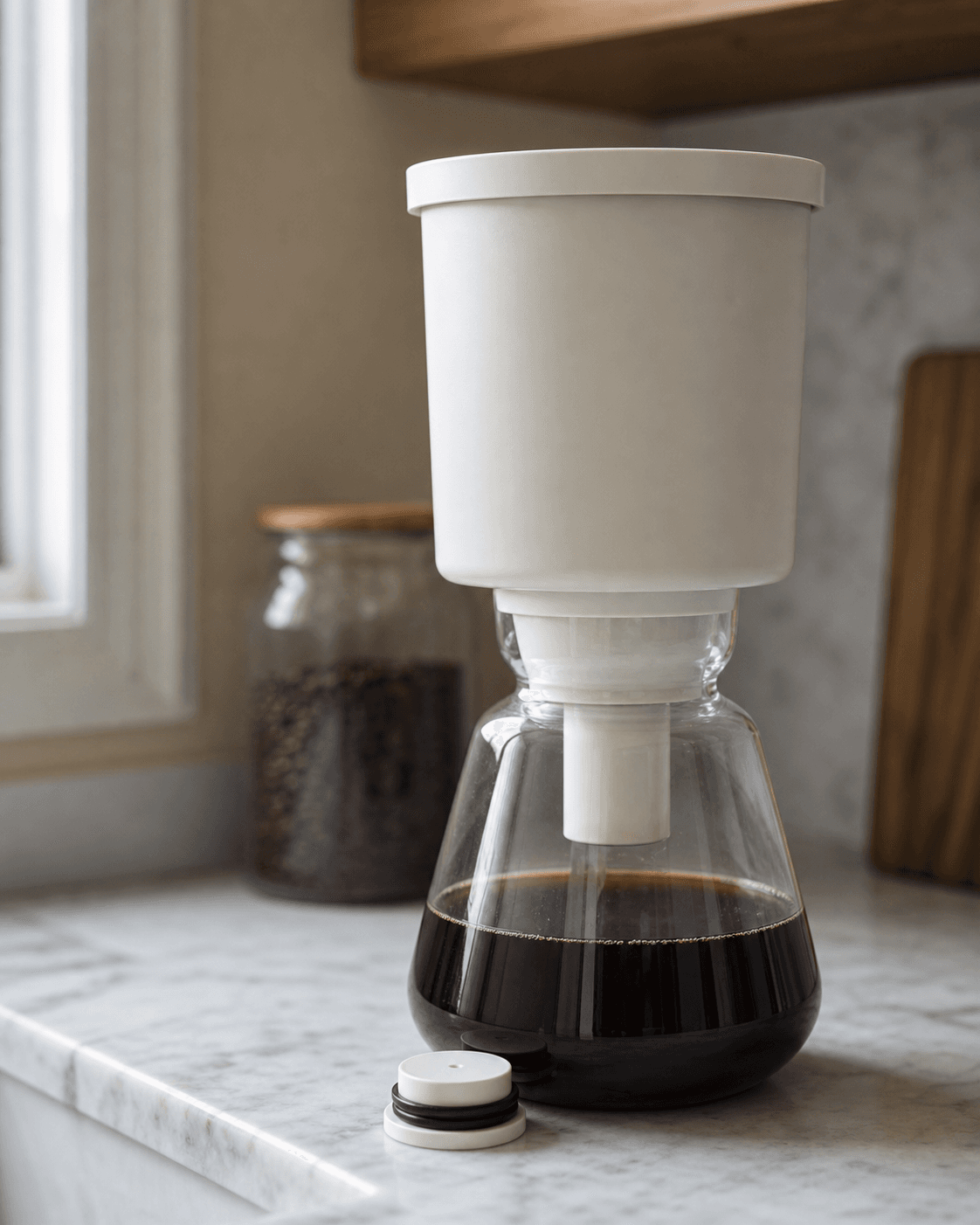
If you've never used one: it's two plastic containers. The top one holds coarse grounds and water, sits on a rubber stopper, and drains through a reusable felt filter into the decanter below when you pull the plug. No pump, no power cord, no app. You dump grounds in at night, pull the stopper the next morning, and you've got concentrate.
Who it's for — and who should skip it
This is built for people who drink cold brew often enough that batching matters — a household of two or three coffee drinkers, someone who brings iced coffee to the office all week, or anyone tired of running out by Wednesday. If you're making a big Sunday batch and drinking off it through Friday, the math works in your favor: one bag of beans, one session of cleanup, five to seven days of ready coffee.
Skip it if you live alone and drink coffee occasionally, or if counter space is tight and you don't have a spot to tuck this away between brews — it's not something you leave out. Skip it too if you want fast turnaround; steep time runs 12 to 24 hours, and there's no shortcut version. If you want something you can start after dinner and drink by morning without planning ahead, a smaller pitcher-style brewer with a shorter, more forgiving window fits better.
Build & materials
The brewing container and decanter are both BPA-free plastic — no glass here, which some buyers hold against it, but it's also the reason you can drop this in a cabinet without worrying about a crack. The rubber stopper is the one part that genuinely wears: it sits wet for hours at a stretch and after a year or two of regular use it starts to lose its seal, leaking slowly instead of holding tight until you pull it. Replacement stoppers are sold separately and cheap, so it's not a dealbreaker, just something to expect.
The felt filter is the heart of the system and it's a real fabric filter, not a mesh screen dressed up as one. It traps fine coffee particles that a mesh basket lets straight through, which is the single biggest reason Toddy concentrate pours out cleaner than what you get from a Takeya or similar pitcher-style brewer. The tradeoff is that felt needs care — more on that below.
Core performance
Brew quality and clarity
This is where the felt filter earns its reputation. Grounds steep in the top chamber for 12–24 hours, and when you pull the stopper, everything drains through felt before it reaches the decanter. The result is concentrate with almost no visible grit — pour it into a glass and hold it to the light, and it looks more like dark tea than muddy coffee. Compare that to a mesh-filtered pitcher brewer and you'll see the difference by the second glass; mesh lets enough fines through that you get a slight silty texture, especially in the last pour from the pitcher. Felt just doesn't.
Flavor-wise, the long cold steep produces the same low-acid, chocolate-forward profile you'd expect from any proper immersion cold brew — this isn't a filter-specific flavor, it's the process. What the felt buys you is a cleaner finish and less bitterness from fine sediment sitting in your glass slowly over-extracting as it warms up.
Concentrate strength and dilution
The default steep ratio (Toddy recommends roughly 12 ounces of coarse grounds to 9 cups of water) produces a strong concentrate meant to be cut, typically 1:1 with water for iced coffee or a bit more diluted for milk drinks. That's worth knowing going in — straight from the decanter it's noticeably stronger than brewed coffee, closer to what you'd use as a base for a latte than something you'd drink undiluted. New users sometimes taste it straight, find it overwhelming, and assume something went wrong. Nothing did — dilute it and it settles into a normal cup.
Capacity for real households
2.5 quarts of grounds and water in, about 1.5 quarts of concentrate out. Diluted 1:1, that's close to three quarts of drinkable coffee — realistically 10 to 12 servings depending on glass size. For a two-person household drinking a glass or two a day each, one batch covers most of a week. That's the Toddy's real advantage over smaller pitcher brewers: you brew once and mostly forget about it until the concentrate runs low, instead of restarting a steep every two or three days.
Daily use, maintenance & cleanup
Setup is genuinely simple — coarse grounds in, water in, stopper in, wait. Where it gets less convenient is the felt filter's upkeep. After each brew, it needs a rinse under cold water to clear out trapped grounds, and Toddy's own guidance is to store it in the freezer between uses so it doesn't develop mold or pick up off-flavors. That's an extra step most cold brew makers don't ask of you, and it's the main reason this scores lower on cleanup than on brew quality. Skip the freezer step a few times and you'll notice — the filter starts smelling like old coffee, and that smell transfers to your next batch.
The plastic containers themselves are easy — rinse and go, dishwasher-safe on the top rack. It's specifically the felt that adds friction to the routine. If you're the kind of person who's diligent about small maintenance habits, it's a non-issue after the first couple of batches become routine. If you're not, budget for buying replacement felt filters more often than you'd like.
How it compares
Against the OXO Cold Brew Coffee Maker, the Toddy wins on batch size — the OXO's glass carafe holds meaningfully less concentrate — but loses on countertop presence; the OXO's carafe is designed to sit out, the Toddy is designed to be put away. Against the Takeya Cold Brew Maker, the difference is almost entirely about filtration and price: Takeya is a third of the cost and uses a mesh filter that's faster to clean but lets more sediment through. If clarity matters more to you than convenience, Toddy wins that trade every time. If you just want cold coffee with minimal fuss and don't mind a bit of grit, Takeya's simplicity is hard to argue with.
Value
At around $40, this isn't the cheapest way into cold brew, but per ounce of clean concentrate it's genuinely competitive — you're not paying for electronics, a pump, or a design refresh, you're paying for a filter system that's been refined by decades of nobody needing to change it. The real cost consideration is felt filter replacements over time, which add up slowly but aren't dramatic. For anyone drinking cold brew regularly enough to notice sediment in their glass, this pays for itself in the first few batches just by making that problem go away.
Known issues
The most common complaint, across owner reviews and forums, is the same one I'd flag myself — the rubber stopper wearing out and starting to leak before it should. It's a cheap fix but an annoying one to discover mid-brew. The second most common gripe is the felt filter's maintenance routine; people who buy this expecting a "set it and forget it" appliance are sometimes surprised there's a filter-care step at all. Neither issue is severe, but both are worth going in aware of.
Verdict
The Toddy earns its reputation the unglamorous way — by making a genuinely large batch of clean concentrate with a filter that actually filters. It loses points on cleanup because the felt filter asks more of you than a mesh basket does, and it's not something you'll want sitting out on the counter. But if you drink enough cold brew that batching matters and you care about what's in your glass, this is still the reference point everything else in the category gets measured against.
What we like
- Felt filter produces a noticeably cleaner, less gritty concentrate than mesh
- Large batch means you're not rebrewing every other day
- Dead simple design with almost nothing mechanical to fail
What we don't
- Felt filter needs rinsing and freezer storage between brews or it gets funky
- Bulky footprint that's hard to justify leaving on the counter
- Rubber stopper degrades over a year or two and eventually needs replacing
Specifications
| Type | Immersion |
|---|---|
| Capacity | 2.5 qt brewing container |
| Filter type | Reusable felt filter |
| Material | BPA-free plastic container and decanter |
| Warranty | Unknown |
Frequently asked questions
How much coffee does the Toddy Cold Brew System actually make?
One batch fills the 2.5-quart brewing container and yields roughly 1.5 quarts — about 48 ounces — of concentrate. Diluted 1:1 with water or milk, that's close to a dozen full mugs, which is why one brew can carry a household most of a week.
Do I need special filters for the Toddy?
The stock felt filter is reusable and does most of the work — Toddy also sells paper filters that go underneath it for extra clarity, and you can run paper alone in a pinch. Regular coffee filters don't fit the shape, so stick with what's made for the system.
How long does Toddy concentrate last in the fridge?
About two weeks, sometimes closer to three if your fridge runs cold and the container is sealed well. It doesn't go sour so much as it goes flat — you'll notice the flavor fading before it goes bad.
Can I use the Toddy for tea or cocktail infusions?
Yes, and a fair number of owners do. The felt filter handles loose tea and fruit-infused syrups fine — just expect to dedicate that filter to non-coffee use since felt holds onto flavor.