Researched
Timemore Black Mirror Basic 3 Review: The Espresso Scale That Skips the App
A no-nonsense coffee scale that nails the fundamentals — buy it if you want direct button control and a low profile under a portafilter, not a screen holding your hand through the pour.
On this page
The short version
Under $50, the Basic 3 does exactly two things well: it reads weight fast and accurately, and it gets out of the way physically so it fits under a portafilter without you rearranging your whole setup. It doesn't try to teach you how to brew. That's either exactly what you want or a reason to look elsewhere, and it's worth being honest about which one you are before buying.
Timemore built a name for itself with the original Black Mirror line, and the Basic 3 is the current entry point into it — a scale that trades the guided hand-holding of pricier rivals for speed, directness, and a genuinely low price.
Who it's for, who should skip it
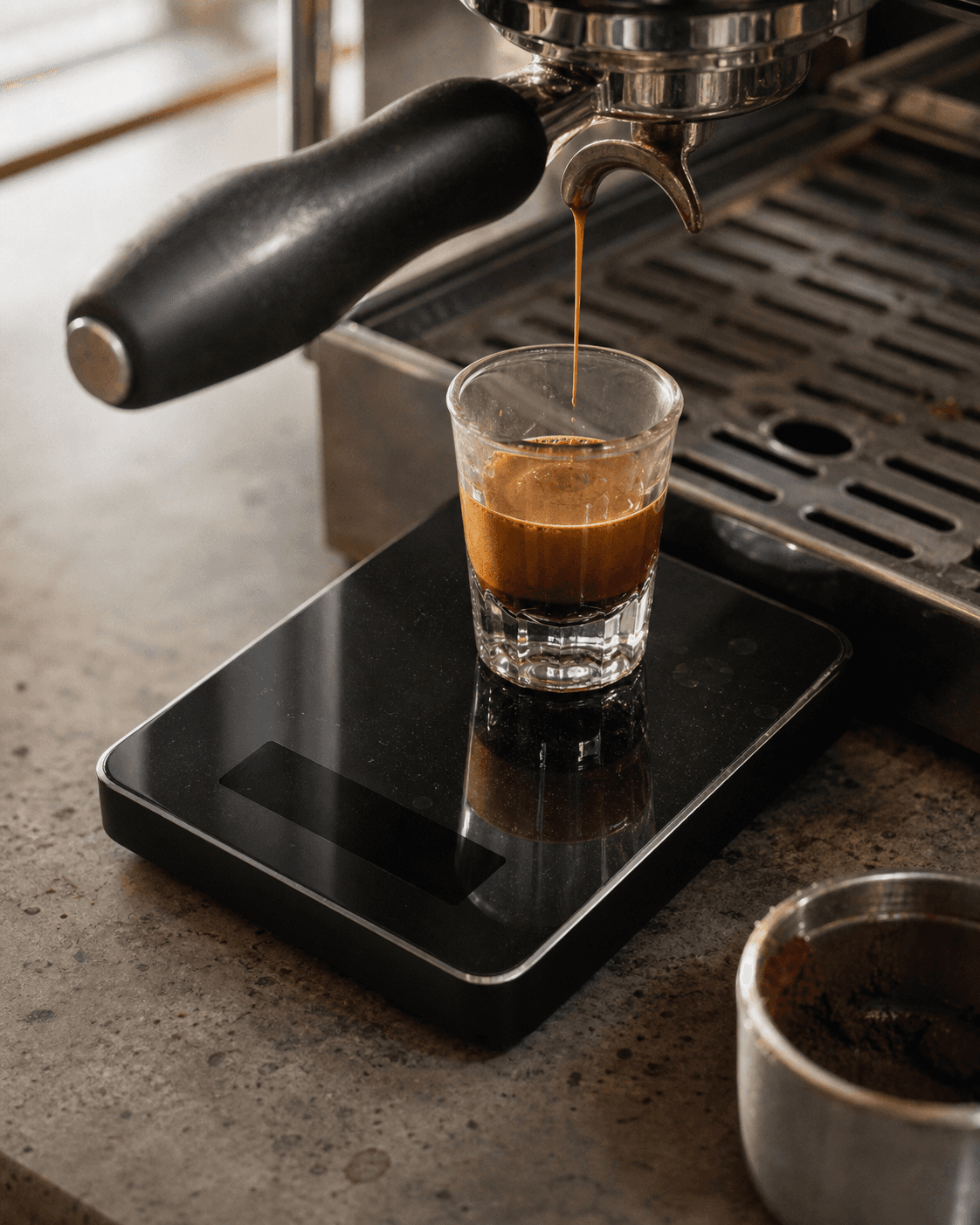
This is for people who already know their ratios and just need a fast, accurate number while they work — espresso dosing, pour-over timing you're managing yourself, or dialing in a new bag of beans by feel and weight together. It's also a solid pick if counter space or portafilter clearance is tight, since the low profile is a real, measurable advantage over bulkier scales.
Skip it if you're new to pour-over and want a screen that tells you when to bloom and when to pour next — that's not what this scale does, and you'll end up either guessing or running a timer app alongside it, which defeats some of the point.
Design and build
The mirrored glass top is the signature look of the whole Black Mirror line, and it photographs well, but day to day it's a fingerprint magnet — expect to wipe it down before most brewing sessions if you care about how it looks. Underneath, the body is a mix of metal and plastic that feels solid enough for countertop use without being showy about materials.
The genuinely useful design decision is the low overall height. A lot of coffee scales, especially ones with big displays, sit tall enough that a portafilter spout clears the rim of a cup but bumps into the scale's housing. The Basic 3's flatter profile avoids that problem, which matters more in daily use than most spec sheets let on.
Core performance
Weighing accuracy and resolution
At 0.1 gram graduation up to a 2000 gram max, the Basic 3 covers the full range a home coffee setup needs, from a 9-gram single-basket dose up to weighing full bags of beans. That resolution is standard for the category rather than exceptional, but it's exactly what espresso dosing requires — the difference between an 18.0 gram and 18.3 gram dose is visible and actionable.
Response speed
This is where the Basic 3 quietly earns its reputation. Refresh rate matters enormously for espresso, where a shot runs 25-35 seconds and you're watching the weight climb in real time to hit a target yield. A scale with laggy refresh either shows you old numbers or jumps in visible steps, both of which make it harder to stop the shot at the right moment. Owner reports consistently describe the Basic 3 as tracking a live pour smoothly, without the stutter some budget scales show.
Tare and unit switching
Tare is instant with a single button press, and switching between grams, ounces, and milliliters is equally direct — no menu diving, no long-press combinations to memorize. For a tool you're going to touch multiple times a day, that directness adds up.
Daily use and ergonomics
Because everything is a physical button, there's zero setup friction — no app to install, no Bluetooth pairing, no account. You place it, tare it, and go. The auto-off timer is adjustable, which matters because a scale that sleeps mid-pour is worse than useless; you want it to stay awake through your longest normal brew.
The small display is the one ergonomic trade-off worth calling out. It's legible, but it doesn't have the size or contrast of the larger screens on premium rivals, so if your eyesight or your kitchen lighting makes small numbers hard to read at a glance mid-pour, that's a real consideration.
Maintenance
There's very little to maintain — wipe the glass top after use, keep the USB-C port free of grounds and moisture, and recharge every couple of weeks depending on how often the auto-off feature is triggered. No batteries to replace, no removable parts to lose.
How it compares
Fellow Tally Pro is the natural comparison and the two scales represent genuinely different philosophies. The Tally Pro's guided screen walks a pour-over beginner through bloom and pour timing step by step, and its larger display is easier to read from a distance — but it costs roughly double and its bigger body doesn't tuck under an espresso portafilter nearly as cleanly. If you want guidance, pay for the Tally Pro. If you want speed and a low profile, the Basic 3 wins.
Acaia Lunar, a well-known premium espresso scale, plays in a similar low-profile space but at a significantly higher price, adding app connectivity and shot-tracking software. The Basic 3 gets you most of the practical, in-hand experience — fast readout, good clearance — without the software layer or its price tag, which is either a downgrade or an irrelevance depending on whether you actually use shot-tracking apps.
OXO 11-lb kitchen scale, a general-purpose kitchen scale rather than a coffee-specific one, is worth mentioning as a contrast: it's built for baking-scale ranges and coarser precision, not the sub-gram resolution and fast refresh espresso timing demands. The Basic 3 is the more specialized, more coffee-appropriate tool.
Value
At $40-50, the Basic 3 undercuts most dedicated coffee scales while still delivering the two things that actually matter for espresso and pour-over — accurate resolution and fast response. It's hard to find a better-performing scale for less money in this category; the features it skips (guided brewing, app connectivity) are the kind of thing you either don't need or can work around with a separate timer.
Known issues
The most consistent complaint in owner feedback is the small display being harder to read in dim kitchen lighting or from an angle, which tracks with the compact, low-profile design being a deliberate trade-off. A second recurring note is the mirrored surface picking up scratches over time if cleaned with anything abrasive — a soft cloth avoids this. A smaller number of owners wish the auto-off timer defaulted longer out of the box, though it is adjustable.
Verdict
The Basic 3 earns its strong performance and value scores (8 and 9) by doing the core job — fast, accurate weighing with a low profile — better than most scales at any price, let alone this one. Its lower features score (5) is an honest reflection of what it deliberately doesn't do: hold your hand through a brew. If you already know how to brew and just want a scale that gets out of your way, this is one of the best values in the category.
What we like
- Low profile clears most portafilters and drip stands without the neck of the scale getting in the way
- Physical buttons respond instantly — no app pairing, no lag, no firmware update gating basic function
- Genuinely fast refresh rate for espresso timing, where a half-second of lag actually matters
- Priced well below most "premium" coffee scales while covering the fundamentals competently
What we don't
- No screen-guided brewing routine — you're reading raw numbers and doing the timing judgment yourself
- Display is small and can be harder to read at a glance mid-pour compared to larger-screen rivals
- The mirrored glass top shows fingerprints and water spots constantly, and needs wiping down often
Specifications
| Max weight | 2000 g |
|---|---|
| Graduation | 0.1 g |
| Units | g / oz / ml |
| Tare | Yes |
| Power | USB-C rechargeable |
| Auto-off | Yes |
| Warranty | 1 yr |
Frequently asked questions
Does the Timemore Black Mirror Basic 3 fit under an espresso portafilter?
Yes — its low profile is one of its main selling points, and it clears most standard portafilters, including 58 mm commercial spouts, without the scale's body getting in the way.
Does the Basic 3 have a guided brewing mode like the Fellow Tally Pro?
No — it's a straightforward weight-and-timer scale with physical buttons, not a screen-guided pour-over assistant, so you're responsible for your own timing and technique.
How accurate is the Timemore Black Mirror Basic 3?
It reads to 0.1 gram graduation, which is standard resolution for espresso dosing and precise enough for dialing in ratios down to a tenth of a gram.
Is the Basic 3 rechargeable or does it use batteries?
It charges over USB-C, so there are no disposable batteries to replace — just plug it in periodically like a phone.