Best Cookware Sets (2026)
A cookware set isn't one purchase — it's a bet on a cooking philosophy. Tri-ply stainless, hard-anodized nonstick, and cast iron all solve the same basic problem (getting heat into food evenly) in completely different ways, with different maintenance demands and different lifespans. The "best" set depends entirely on which of those trade-offs fits how you actually cook, not on which brand name is stamped on the handle.
We're recommending across four distinct situations rather than crowning one universal winner, because the honest answer to "what's the best cookware set" changes depending on your budget, your cooktop, and whether you're the kind of cook who babies a pan or the kind who just wants something that survives daily use without a lot of thought.
Our top picks
 Best Overall ValueTramontina Tri-Ply Clad 12-Piece Set
Excellent
Our score: 80 / 100
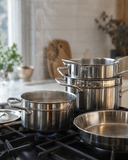 Best Splurge / Buy-It-For-LifeAll-Clad D3 10-Piece Set
Excellent
Our score: 85 / 100
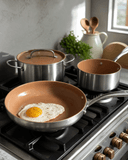 Best PFAS-Free NonstickGreenPan Valencia Pro 11-Piece Set
Good
Our score: 70 / 100
 Best for Small KitchensCalphalon Premier Space-Saving 10-Piece Set
Good
Our score: 75 / 100
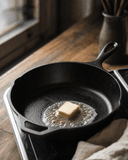 Best Specialty / Single-Pan PickLodge Cast Iron Skillet
Excellent
Our score: 84 / 100
Tramontina Tri-Ply Clad 12-Piece Set
Excellent
Our score: 80 / 100
Genuine base-to-rim tri-ply construction — the same core engineering that makes All-Clad worth buying — at a fraction of the price, primarily through Costco. Independent testing has repeatedly found its stovetop heat performance close to indistinguishable from far pricier competitors. This is the set we point most people toward first.
All-Clad D3 10-Piece Set
Excellent
Our score: 85 / 100
If you cook nightly and think in decades rather than years, All-Clad's handle durability, exterior finish, and repair program justify the premium. The heat performance gap over cheaper tri-ply sets is real but small — you're mainly paying for longevity and polish.
GreenPan Valencia Pro 11-Piece Set
Good
Our score: 70 / 100
Genuinely PFAS-free ceramic coating and rare induction compatibility for a nonstick set, with excellent out-of-the-box release. The coating won't last as long as Teflon-based nonstick, so budget for replacing the most-used pieces sooner.
Calphalon Premier Space-Saving 10-Piece Set
Good
Our score: 75 / 100
Nesting pans and stacking lids genuinely cut cabinet footprint by roughly a third, with solid dual-layer nonstick performance. Not induction compatible, so check your cooktop before buying — but a smart pick for anyone tight on storage.
Lodge Cast Iron Skillet
Excellent
Our score: 84 / 100
Not a boxed set — a single flagship skillet, and worth including anyway because no set on this list sears or holds heat like properly seasoned cast iron. At around $25, it's the cheapest, most durable pan on this entire list, and a natural companion to any stainless or nonstick set rather than a replacement for one.
How we chose
We weighted real, verifiable heat performance over brand prestige — citing independent side-by-side testing where it exists, particularly around tri-ply heat distribution claims, rather than taking manufacturer marketing at face value. We also treated longevity and cost-per-year as a core value metric, not just sticker price, since a nonstick set that needs partial replacement in three years and a tri-ply set that lasts twenty aren't actually competing on the same axis. Finally, we picked for distinct situations — value, premium, PFAS-free, small-kitchen storage, and specialty cast iron — rather than ranking five similar sets against each other, since the honest best pick depends heavily on your cooktop, budget, and how much you already know about stainless technique.
What to look for
Tri-ply stainless vs. nonstick vs. cast iron — pick the philosophy first
These aren't competing products so much as different tools. Tri-ply stainless (All-Clad, Cuisinart, Tramontina) offers the longest lifespan, real searing and fond-building, and zero coating to wear out — at the cost of a real technique learning curve to avoid sticking. Nonstick (Calphalon, GreenPan) trades that learning curve for easy release and easy cleanup, at the cost of a finite coating lifespan and a hard ceiling on high-heat searing. Cast iron (Lodge) sits apart entirely — exceptional heat retention and a nonstick-like surface once seasoned, at the cost of weight and maintenance discipline. Most serious home cooks eventually own a mix rather than picking just one.
What "tri-ply" actually means, and why it's worth checking for
Tri-ply means an aluminum core is bonded between two layers of stainless steel across the entire pan — base and walls — not just clad onto the bottom as a disc. That's the detail that determines whether a "stainless steel" set actually heats evenly or scorches food near the edges. Cheaper disc-bottom sets skip this and market themselves with similar language, so check specifically for full clad construction before assuming two stainless sets are engineering-equivalent.
Induction compatibility is now a real filter, not a niche one
Induction cooktops need a magnetic base to work at all, and this rules out most hard-anodized nonstick cookware outright — Calphalon's set here is not induction compatible, while GreenPan's is, specifically because it builds in a magnetic stainless disc. All tri-ply stainless sets in this guide are induction compatible by default, since the steel exterior layer is naturally magnetic. If you have or are considering an induction range, confirm this spec before buying rather than assuming.
Piece count is a trap if you buy on it alone
A 12-piece set isn't automatically better than a 10-piece set — it often just means smaller, less useful pieces (a tiny saucepan, an extra lid you'll rarely use) padding the count for marketing purposes. Look at what sizes are actually included and whether they match what you cook, rather than optimizing for the highest number on the box.
Nonstick coating lifespan is a real, recurring cost
Budget for replacing nonstick pieces every 3-5 years with regular use, faster for ceramic coatings like GreenPan's than for reinforced Teflon-style coatings like Calphalon's. This recurring cost should factor into any honest price comparison against tri-ply stainless, which effectively never wears out the same way.
Handle and lid quality separate good sets from great ones at similar price
Two sets can share nearly identical core cooking performance and still feel completely different in daily use based on handle shape, rivet durability, and lid fit. This is where premium sets like All-Clad earn their keep over the long run, even when stovetop heat performance itself is close between competitors.
Frequently asked questions
Do I need a full cookware set, or should I buy pieces individually?
A set makes sense if you're furnishing a kitchen from scratch and want consistent construction across pieces — it's usually cheaper per-piece than buying individually. If you already own a few good pans, buying individual pieces to fill gaps (a stockpot, a second saucepan) is often the smarter move rather than duplicating what you have.
Is stainless steel or nonstick better for a first cookware set?
Stainless lasts far longer and handles searing better, but has a real learning curve to avoid sticking. Nonstick is easier to use well immediately but needs replacing every few years. Many experienced cooks end up with a stainless set plus one dedicated nonstick pan, rather than choosing one philosophy exclusively.
How much should I actually spend on a cookware set?
$200-350 covers genuinely good tri-ply stainless (Tramontina, Cuisinart) or premium nonstick (Calphalon, GreenPan) that will serve most households well. Spending $700-plus, as with All-Clad, buys meaningfully better long-term durability and finish, not a transformed cooking experience — worth it mainly if you're planning to own the set for decades.
Is cast iron worth adding to a modern cookware set?
Yes, as a complement rather than a replacement — a cast iron skillet like Lodge's holds heat and sears in a way no stainless or nonstick pan quite matches, for around $25, and will outlast everything else in your kitchen with basic care.
What's the real difference between a $200 set and a $700 set?
At the construction level, less than the price gap suggests — both can be genuine tri-ply stainless with even heat distribution. The $700 set typically wins on handle rivet longevity, exterior finish holding up over 15-20 years, and a more established repair or replacement program, not on how food cooks on day one.