Breville Smart Kettle vs Bonavita 1.7L Variable Temperature Kettle
Buy the Breville Smart Kettle if…
You want the most polished, feature-complete variable-temperature kettle here — custom-degree entry, a keep-warm mode with selectable duration, and design touches like a soft-open lid and lit water window — and don't mind paying $30-40 more for them.
Buy the Bonavita 1.7L Variable Temperature Kettle if…
You want the same core single-degree temperature precision and fast heating for less money, and you're fine skipping keep-warm entirely and living with a more basic plastic handle and lid.
Side by side
| Specification | 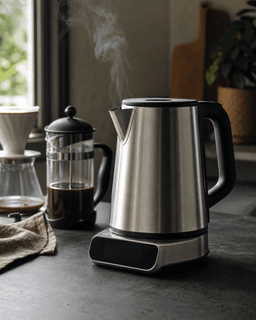 | 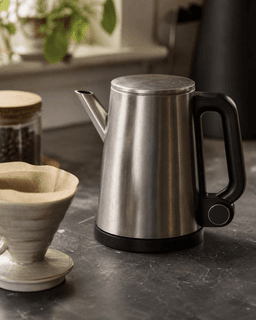 |
|---|---|---|
| Our score | 81Best | 74 |
| Capacity | 1.7 L / 57.6 ozBest | 1.7 L / 57 ozBest |
| Material | Brushed stainless steel | Stainless steel body |
| Temperature control | Yes — precise digital | Yes — variable |
| Gooseneck | No — wide pour spout | No — standard wide spout |
| Keep-warm | Yes — selectable duration | No |
| Wattage | 1500 W | 1500 W |
| Warranty | 1 yr | 1 yr |
Two kettles solving almost the same problem, with one meaningful gap between them
Put the Breville Smart Kettle and the Bonavita 1.7L Variable Temperature Kettle side by side and the differences aren't dramatic — both are non-gooseneck, variable-temperature kettles aimed at buyers who care about hitting a specific number rather than just boiling. The gap that actually separates them is narrower than the price difference suggests, and it comes down to one feature Bonavita skips entirely, plus a general step up in interface polish on the Breville.
At a glance — where they actually differ
Both kettles hold a set temperature accurately enough that back-to-back cups taste consistent, and both heat a full 1.7-liter load in roughly the same four and a half to five minutes. Where they split: the Breville has a keep-warm mode with selectable duration; the Bonavita has none at all. The Breville uses a dial-plus-LCD interface with a soft-open lid and an illuminated water window; the Bonavita uses simple up/down buttons and a plainer digital readout, with a plastic handle and lid that feel a notch below Breville's fit and finish. And the Breville costs roughly $30-40 more.
Precision — closer than the price gap suggests
Both kettles let you dial in a specific target rather than rounding to a preset, and both hold reasonably close to that number at the point of shutoff — this is genuinely not where the price difference is earned. If your only criterion is "can I set an exact temperature and trust it," either kettle answers yes. The meaningful precision question is really about what happens after you hit that temperature, which is where keep-warm comes in.
Keep-warm — the one feature that actually separates them
This is the real story of the comparison. The Breville's keep-warm mode actively cycles the heating element to hold your target temperature for a duration you select, which matters any time there's a gap between the kettle clicking off and you actually pouring — a French press bloom timer, a distraction, a second cup poured a few minutes after the first. The Bonavita has no equivalent; once it shuts off, the water starts cooling immediately on its own curve, and there's no way to hold it. If your routine regularly has that gap, the Breville's premium buys something you'll use constantly. If you pour the moment the kettle clicks off, every time, this difference simply doesn't apply to you.
Build and design — polish vs. plainness
The Breville feels like the more finished product day to day — a soft-open lid that pops with a button press instead of needing to be pried, an illuminated water window that's genuinely easier to read while filling in a dim kitchen, and a control dial that sits at handle height rather than the base. The Bonavita's stainless body looks similarly nice on a shelf, but the plastic handle and lid, along with the simpler button interface, read as a more utilitarian design overall — functional, not fussed over. Neither is poorly built, but the Breville's extra attention to small daily-use details is real and noticeable within the first week of ownership.
Spout design — neither is built for pour-over
It's worth being clear that neither kettle has a gooseneck spout. Both pour water in a confident, wide stream suited to filling a mug or a French press carafe, and neither offers the slow, thin, controllable stream that pour-over technique wants for an even bloom and pour. Buyers coming from a pour-over-focused mindset sometimes assume the more expensive or more "coffee-branded" option (often the Bonavita, given its popularity with coffee enthusiasts) must have a gooseneck — it doesn't, and neither does the Breville. If a gooseneck spout is genuinely important to you, look outside this comparison entirely, toward something like the Fellow Stagg EKG.
Price and value
At around $120-130, the Breville positions itself against premium alternatives like the Fellow Stagg EKG rather than against budget kettles, and the comparison holds up reasonably well given the feature set. The Bonavita, at roughly $70-90, undercuts it by a meaningful margin while keeping the core temperature precision intact — you're specifically giving up keep-warm and some interface polish to get there, not giving up accuracy.
Which should you buy
Buy the Breville Smart Kettle if you'll actually use keep-warm regularly, and if small daily-use touches — a soft-open lid, a lit water window, a more refined interface — are worth $30-40 to you over a kettle that does the core job just as accurately. Buy the Bonavita 1.7L Variable Temperature Kettle if you want the same real, single-degree temperature precision for meaningfully less money, you always pour right when the kettle clicks off anyway, and you don't mind a plainer, more utilitarian design in exchange for the savings.
Frequently asked questions
Are the Breville Smart Kettle and Bonavita 1.7L Variable Temperature Kettle actually that different, or mostly the same kettle at different prices?
They're closer than most kettle comparisons — both are variable-temperature, non-gooseneck kettles with single-degree-adjacent precision. The real differences are keep-warm (Breville has it, Bonavita doesn't) and interface polish (Breville's dial and lit window versus Bonavita's simpler digital buttons), not raw temperature accuracy.
Which one heats water faster?
They're close — both reach a full boil for a 1.7-liter load in around four and a half to five minutes at 1500 watts. Neither has a meaningful speed advantage over the other; the differentiation is in what happens with the temperature control, not raw heating time.
Does either of these have a gooseneck spout for pour-over?
No — both use a standard, wider spout built for filling a mug or French press rather than a slow, controlled pour-over stream. If a gooseneck spout is a hard requirement, neither of these is the right pick; the Fellow Stagg EKG is the gooseneck option in this category.
Is the Breville's extra cost actually justified by its features?
It depends on whether you'll use keep-warm regularly. If there's often a gap between the water reaching temperature and you pouring it — waiting on a French press timer, getting distracted mid-morning — the Breville's ability to hold that temperature is a real, felt benefit. If you pour immediately every time, that feature goes unused and the Bonavita gets you the same core precision for less.