KitchenAid 9-Cup Food Processor vs Cuisinart 14-Cup Food Processor
Buy the KitchenAid 9-Cup Food Processor if…
Buy if you slice vegetables often and want dial-adjustable thickness, a stainless bowl, and a smaller footprint — and you don't need to process in large batches.
Buy the Cuisinart 14-Cup Food Processor if…
Buy if you cook in volume — batch dough, big vegetable prep, large-batch sauces — and want more motor power and a three-year warranty for a similar price.
Side by side
| Specification | 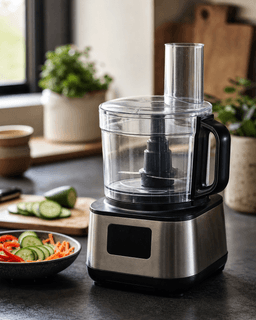 | 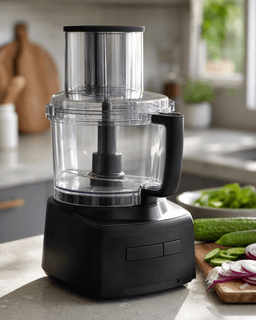 |
|---|---|---|
| Our score | 72 | 75Best |
| Bowl capacity (cups) | 9 | 14 |
| Motor power (W) | 300 | 720 |
| Blades/discs | Multipurpose stainless blade, dough blade, reversible ExactSlice adjustable slicing disc, reversible shredding disc | Stainless chopping blade, reversible slicing/shredding disc, dough blade |
| Feed tube | Wide feed tube with built-in ExactSlice thickness dial on the pusher | Large + small feed tube with pushers |
| Speeds | 2 speeds + pulse | 2 speeds + pulse |
| Dishwasher safe | Yes (bowl, lid, blades, discs — top rack) | Yes (bowl, lid, blades — top rack) |
| Warranty (yr) | 1 | 3 |
At a glance
These two sit at almost the same price — $150-180 for the KitchenAid, $180-220 for the Cuisinart — but they're solving different problems. The KitchenAid is built around precision: a stainless bowl, a die-cast base, and a slicing disc with a dial for exact thickness. The Cuisinart is built around capacity and raw power: a bowl 5 cups bigger, a motor more than twice as strong, and a three-year warranty that says more about the brand's confidence than any spec sheet does.
Where they differ
Capacity and who it's built for
The Cuisinart's 14-cup bowl handles genuine batch cooking — a full recipe of pie dough, a whole cabbage for slaw, pesto by the batch to freeze — without needing a second run. The KitchenAid's 9-cup bowl is sized for a smaller household or lighter, more frequent use; fill it with a quantity meant for a 14-cup bowl and small ingredients get lost and unevenly processed. Neither size is objectively better — it depends entirely on how much you actually cook at once.
Motor power
720 watts against 300 is the single biggest functional gap between these two. On everyday jobs — chopping an onion, shredding cheese, a quick pesto — the difference barely registers. On dense bread dough, hard root vegetables, or nut butter, the Cuisinart keeps a consistent speed while the KitchenAid audibly slows and sometimes needs the load broken into smaller batches to avoid straining the motor.
Slicing precision
This is the category where the KitchenAid pulls ahead. The ExactSlice system puts a thickness dial right on the pusher, so you adjust cut thickness before feeding food through rather than swapping to a different disc. The Cuisinart's reversible disc gives you two fixed thicknesses — perfectly fine for most home cooking, but a real limitation if you slice often and want, say, a specific gratin thickness without eyeballing it.
Build materials and long-term durability
The KitchenAid's stainless steel bowl won't stain from turmeric or beet juice the way the Cuisinart's tinted plastic bowl can over years of use, and its die-cast base is comparably solid. But the Cuisinart backs its plastic bowl with a three-year warranty against the KitchenAid's one — a meaningful gap in how long each brand is willing to stand behind the motor and mechanism specifically, even if the bowl material favors KitchenAid.
Feed tube and prep convenience
The Cuisinart has a large-plus-small nested feed tube setup that fits more without pre-cutting; the KitchenAid's feed tube is standard-width but paired with the ExactSlice dial on the pusher, which is a different kind of convenience — less about fitting large pieces, more about not needing to swap discs mid-task.
Price and what you're actually paying for
At nearly the same price, the practical question is what you value more: the Cuisinart's extra 5 cups of capacity and more than double the motor power, or the KitchenAid's precision slicing and stainless bowl in a smaller footprint. Neither is the objectively better buy — they're priced closely because they're each strong at a different thing.
Which should you buy
If your kitchen work involves real batches — dough for a crowd, a full head of cabbage, freezer-batch sauces — the Cuisinart's capacity and motor power will get used regularly, and the three-year warranty is a genuine bonus for the same rough price. If your cooking is smaller-scale but slicing-heavy — potatoes, cucumbers, cabbage, cheese, done often and with an eye toward consistent thickness — the KitchenAid's ExactSlice system and stainless bowl are worth the trade-off in raw capacity and power. Neither one is a poor choice at this price; the right pick depends on which limitation you'd rather live with.
Frequently asked questions
Which one has the stronger motor?
The Cuisinart, by a wide margin — 720 watts against the KitchenAid's 300. That gap shows up specifically on dense dough and hard vegetables, not on everyday chopping and shredding, where both perform similarly.
Is 9 cups too small for a typical household?
For a household of one or two doing everyday chopping and the occasional dip or pesto batch, no — 9 cups is plenty. For batch cooking, meal prep, or a bigger family, the Cuisinart's 14-cup bowl fills a real need the KitchenAid can't.
Does the KitchenAid's ExactSlice disc beat the Cuisinart's slicing disc?
Yes, for precision — ExactSlice lets you dial in thickness on the fly, where the Cuisinart's reversible disc only offers two fixed thicknesses. If slicing consistency matters to you specifically, that's a real point in the KitchenAid's favor.
Which is the better long-term investment?
The Cuisinart, mainly because of its three-year warranty against the KitchenAid's one, plus a stronger motor that isn't being asked to work as hard on tough jobs — both signal it's built for a longer service life under real use.
Are they interchangeable for most kitchen tasks?
For light, everyday tasks — chopping, shredding, small dips — yes, both do the job well. Differences show up specifically on batch size and on dense or hard ingredients, where the Cuisinart pulls ahead.