Omega NC900 vs Hurom H200
Buy the Omega NC900 if…
You want the most versatile masticating juicer here — strong all-around yield, the longest warranty in the category, and real capability beyond juice through its mincing and pasta attachments.
Buy the Hurom H200 if…
Leafy greens and wheatgrass are a regular part of your juicing routine and you want the clearest, lowest-foam juice a masticating juicer can produce, in a compact footprint.
Side by side
| Specification | 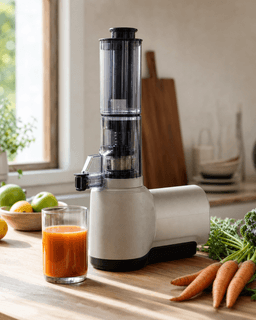 | 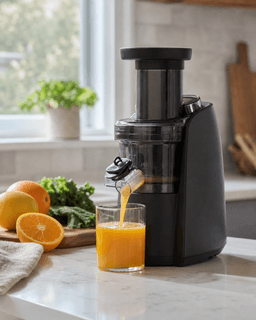 |
|---|---|---|
| Our score | 83Best | 77 |
| Type | Masticating (horizontal, dual-stage single auger) | Masticating (vertical slow-squeeze auger) |
| Motor power | 150W (low-speed, high-torque)Best | 150WBest |
| Feed chute | 1.5 in | 1.6 inBest |
| RPM | 80 | 43 |
| Yield | High — dual-stage auger presses produce twice per pass | High, especially on leafy greens and wheatgrass |
| Ease of cleaning | Moderate — 5 main parts, screen needs prompt rinsing | Moderate — strainer needs the included brush, fewer parts than a twin-gear press |
| Warranty | 15 yrBest | 10 yr motor / 2 yr parts |
At a glance
The Omega NC900 and Hurom H200 sit within a few dollars of each other, use the same basic mechanism — a slow-turning single auger instead of a spinning blade — and target the same buyer: someone who's already decided masticating juicing is the right format and is choosing between two of its best-known names. The differences that actually matter are narrower than the marketing suggests, but they're real.
The NC900 runs its auger horizontally at about 80 RPM with a dual-stage press, and backs it with a 15-year warranty and a genuine attachment ecosystem for mincing, pasta, and nut butter. The H200 runs vertically at a slower 43 RPM, specializing specifically in leafy-green yield and low-foam clarity, with no attachments beyond juicing.
Where they differ
Yield
Both are strong masticating performers, but they don't win in the same place. The NC900's dual-stage auger — produce gets pressed once, then pressed again through a tighter section — gives it a slight edge on dense produce like carrots, beets, and apples, where owners report noticeably drier pulp than from many single-stage designs. The H200's slower 43 RPM vertical squeeze, by contrast, tends to edge out the NC900 specifically on leafy greens and wheatgrass, extracting more juice from produce that's notoriously hard to juice efficiently at any speed.
Neither gap is dramatic. If your juicing is a genuine mix of hard produce and greens, either machine performs well; the choice comes down to which end of that spectrum you lean toward more often.
Noise
Both are quiet relative to any centrifugal juicer — this is the whole appeal of masticating juicing — but the H200's 43 RPM auger runs noticeably slower than the NC900's 80 RPM, and it's commonly reported as the quieter of the two. Neither will disturb a household the way a centrifugal juicer at 13,000 RPM would; this is a difference of degree within an already-quiet category, not a dealbreaker either direction.
Versatility
This is the clearest, least subtle difference between the two. The NC900 comes with — or supports — attachments for mincing garlic and herbs, extruding fresh pasta shapes, grinding coffee or nuts into butter, and processing baby food, all using the same auger-and-screen mechanism with a swapped attachment. The H200 does none of this; it's a dedicated juicer, full stop. If you want a single appliance that earns its counter space doing more than one job, the NC900 wins clearly. If you'll only ever juice with it, that versatility is capability you're paying for and not using.
Ease of cleaning
Both require disassembling several parts and hand-attention on the fine mesh screen or strainer, since neither is fully dishwasher-recommended for long-term care. The H200 includes a cleaning brush specifically sized for its strainer, which some owners find speeds up the process slightly. The NC900 has marginally more total parts to manage if you're using its attachments regularly, though juicing-only cleanup is roughly comparable between the two — both land around 5-8 minutes for a full wash if you rinse promptly after use.
Feed chute and prep time
Neither juicer is convenient here. The NC900's chute measures about 1.5 inches, the H200's about 1.6 inches — a difference too small to matter in practice. Both demand real precutting of anything bigger than a grape, and neither competes with wide-chute masticating juicers like the Kuvings B1700 on this specific point.
Warranty and build
The NC900's 15-year warranty is the standout figure in the entire juicer category, reflecting Omega's long track record of supporting older models with spare parts. The H200 offers a 10-year motor warranty paired with a shorter 2-year warranty on wear parts like the strainer — still solid, but a step below the NC900's headline number. Both use durable, purpose-engineered plastics for their augers and housings, built for years of regular use rather than light occasional juicing.
Which should you buy
Buy the Omega NC900 if you want the more well-rounded machine — solid yield across produce types, the best warranty in the category, and real extra capability if you'll actually use the mincing or pasta attachments. Buy the Hurom H200 if your juicing leans heavily on leafy greens and wheatgrass, you want the clearest, lowest-foam juice a masticating juicer can produce, and you don't need anything beyond juicing from the machine.
If you're still torn, the honest tiebreaker is this: do you see yourself using the pasta or mincing attachments even occasionally? If yes, the NC900's versatility justifies itself. If you know for certain this will only ever be a juicer, the H200's specific strength on greens and its smaller footprint make it the more focused tool for that one job.
Frequently asked questions
Are the Omega NC900 and Hurom H200 really that similar?
Mechanically, yes — both are single-auger masticating juicers within a few dollars of each other in price. The real differences are auger orientation, RPM, and what each is specifically built to do well.
Which one produces more juice?
It depends on the produce — the NC900's dual-stage press has a slight edge on dense produce like carrots and beets, while the H200's slower 43 RPM squeeze tends to edge it out on leafy greens and wheatgrass.
Which is quieter?
Both are quiet compared to any centrifugal juicer, but the H200 runs at a slower 43 RPM versus the NC900's 80 RPM, and owners commonly report it as the quieter of the two.
Can either of these do more than juice?
Only the NC900 — with its attachments it minces, extrudes pasta, and grinds nut butter. The H200 is a dedicated juicer with no additional attachments.
Which has the easier feed chute to work with?
Neither is generous by wide-chute standards — the NC900's 1.5-inch opening is marginally smaller than the H200's 1.6 inches, but both require real precutting of anything larger than a grape.