Researched
Wacaco Picopresso Review: The Portable Espresso Maker That Makes You Prove It
A genuinely capable pocket espresso maker that rewards good technique and punishes bad technique in equal measure — buy it if you already know what a good shot looks like and want that quality on the road.
On this page
The short version
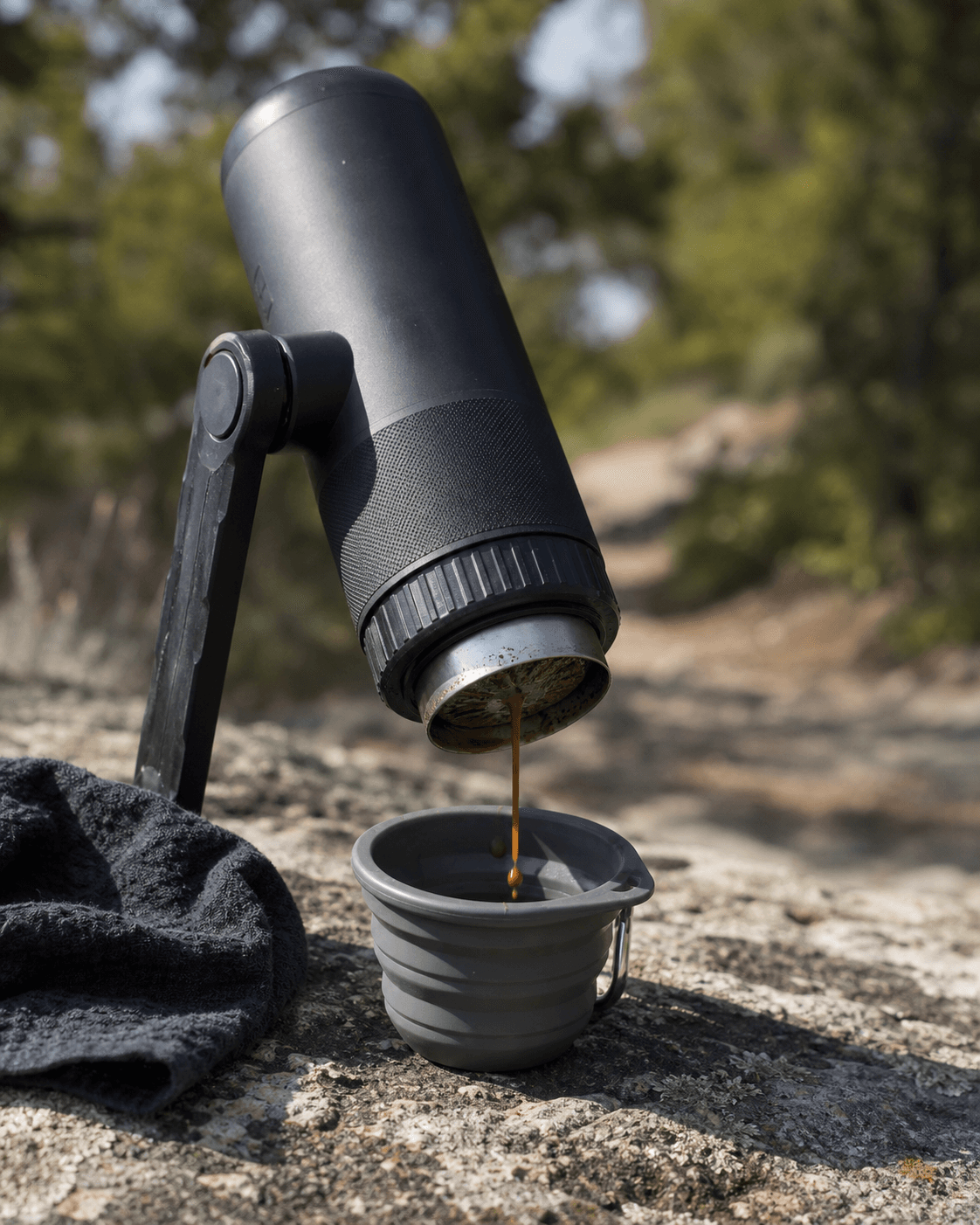
The first time I ran the Picopresso at a trailhead picnic table, the stream came out crooked and sputtering — thin on one side, gushing on the other. That's not a defect. That's the Picopresso doing exactly what it's designed to do: show you, in real time, that your tamp was off-center. Most portable espresso makers hide that information behind an opaque basket. This one puts it right in front of your face, which is either a feature or an insult depending on how confident you are in your technique.
Wacaco built its name on the Minipresso and Nanopresso — dead-simple, pump-and-go devices that make a passable shot with minimal fuss. The Picopresso sits a step up in that lineup: same manual-pump philosophy, same no-battery promise, but aimed at people who already care about extraction quality and want more control over it, not less. That's the trade Wacaco is making here — more capability, more demand on you.
Who it's for, who should skip it
This is for someone who already pulls decent shots at home and doesn't want to give that up when they travel, camp, or work somewhere without a proper machine. If you can tell the difference between a good 25-second pull and a sour 18-second one, you'll get real value out of the Picopresso's naked basket — you'll actually use the visual feedback to correct your next shot.
Skip it if you've never dialed in an espresso grind before, or if you just want caffeine with minimal ceremony. A Nanopresso, an AeroPress, or even instant espresso packets will get you there with a fraction of the fuss. The Picopresso isn't punishing for the sake of it, but it's not going to meet you halfway on bad technique the way a pod machine would.
Design and build
The body is mostly metal and hard plastic, and it feels dense for its size — 19.4 ounces isn't heavy in absolute terms, but it's heavier than you'd expect for something marketed as pocketable. It isn't pocket-pocketable in the literal sense; it lives in a bag's side pocket or a padded pouch, not a jacket. The pump lever has a satisfying, slightly stiff resistance that loosens up after the first dozen uses.
The naked-basket design is the headline feature and it's not a gimmick. Instead of a closed spout that hides the puck, you're looking at an open basket where the shot pours directly out the bottom, fully visible. Baristas use naked portafilters on full-size machines for exactly this reason — it's diagnostic. A centered, syrupy stream means even extraction. A stream that jets out one side, sprays, or channels through a crack means the puck was tamped unevenly or the grind was inconsistent. On a $150 travel device, that's a surprisingly serious piece of equipment.
Core performance
Grind and tamp demands
The Picopresso wants a genuine espresso-fine grind — not "a little finer than drip," but the kind of grind that clumps and resists sifting through your fingers. If your travel grinder tops out at a medium-fine setting, you'll pump against dead resistance and get a weak, fast-running shot no matter how hard you work the lever. This is the single biggest reason people write it off as "hard to use" — the machine is fine, the grind fed into it was wrong.
Tamping matters just as much. Because the basket is naked, an off-center or uneven tamp shows up as a crooked stream within the first five seconds. That's uncomfortable the first few times, especially if you're used to a machine that just quietly under-extracts without telling you. Give it two or three sessions and you start reading the stream the way you'd read a shot timer.
Pressure and the manual pump
Wacaco rates the Picopresso up to 18 bar of peak pressure, though the extraction itself settles closer to the 9-bar range that actually matters for espresso — the 18-bar figure is a marketing number more than an operating one, and you shouldn't chase it. What matters in practice is that the hand pump genuinely gets you into commercial-machine pressure territory, which very few manual devices at this price manage. You're pumping maybe 15-20 strokes per shot with steady, moderate force — not a workout, but enough that you notice it in your forearm after a couple of shots back to back.
Shot consistency
With good technique — correct grind, level tamp, hot water around 195-205°F — the Picopresso produces a shot with real crema and a flavor profile that's recognizably espresso, not a strong Americano. It's not going to out-perform a temperature-controlled home machine with a PID, but it's well ahead of most portable devices in this price range, precisely because the naked basket forces you to fix problems a closed spout would let you ignore.
Daily use and ergonomics
In practice, a Picopresso session goes: boil water separately, fill the small water chamber (2.5 oz, enough for one shot), grind and tamp into the basket, lock it in, pump. The water capacity is genuinely tiny, which means you're either carrying a thermos or boiling water on-site every time — there's no getting around needing a heat source nearby.
The learning curve is real but short. Your first shot will probably look ugly. By your fifth or sixth, you'll have adjusted your tamp pressure and grind size enough that the stream runs straight and centered most of the time. That feedback loop is honestly the best argument for the device — it teaches you to be a better home barista too, not just a portable one.
Maintenance
Rinse the basket and shower screen after every shot — old, wet grounds left in the group for a day or two start affecting the seal and can leave the next shot tasting stale. It's a two-minute job with water from a bottle, no soap needed most of the time. Every few weeks, a proper wash with mild soap and a rinse keeps oils from building up. There's no pump, motor, or electronics to fail, which means the maintenance burden is entirely about cleanliness, not mechanical upkeep.
How it compares
Wacaco Nanopresso is the obvious sibling comparison, and the honest answer is that the Nanopresso is easier and the Picopresso is better. The Nanopresso's closed spout hides extraction flaws, which makes it more forgiving for casual use but also means you never get diagnostic feedback on your technique. If you want the simplest possible portable shot, buy the Nanopresso. If you want to actually get better at pulling shots while you travel, the Picopresso is worth the extra bulk and price.
Flair Neo Flex is a different category entirely — it's a countertop lever machine, not something that fits in a bag, but it shares the Picopresso's manual, no-electricity philosophy and its emphasis on control over convenience. If you camp near your car or have a stable counter wherever you're going, the Neo Flex gives you more leverage and a steadier base to work from. The Picopresso wins on true portability; the Neo Flex wins on ease of getting a consistent pull.
AeroPress isn't a competitor so much as a reality check. It makes a genuinely good, low-effort travel coffee for a fraction of the price and weight, but it's not espresso — no crema, no 9-bar extraction, different drink entirely. If you're on the fence about whether you actually need espresso on the road versus just good coffee, the AeroPress question is worth asking honestly before you spend $140.
Value
At $130-150, the Picopresso isn't cheap for a manual device with no electronics inside, but the naked basket and the pump mechanism that actually reaches real espresso pressure are doing legitimate engineering work you're paying for. Compared to buying a cheap portable machine and being disappointed by weak, watery shots, it's money well spent if you'll actually use the diagnostic feedback. Compared to just traveling with an AeroPress and skipping espresso altogether, it's a discretionary purchase for people who specifically miss crema and body when they're away from their home setup.
Known issues
The most consistent complaint across owner reports is the pump arm requiring more force than people expect, especially on a fine grind — some describe their forearm getting tired mid-shot, which tracks with the mechanics of building 9 bar by hand. A second recurring theme is people blaming the machine for bad shots that trace back to a grind that wasn't fine enough, which is more a documentation gap than a hardware flaw. A smaller number of owners note the small parts — the funnel, the tamper — are easy to lose in a bag if you don't keep them in the included case.
Verdict
The Picopresso earns its score by being honest rather than easy. An 8 on shot quality reflects that it can genuinely produce real espresso when you feed it correctly, and a 5 on ease of use reflects that "correctly" is doing a lot of work in that sentence. If you already know your way around a portafilter, this is one of the better portable espresso makers you can buy. If you're looking for your first taste of espresso with zero learning curve, look at the Nanopresso instead and graduate to this later.
What we like
- Naked-style basket lets you see channeling and uneven extraction as it happens, which is genuinely useful feedback
- No battery, no charging cable, no app — it works the same on day one and year five
- Real espresso-range pressure from arm strength alone, which is a small miracle of engineering
- Small enough to live in a backpack's water bottle pocket
What we don't
- Demands an espresso-fine grind and a real tamp — sloppy technique shows up immediately as a crooked, sputtering stream
- You still need a separate kettle or thermos for hot water, and a grinder that can go fine enough
- Pumping a full shot works your forearm more than any machine at home ever will
- Rinsing the basket and group after every shot is non-negotiable or grounds cake onto the seal
Specifications
| Type | Manual pump portable espresso maker |
|---|---|
| Pressure | Up to 18 bar peak |
| Weight | 19.4 oz (550 g) |
| Water capacity | 2.5 oz (75 ml) |
| Power source | Manual (no battery or electricity) |
| Warranty | 1 yr |
Frequently asked questions
Does the Wacaco Picopresso need batteries or power?
No. It's fully manual — you pump a lever by hand to build pressure, so it works anywhere, including flights, campsites, and places with no outlets.
Can beginners use the Picopresso, or is it only for experienced coffee people?
Beginners can use it, but expect a learning curve — the naked basket shows every tamping mistake as a crooked or spraying stream, so your first few shots will probably look messy before your technique catches up.
How is the Picopresso different from the Wacaco Nanopresso?
The Picopresso uses a naked-style basket that exposes the extraction for visual feedback and generally produces a more refined shot, while the Nanopresso is smaller, simpler, and more forgiving — it's the easier machine, not the more capable one.
Do I still need a grinder and hot water source?
Yes. The Picopresso has no grinder and no water heater — you need espresso-fine grounds from a separate grinder and hot water carried in a thermos or heated on-site.
How long does it take to clean the Picopresso after a shot?
A couple of minutes — knock out the puck, rinse the basket and shower screen, and wipe the group. Skip it a few times in a row and old grounds start affecting the seal.