Best Juicers (2026)
Juicers split into two genuinely different families — masticating (slow auger) and centrifugal (fast spinning blade) — and picking the wrong one for your habits is the single most common juicing regret. Centrifugal gets you a glass in under a minute but oxidizes faster and struggles with leafy greens. Masticating takes real patience and cleanup but yields more, keeps juice fresh longer, and runs whisper-quiet.
We picked five juicers that actually differ from each other in meaningful ways, rather than five variations on the same machine. Two are dedicated masticating juicers with different specialties, one trades some masticating yield for daily convenience, one is a fast centrifugal all-rounder, and one is a genuinely cheap way to find out if juicing is for you at all.
None of these are wrong choices within their category — the real decision is which family fits how you actually plan to juice, several times a week or a few times a month, mostly greens or mostly hard produce.
Our top picks
- Best OverallOmega NC900
Excellent
Our score: 83 / 100
- Best for Leafy GreensHurom H200
Good
Our score: 77 / 100
- Most Convenient Masticating JuicerKuvings B1700
Good
Our score: 77 / 100
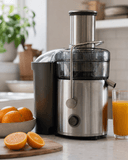 Best Centrifugal / FastestBreville Juice Fountain Cold
Fair
Our score: 67 / 100
- Best BudgetHamilton Beach Big Mouth Pro
Poor
Our score: 58 / 100
Omega NC900
Excellent
Our score: 83 / 100
The most versatile pick here — strong yield from its dual-stage auger, a 15-year warranty nobody else matches, and a genuine second life as a mincer and pasta extruder. The trade-off is a narrow feed chute that demands real precutting.
Hurom H200
Good
Our score: 77 / 100
Runs at just 43 RPM, the slowest auger speed in this guide, which translates to unusually clear, low-foam juice and the best green-juice yield of the bunch. It's a dedicated juicer only — no attachments — and asks for patience at the feed chute.
Kuvings B1700
Good
Our score: 77 / 100
The only masticating juicer here with a full 3-inch feed chute, which means whole small apples and most produce go in with little to no cutting first. Yield stays competitive with narrower-chute rivals; the trade is a bulkier machine.
Breville Juice Fountain Cold
Fair
Our score: 67 / 100
Juice in under a minute with minimal prep, thanks to a 3-inch chute and Breville's cold-spin engineering that trims some of the usual centrifugal oxidation. Expect real noise and lower yield on greens versus any masticating pick here.
Hamilton Beach Big Mouth Pro
Poor
Our score: 58 / 100
At under $100, this is the lowest-risk way to find out whether juicing is a habit worth keeping. Single-speed and lighter-duty than the rest of this list, but it juices whole small produce competently for a fraction of the price.
How we chose
We started from the two-family split — masticating versus centrifugal — and made sure this guide represents both honestly rather than defaulting to one. Within masticating, we picked machines with genuinely different strengths (dual-stage yield and versatility, slow-squeeze clarity and green performance, wide-chute convenience) rather than three near-identical single-auger units. Within centrifugal, we picked the format's strongest all-rounder and its clearest budget entry point, skipping a redundant second centrifugal pick that would have overlapped too much with the Juice Fountain Cold.
Every pick here is judged against Dat's Guide's juicer scoring criteria — performance, versatility, ease of cleaning, build quality, noise, and value — weighted toward performance and versatility since those are what most determine whether a juicer earns a permanent spot on the counter or ends up in a cabinet after a month.
What to look for
Masticating vs centrifugal is the first decision, and it matters more than any brand name. Masticating (slow-auger) juicers run at roughly 40-90 RPM, yield more juice per pound especially from leafy greens, keep juice fresh for two to three days, and run quietly — at the cost of speed and, often, a narrower feed chute. Centrifugal juicers spin a cutting disc at 6,000-13,000+ RPM, delivering a glass in under a minute with wide feed chutes and minimal prep, at the cost of more oxidation (drink it within a day), more foam, more noise, and weaker performance on greens.
Feed chute size determines how much prep time you'll actually spend. A 3-inch chute takes whole small apples and most produce with little cutting; anything under 2 inches means real prep work every single time you juice. This matters enormously for whether a juicer survives daily use versus becoming a chore you avoid.
RPM tells you the oxidation and noise story before you buy. Lower RPM (masticating territory) means quieter operation and juice that keeps longer; higher RPM (centrifugal) means speed and convenience at the cost of both. There's no universally "correct" RPM — it's a direct trade-off matched to how you'll actually use the machine.
Warranty length is a real signal, not boilerplate. Masticating juicers commonly carry warranties of 10-15 years on the motor specifically because slow, high-torque motors experience less wear than fast-spinning centrifugal motors. A short 1-year warranty on a centrifugal juicer isn't necessarily a red flag — it reflects the category's mechanics, not automatically poor build quality — but it's worth factoring into value math over the machine's expected lifespan.
Cleaning reality matters more than most buyers expect going in. Every juicer, masticating or centrifugal, has a fine mesh strainer or filter that needs prompt rinsing after use — let pulp dry in the mesh and cleanup time roughly doubles. If a 5-10 minute post-juicing cleanup routine feels like a dealbreaker, be honest with yourself about that before buying any juicer, not just the cheapest one.
Frequently asked questions
Should I get a masticating or centrifugal juicer?
Get masticating if you juice often, care about yield on leafy greens, and don't mind a slower process with more precutting on narrower-chute models. Get centrifugal if speed and minimal prep matter more than squeezing out every last drop, and you're mainly juicing hard produce like apples and carrots.
Is a more expensive juicer always better?
No — it depends what you're optimizing for. A $99 centrifugal juicer does a genuinely competent job on hard produce for someone testing the habit; a $299 masticating juicer only pays off if you'll actually use its yield and longevity advantages regularly.
Why do masticating juicers have such long warranties?
Their motors run at low RPM with high torque rather than spinning fast, which puts less mechanical stress on the motor over time — that durability difference is exactly what a 10-15 year warranty is signaling.
How much juice yield difference is there between masticating and centrifugal really?
On hard produce like carrots and apples, the gap is moderate. On leafy greens and wheatgrass, it's substantial — masticating juicers routinely extract noticeably more juice from the same amount of greens, which is the main reason serious green-juice drinkers lean masticating.
Can I juice whole fruit without cutting it first?
Only with a wide feed chute (around 3 inches), found on the Kuvings B1700, Breville Juice Fountain Cold, Breville Juice Fountain Multi-Speed, and Hamilton Beach Big Mouth Pro in this guide — narrower-chute masticating juicers like the Hurom H200 require real precutting regardless of produce size.