Researched
1Zpresso J-Max Review: The Hand Grinder That Wants to Replace Your Electric One
If you're willing to crank by hand, this covers more ground — espresso to French press, on one dial — than almost anything electric near its price. It just costs you time and a little shoulder work.
On this page
The pitch that's actually true for once
Most hand grinders pick a lane — some are espresso specialists, some are dialed for pour-over and nothing finer. The J-Max's whole reason for existing is refusing to pick. 1Zpresso built an external adjustment dial with enough click resolution spread across multiple full rotations that you genuinely can go from fine espresso to coarse French press on the same burr set, same grinder, same crank. I went in skeptical of that claim, the way you should be skeptical of any "does everything" pitch. It mostly holds up.
Who this is actually for
Buy it if you own multiple brew methods — say, an espresso setup and a French press or pour-over habit — and don't want to own multiple grinders to cover them. The external dial's range genuinely spans both worlds convincingly, which is rare.
Buy it if you travel with your coffee habit and want a single grinder that handles wherever you land, hotel-room pour-over one week, a borrowed espresso machine the next.
Skip it if speed matters to you every single morning and espresso is your only use case — a hand grinder, however good, asks more time and physical effort than an electric one, and if you're not getting the "covers everything" benefit out of that trade because you only ever make one drink, an electric grinder is the more efficient choice.
Build quality
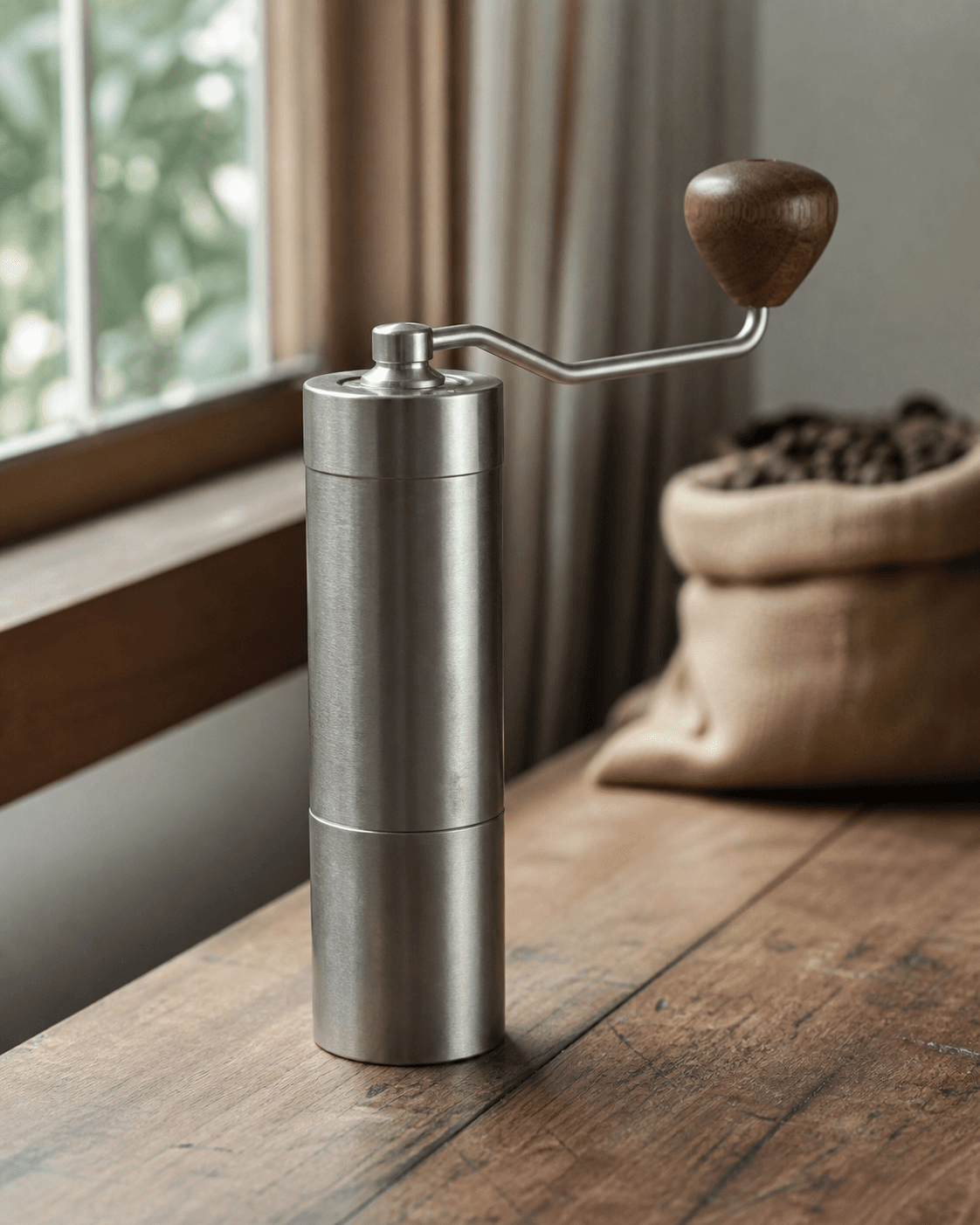
Full metal body, a crank arm that feels substantial rather than flimsy, and a 48 mm stainless conical burr set that 1Zpresso has clearly iterated on across several product generations before landing here. The external dial itself is the star of the build — a knurled ring you can turn with the crank still engaged, giving you tactile clicks fine enough that dialing in feels closer to a stepless grinder than a typical stepped hand grinder.
The weight that comes with an all-metal build is a genuine trade-off. It feels premium in hand and grinds with real stability on a table, but it's not the grinder you grab if shaving grams for a hiking trip is the priority — there are lighter hand grinders built for exactly that instead.
Core performance
Grind consistency and particle distribution
The 48 mm conical burr set produces impressively uniform particles for a hand grinder, closing much of the gap with electric flat burr grinders that cost considerably more. Hand grinders in general benefit from lower, more controlled grind speed than most electric motors — you're not fighting motor-induced heat or high-RPM chatter, which shows up as a cleaner particle profile than the burr size alone would suggest.
Adjustment mechanism and range
This is the reason to buy this specific grinder over most competitors. The external click dial spans an enormous range across multiple full rotations of the adjustment ring, with fine enough resolution per click that espresso dialing doesn't feel like a compromise the way it does on hand grinders built primarily for filter coffee. Being able to nudge the dial without disassembling anything is a real, practical advantage during a dial-in session — you can taste, adjust, and taste again in seconds rather than resetting from scratch.
Retention and mess
Hand grinders inherently excel here, and the J-Max is no exception — the single-dose chamber and short grounds path leave next to nothing behind between grinds. If retention is your top priority above all else, a well-built hand grinder like this one is hard to beat regardless of price tier.
Secondary performance
Noise is essentially nonexistent beyond the mechanical clicking of burrs against beans — you can grind at 5 a.m. in an apartment with thin walls and nobody stirs. There's no motor heat to worry about at all, which keeps flavor-sensitive light roasts fully intact through the grind.
Daily use and ergonomics
The crank motion is smooth, and the external dial means you're not stopping mid-session to readjust through disassembly the way older hand-grinder designs require. That said, cranking a fine espresso dose by hand takes real, sustained effort — somewhere north of a minute for a proper espresso grind, more if your beans are particularly dense or oily. This is where the "does it all" promise costs you something concrete: time and a bit of forearm fatigue, every single time, not just once.
Maintenance and longevity
Mechanically simple by nature — no motor to fail, no electronics beyond none at all. Burr replacement and cleaning are straightforward, and metal construction throughout suggests this is built to outlast a decade of daily grinding with basic care. Brush out the burr chamber regularly, and there's little else to maintain.
Upgrades and accessories
1Zpresso sells accessory items like static-reducing tools and alternative catch containers for their grinder lines, though the core unit doesn't have the aftermarket burr-swap culture that surrounds something like the DF64 — the burr set here is proprietary to the platform rather than a standard size shared across brands.
How it compares
Against the Comandante C40, the direct rival in the premium hand-grinder space, the J-Max wins clearly on stated grind range and external mid-grind adjustability, while the Comandante counters with a more storied reputation, arguably even more refined build feel, and a slight edge in pure grind consistency at the very finest settings favored by pour-over purists.
Against an electric single-dose grinder like the DF64, the J-Max trades speed for silence, portability, and zero cords — a fair trade for someone who values those things, a clear loss for someone who just wants their morning espresso as fast as possible.
Against cheaper hand grinders like a Timemore Chestnut, the J-Max's external dial and wider stated range justify its higher price for anyone who actually needs that range — if you only ever grind for pour-over, a cheaper, simpler hand grinder covers your actual use case for less money.
Value analysis
At roughly $200, you're getting a grinder that genuinely replaces both a dedicated espresso hand grinder and a dedicated filter hand grinder for a lot of buyers, which is real value if you actually use both ends of that range. If you only use one end, you're paying for range you won't touch, and a cheaper specialist grinder would serve you just as well for less.
Known issues
The most common complaint is exactly the trade you'd expect — hand-cranking a fine espresso dose is genuinely tiring compared to an electric grinder, and buyers who didn't fully internalize that before purchasing sometimes feel surprised by it. A smaller complaint is the added weight from the metal build, which some travelers find less convenient than a lighter plastic-bodied alternative.
Verdict
The J-Max delivers on an unusually honest promise — one hand grinder that actually covers espresso through French press competently, thanks to a genuinely clever external dial. It asks for your time and a bit of physical effort in exchange, which is a fair trade for the right buyer and a real drawback for someone who just wants speed. Know which one you are before you buy.
What we like
- Enormous click range covers everything from espresso-fine to French-press-coarse on one grinder
- External adjustment dial lets you change grind size mid-crank without opening the unit
- Essentially zero retention, since the whole design is built around a single dose
What we don't
- Hand-cranking a fine espresso dose takes real time and a bit of forearm effort
- Metal body adds weight versus some plastic-bodied hand grinders, which cuts both ways for travel
- That many click positions is a blessing and a curse — dialing in takes patience at first
Specifications
| Burr type | Conical |
|---|---|
| Burr size | 48 mm |
| Burr material | Stainless steel |
| Grind settings | External numbered dial, hundreds of micro-click positions across multiple rotations |
| Adjustment | External stepped dial, adjustable mid-grind |
| Single-dose | Yes |
| Hopper capacity | ~35 g bean chamber |
| Retention | <0.1 g |
| Motor | None (hand crank) |
| Warranty | 2 yr, varies by retailer |
Frequently asked questions
How long does it take to hand-crank an espresso dose?
Expect somewhere around a minute or a bit more for a fine espresso grind, longer than an electric grinder by a wide margin — the trade is silence, portability, and effectively zero retention in exchange for your own effort.
Can I really cover espresso through French press on one grinder?
Yes — that's the J-Max's whole pitch, and the external dial's huge click range genuinely delivers it, which is unusual even among premium hand grinders that often specialize toward one end of the range.
Is it too heavy to travel with?
It's heavier than a plastic-bodied hand grinder, though still small enough to pack. If ounces matter more than anything else for backpacking or air travel, a lighter hand grinder will suit you better.
Does the external dial mean I can adjust it mid-grind?
Yes — that's a real practical advantage over grinders where you have to stop, disassemble, and reset. You can nudge the dial finer or coarser while the crank is still in your other hand.
Is this better than an entry electric grinder like the Baratza Encore ESP?
Different tool, not strictly better — the J-Max wins on range and retention, the Encore ESP wins on speed and zero physical effort. If you only ever make espresso and value speed, go electric. If you want one grinder for everything and don't mind cranking, this is the one.
Keep reading
- Comandante C40 Review: Why Coffee Nerds Pay This Much for a Crank
Excellent
Our score: 80 / 100
- Eureka Mignon Specialita Review: The Grinder That Makes Espresso Feel Like a Café Habit
Excellent
Our score: 81 / 100
- DF64 Review: The Grinder the Enthusiast Forums Won't Stop Talking About
Good
Our score: 75 / 100
- Fellow Ode Gen 2 Review: The Filter Grinder That Learned to Do Espresso
Good
Our score: 75 / 100