Researched
Fellow Ode Gen 2 Review: The Filter Grinder That Learned to Do Espresso
As a single-dose filter grinder, it's close to the best-looking, lowest-mess option at this price. As an espresso grinder, it's good only after you buy the burr upgrade — budget for both before you commit.
On this page
The grinder that was never really about espresso first
Fellow built the original Ode as a filter and pour-over grinder, full stop — no espresso pretensions, no stepless micrometric adjustment chasing a 58-bar shot. Gen 2 keeps that identity but adds a door: buy the optional espresso burr set, swap it in, and the same chassis grinds fine enough for a portafilter. That's a smart move for Fellow's catalog and a slightly confusing one for a buyer trying to figure out which grinder to purchase, because "the Ode does espresso now" and "the Ode is an espresso grinder" are two very different claims, and only the first one is fully true.
Who should actually buy this
Buy it if filter coffee and pour-over are your primary use case, and espresso — if you make it at all — is occasional rather than your main daily drink. In that world, this is one of the cleanest, lowest-maintenance single-dose grinders at its price, and the optional espresso burr set is a nice-to-have you can add later if your habits shift.
Buy it if you specifically want the espresso burr set and you value near-zero retention and a design that doesn't look like it belongs in a lab — just go in budgeting for both the base unit and the upgrade burr set together, because that's the real price of admission for espresso use.
Skip it if espresso is your main event and you want the best possible fine-grind performance for the money — a grinder purpose-built for espresso, whether that's the Baratza Encore ESP at a lower price or the Eureka Mignon Specialita a tier up, will out-perform the Ode-plus-upgrade path for similar or less total spend.
Build quality
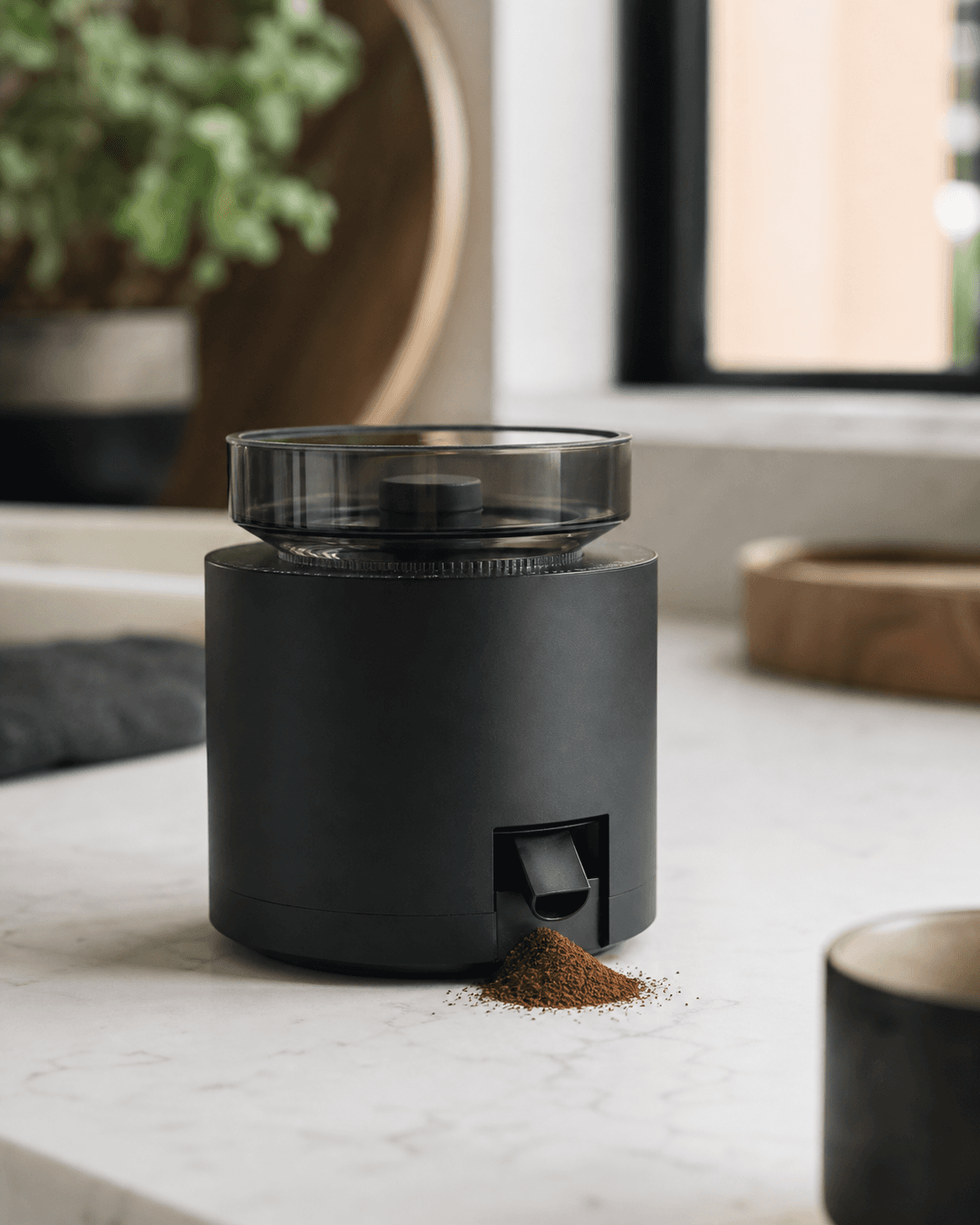
The Ode Gen 2 looks like a piece of kitchen equipment someone actually designed, not just engineered — anodized aluminum housing, a satisfying weighted feel to the adjustment dial, and a catch bin that seats magnetically rather than wobbling into place. Fellow clearly spent design budget here in a way that shows, and it's one of the few grinders in this price range you wouldn't mind leaving out on the counter permanently.
Under the hood, the 64 mm flat steel burr set is a serious piece of hardware for the price, and the declumping geometry Fellow reworked for Gen 2 — small internal changes to how ground coffee exits the burr chamber — genuinely reduces the static-clinging mess that plagued the first generation. It's a real engineering fix, not a marketing refresh.
Core performance
Grind consistency and particle distribution
Flat burrs generally produce a tighter, more uniform particle distribution than conical burrs of similar quality, and the Ode's 64 mm set delivers on that promise for filter and pour-over grinds — you get a noticeably more even extraction than a cheaper conical grinder, less muddiness, cleaner separation of flavors in a V60 or batch brew. For filter coffee this is close to the ceiling you can reach without spending significantly more.
For espresso, once you've installed the optional finer burr set, consistency is good but not best-in-class — the Ode's roots as a filter grinder mean its overall engineering wasn't optimized around espresso's much narrower and more demanding fine-particle window the way a dedicated espresso grinder's is.
Adjustment mechanism and range
Thirty-one stepped macro settings, each with a small range of fine sub-adjustment via a secondary dial — Fellow's compromise between the simplicity of a stepped grinder and the precision espresso drinkers usually want. It works well for filter coffee, where the acceptable grind window is wider and forgiving. For espresso, stepped adjustment is the platform's biggest handicap: fine dialing sometimes lands you between two available settings, one slightly too fast, one slightly too slow, with no in-between option the way a stepless collar would offer.
Retention and mess
This is the Ode Gen 2's standout feature. Fellow's declumping redesign and single-dose catch-cup engineering bring retention down to a genuinely small fraction of a gram in most real-world reports — you can switch beans, switch roasts, or switch grind settings without meaningfully contaminating your next dose. For anyone who's used a hopper-fed grinder and dealt with stale grounds mixing into a fresh dose, this is the single biggest quality-of-life difference the Ode offers.
Secondary performance
The built-in digital timer is a small but genuinely useful touch — set a grind time, walk away, and it stops automatically, which matters more than it sounds like when you're also managing a kettle or a portafilter at the same moment. Noise sits in the quieter half of the field for its motor class, and heat buildup is well controlled at 950 RPM, low enough to avoid cooking delicate light roasts during a longer espresso grind.
Daily use and ergonomics
Loading beans is straightforward — pour into the top chute, no big hopper to manage, no leftover beans from three roasts ago mixing together. The catch bin seats and releases cleanly, and static cling on grounds is noticeably reduced versus Gen 1 or most competing single-dose grinders at this price. It's a grinder that rewards a quick, no-fuss morning routine, which is exactly the audience Fellow is chasing with the whole Ode line.
Maintenance and longevity
Weekly brush-outs of the burr chamber keep oil buildup in check, and the declumping chamber design makes this easier than on grinders with more convoluted grounds paths. Fellow's parts and burr-replacement support is solid, if not as deep or long-running as Baratza's decade-plus track record — the Ode line is newer, so its long-term reliability story is still being written rather than proven over many years the way an older platform's is.
Upgrades and what to pair it with
The obvious one is the espresso burr set itself, which is really a second product disguised as an accessory — budget for it from day one if espresso is even a possibility for you, rather than treating it as a maybe-later purchase. Beyond that, a small distribution tool helps even out dosing into a portafilter basket, standard advice across every single-dose grinder in this guide.
How it compares
Against the Baratza Encore ESP, the Ode Gen 2 wins clearly on retention and industrial design, and its flat burr geometry edges out the Encore's conical set on raw particle uniformity — but it costs more, and if espresso is genuinely your main use case, you're paying extra for filter-coffee capability you might not use, then paying again for the burr set you actually need.
Against the DF64, both are 64 mm flat burr single-dose grinders in a similar price bracket, but they come from very different philosophies. The DF64 is a bare-bones chassis built for an enthusiast community that swaps burrs and adds bellows kits; the Ode is a finished, polished product that assumes you'll use it mostly as shipped. If you want to tinker, the DF64's ecosystem is richer. If you want something that looks and feels complete on day one, the Ode wins easily.
Against the Eureka Mignon Specialita, the comparison flips — the Specialita is a dedicated espresso grinder with stepless adjustment and a proper hopper for daily multi-shot use, while the Ode is fundamentally a single-dose filter grinder wearing an espresso costume. If espresso is your daily driver, the Specialita is the more honest and ultimately better-performing choice.
Value analysis
At its base price, the Ode Gen 2 is a strong value for filter coffee specifically — you're getting flat burr consistency, near-zero retention, and genuinely nice design for less than some inferior single-dose competitors charge. The value proposition weakens once you add the espresso burr set, because at that combined price you're competing directly against grinders engineered for espresso from the ground up, and the Ode's stepped adjustment and filter-first burr geometry make it a slightly compromised competitor in that fight.
Known issues
Gen 1 owners complained loudly about static and clinging grounds, and Fellow's Gen 2 redesign directly addresses that — it's a rare case of a manufacturer fixing the exact thing people were annoyed about rather than a cosmetic refresh. Some current owners still note occasional static on very dry, low-humidity days, though it's a fraction of what Gen 1 produced. The stepped-adjustment limitation for fine espresso dialing is a design decision, not a defect, but it's the complaint you'll see most from buyers who bought the espresso burr set expecting stepless-grinder precision.
Verdict
The Ode Gen 2 is one of the cleanest, lowest-mess single-dose grinders you can buy for filter coffee, and Fellow deserves credit for actually fixing Gen 1's static problems rather than just calling it a new model. Its espresso capability is real but secondary — a genuine option, not a core competency — and buyers should price the whole package, base unit plus espresso burr set, before deciding whether this is the smarter buy over a grinder built for espresso from day one.
What we like
- Exceptionally low retention out of the box — genuinely close to zero grounds left behind
- 64 mm flat burrs deliver even particle distribution across the filter range
- Built-in timer and clean industrial design that doesn't look like lab equipment
- Gen 2's declumping improvements measurably reduce static and clinging fines
What we don't
- Stock burr set is tuned for filter coffee — espresso needs a separate burr purchase
- Stepped adjustment, not stepless, so ultra-fine espresso dialing takes more trial and error
- Price climbs fast once you add the espresso burr kit most espresso buyers will want
Specifications
| Burr type | Flat |
|---|---|
| Burr size | 64 mm |
| Burr material | Steel (stock); ceramic-coated espresso burr set sold separately |
| Grind settings | 31 stepped macro settings with fine sub-adjustment |
| Adjustment | Stepped |
| Single-dose | Yes |
| Hopper capacity | N/A — single-dose catch cup, ~30-40 g per load |
| Retention | <0.3 g claimed with stock filter burrs |
| Motor | 950 RPM DC motor with built-in digital timer |
| Warranty | 1 yr |
Frequently asked questions
Does the Ode Gen 2 come ready for espresso out of the box?
Not really — the stock burr set is optimized for filter and pour-over grinds. Fellow sells a separate espresso burr set that swaps in, and most people buying this for espresso end up purchasing it, which changes the real total cost.
What actually changed between Gen 1 and Gen 2?
Better declumping geometry inside the burr chamber, reduced static, and a refined catch bin — the goal was to fix the clinging-fines complaints from the first generation without changing the core flat burr design.
Is 31 stepped settings enough resolution for espresso?
It's workable but not ideal — stepless grinders make fine espresso dialing easier because you're not choosing between two settings that are each slightly wrong. The Ode's stepped dial means occasional compromise between too-fast and too-slow shots.
How loud is it?
Noticeably quieter than most grinders in its class, though not silent — the 950 RPM motor and enclosed burr chamber keep it to a reasonable hum rather than a shriek.
Is this a good first grinder?
For filter coffee, yes, easily. For espresso specifically, only if you go in knowing you'll likely add the espresso burr set — otherwise a dedicated espresso grinder in this price range will serve you better from day one.
Keep reading
- Comandante C40 Review: Why Coffee Nerds Pay This Much for a Crank
Excellent
Our score: 80 / 100
- 1Zpresso J-Max Review: The Hand Grinder That Wants to Replace Your Electric One
Excellent
Our score: 81 / 100
- Eureka Mignon Specialita Review: The Grinder That Makes Espresso Feel Like a Café Habit
Excellent
Our score: 81 / 100
- DF64 Review: The Grinder the Enthusiast Forums Won't Stop Talking About
Good
Our score: 75 / 100