Researched
Eureka Mignon Specialita Review: The Grinder That Makes Espresso Feel Like a Café Habit
The most complete, best-finished dedicated espresso grinder in this batch — buy it if you make espresso daily and want a machine that never feels like the weak link.
On this page
Where Eureka fits in the story
Eureka has been building grinders in Italy for the better part of a century, mostly for commercial cafés, and the Mignon line is the company's answer to home baristas who want that same lineage scaled down to a countertop footprint. The Specialita sits near the top of the Mignon range — not the cheapest, not the most expensive, but the model most often recommended as the point where "home espresso grinder" stops sounding like a compromise.
Who should buy this
Buy it if espresso is a daily habit rather than a weekend project, you want a hopper-fed grinder you load once and don't think about again for days, and you're willing to pay a real premium for a machine that feels finished in every interaction — dial, dosing, chassis, all of it.
Buy it if you've been running a budget flat burr grinder and have started to notice its rough edges — slower dial adjustment, less refined dosing, plastic where you'd want metal — and you're ready to spend accordingly to remove those friction points permanently.
Skip it if retention matters more to you than daily convenience — this is a hopper-fed grinder first, and while an aftermarket single-dose conversion exists, you're paying premium prices for a machine that isn't natively built around that priority. A DF64 or Ode Gen 2 will serve a strict single-dose habit more directly and for less money.
Build quality
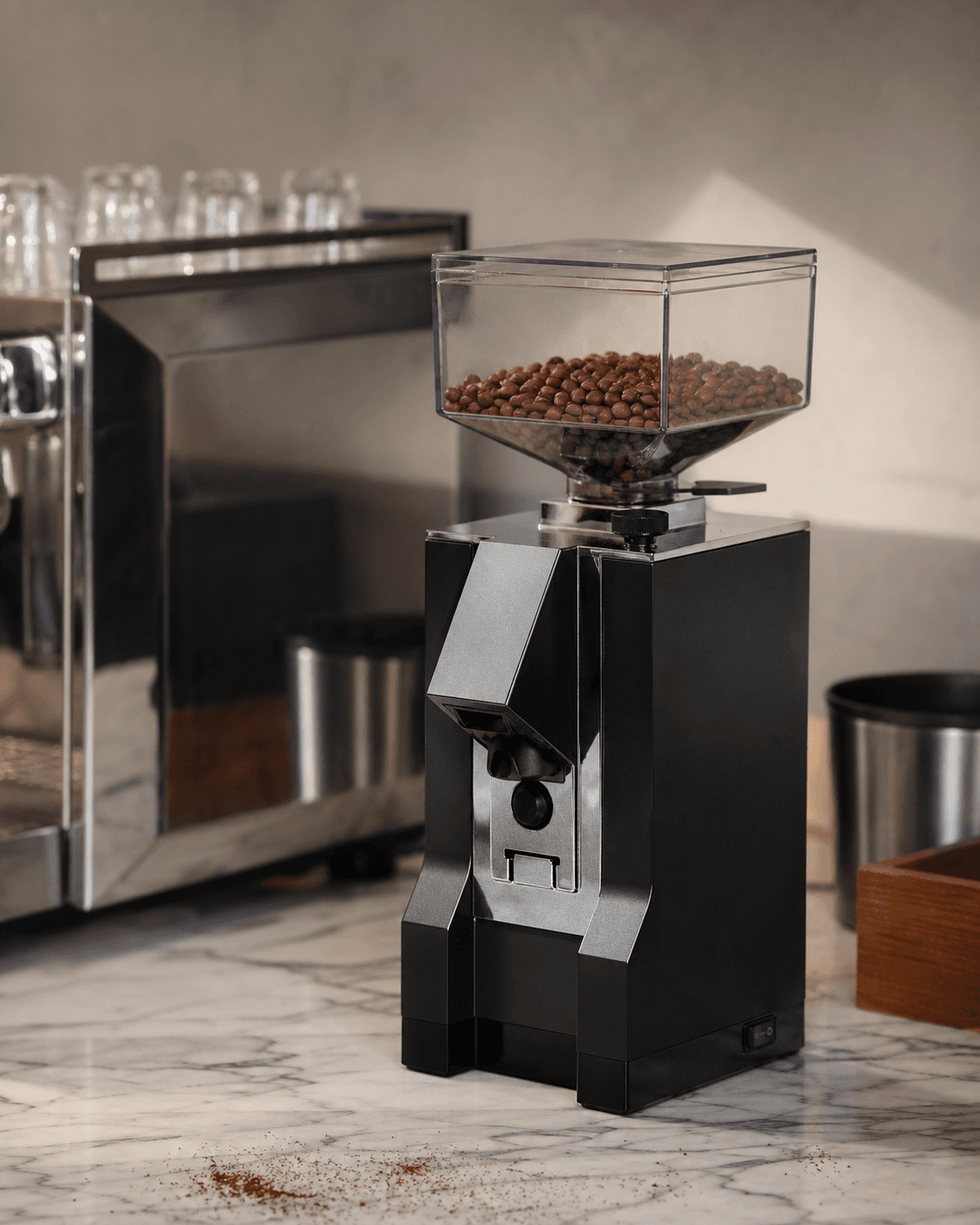
This is where the Specialita separates itself from everything else in this batch. The chassis is metal where competitors reach for plastic, the adjustment collar turns with a weighted precision that genuinely feels like a step above the field, and the digital dosing interface is fast and clearly designed by people who've watched a lot of baristas use a lot of grinders under time pressure. Little details — the way the portafilter cradle holds a basket steady, the tactile click of the stepless collar despite technically being continuous — add up to a machine that doesn't have an obvious weak point in its construction.
The 55 mm flat burr set is smaller than some rivals' 64 mm burrs, and burr-size purists sometimes treat that as a mark against it. In practice, burr geometry, precision of manufacture, and controlled low RPM matter more than raw diameter for grind quality, and Eureka's decades of commercial-grinder experience show in how well this particular combination performs.
Core performance
Grind consistency and particle distribution
Particle distribution here is genuinely excellent — tight enough that shots pull consistently across dosing sessions without the small variances that plague less refined grinders. This isn't accidental; Eureka's anti-clumping vibration (marketed as ACE) actively agitates ground coffee at the chute to prevent clumping and static buildup, which is a real mechanical solution to a problem most competitors just accept as a fact of grinding life.
Adjustment mechanism and range
Stepless micrometric adjustment means you can dial in genuinely tiny changes to grind size, which matters enormously for espresso where a fraction of a turn separates a 25-second shot from a 35-second one. Combined with the digital timer for dosing, adjusting your recipe and repeating it precisely is faster and more intuitive here than on any stepped-dial competitor in this batch.
Retention and mess
This is the honest weak point. As a hopper-fed design, beans sit above the burrs between grinding sessions, and switching roasts or grind settings leaves a real one-to-three-gram residue depending on where you land on the range. Owners who care about zero cross-contamination between beans typically add an aftermarket single-dose conversion funnel, which closes most of the gap but adds cost and a small amount of daily fuss that stock single-dose grinders don't require.
Secondary performance
The anti-clumping vibration doubles as noise you'll notice — not loud exactly, but a distinct hum layered under the grinding sound itself. Heat management benefits from the controlled, moderate RPM motor, which keeps flavor-damaging heat buildup in check even during back-to-back grinding sessions for multiple drinks.
Daily use and ergonomics
This is a grinder built around the rhythm of making multiple espressos across a morning or a small café-style service — load the hopper once, dial in your grind, and pull dose after dose with the digital timer handling repeatability for you. It's the smoothest daily-use experience in this entire batch specifically because it wasn't designed around single servings; it was designed around volume, then scaled down for the home.
Maintenance and longevity
Eureka's commercial pedigree shows here too — parts, burrs, and service support are well established, and the 2-year warranty is the longest in this comparison. Weekly maintenance is a brush-out of the chute and hopper collar; the vibration motor and dosing mechanism are sealed well enough that daily cleaning doesn't require disassembly. Long-term reliability reports are strong, consistent with a company that's built grinders for professional environments for decades.
Upgrades and what to pair it with
The single meaningful upgrade path is an aftermarket single-dose conversion funnel for owners bothered by hopper retention — a real accessory market exists for exactly this modification on Mignon-series grinders. Beyond that, this is a grinder that arrives close to its finished form; there isn't a big burr-swap culture around it the way there is with the DF64.
How it compares
Against the DF64, the Specialita costs meaningfully more for a smaller stock burr set, but the gap closes when you weigh finish, dosing speed, warranty length, and the anti-clumping vibration technology — the DF64 wins on raw value and upgrade ceiling, the Specialita wins on daily polish and out-of-box completeness.
Against the Fellow Ode Gen 2, the comparison is really hopper-fed daily-driver versus single-dose specialist — the Specialita is built for someone pulling multiple shots a day without reloading, while the Ode's whole design philosophy assumes you're weighing out a fresh single dose each time.
Against the Baratza Encore ESP, the Specialita is a clear step up in every performance dimension, at close to double the price — the right comparison isn't "which grinds better," it's "is the daily-use refinement and stepless precision worth the difference to you specifically."
Value analysis
At around $525, this isn't a budget purchase, and Eureka isn't pretending otherwise. What you're buying is Italian commercial-grinder engineering scaled to a countertop, with a level of daily-use polish that budget and mid-tier competitors in this batch don't match. If you make espresso every day and the grinder is genuinely the last piece of your routine that still feels a step behind your machine, this closes that gap convincingly.
Known issues
The most consistent owner complaint is hopper retention when switching beans, which is a known trade-off of this design rather than a manufacturing flaw — hence the popularity of the aftermarket single-dose conversion. A smaller number of owners note the vibration motor's hum as a minor annoyance in a quiet kitchen. Long-term mechanical complaints are rare relative to units sold.
Verdict
The Mignon Specialita is the most complete, best-finished dedicated espresso grinder in this batch, and it earns that status through decades of commercial-grinder engineering rather than flashy specs. It isn't the value leader, and it isn't built around single-dose purity — but for someone whose daily habit is genuinely daily, it's the grinder least likely to ever feel like the weak link in the setup.
What we like
- Italian build quality that feels every bit the prosumer price tag it carries
- Stepless micrometric adjustment gives genuinely fine control over espresso dialing
- Anti-clumping vibration technology measurably reduces static and clumping at the chute
- Digital timer dosing is fast and repeatable for daily multi-shot mornings
What we don't
- Not single-dose stock, and retention is real if you switch beans or roasts often
- Aftermarket single-dose conversion is possible but adds cost and complexity
- Premium price for a 55 mm burr set when 64 mm alternatives exist for less
Specifications
| Burr type | Flat |
|---|---|
| Burr size | 55 mm |
| Burr material | Steel |
| Grind settings | Stepless |
| Adjustment | Stepless collar with digital-timer dosing |
| Single-dose | No — hopper-fed; single-dose conversion possible with aftermarket funnel |
| Hopper capacity | 10.5 oz (300 g) |
| Retention | ~1-3 g depending on grind setting |
| Motor | 220 W, ~1,400 RPM, with anti-clumping vibration (ACE) |
| Warranty | 2 yr |
Frequently asked questions
Is the Specialita worth the premium over a DF64 or similar budget flat burr grinder?
If daily polish, hopper-fed convenience, and Italian build quality matter to you, yes — the difference isn't really about raw grind ceiling, it's about how finished and repeatable the whole experience feels every single morning.
Can it be converted to single-dose?
Yes, aftermarket single-dose conversion funnels exist for the Specialita, and many owners add one to cut down on retention between roasts. It's an added cost and a bit of extra fuss, not a stock feature.
What does the anti-clumping vibration actually do?
A small motor-driven vibration in the chute that keeps ground coffee moving instead of clumping and sticking to the walls on its way to the portafilter — it's a real, measurable improvement over Eureka's older non-vibrating models, not a marketing label.
Is 55 mm too small compared to 64 mm grinders like the DF64?
Burr size alone doesn't decide grind quality — burr geometry and RPM matter just as much. The Specialita's 55 mm set, run at a deliberately low RPM, produces excellent particle distribution despite being smaller than some rivals.
How loud is it day to day?
Moderate — quieter than many bare-bones single-dose grinders thanks to the controlled low-RPM motor, though not silent, especially with the vibration motor engaged.
Keep reading
- Comandante C40 Review: Why Coffee Nerds Pay This Much for a Crank
Excellent
Our score: 80 / 100
- 1Zpresso J-Max Review: The Hand Grinder That Wants to Replace Your Electric One
Excellent
Our score: 81 / 100
- DF64 Review: The Grinder the Enthusiast Forums Won't Stop Talking About
Good
Our score: 75 / 100
- Fellow Ode Gen 2 Review: The Filter Grinder That Learned to Do Espresso
Good
Our score: 75 / 100