Researched
DF64 Review: The Grinder the Enthusiast Forums Won't Stop Talking About
Best grind quality per dollar in this whole batch, if you're willing to treat it as a platform to build on rather than a finished product to unbox.
On this page
The grinder that grew out of a forum thread
The DF64 didn't arrive with a marketing campaign. It spread through enthusiast forums and grinder subreddits as a quiet secret: a 64 mm flat burr single-dose grinder, priced closer to entry-level, that out-ground machines costing twice as much once you put in a little effort. That origin story matters, because it explains both the DF64's strengths and its rough edges — this is a grinder built by people who assumed the buyer would want to tinker, not one designed to be the polished centerpiece of a countertop.
Who this is actually for
Buy it if you're the kind of coffee drinker who reads reviews like this one for fun, doesn't mind ordering a $20 bellows attachment from a specialty shop, and cares more about what comes out of the spout than what the grinder looks like doing it. The DF64 rewards exactly this kind of buyer disproportionately relative to its price.
Skip it if you want to open a box, plug it in, and never think about the grinder again. The stock experience — no numbered dial reference on many units, a fairly plain chassis, inconsistent support depending on where you bought it — asks more patience than a Fellow Ode or Eureka Mignon Specialita does.
Borderline case: if you're brand new to grinders and just want good espresso without a project, put this a notch below the Encore ESP or Specialita on your shortlist — not because it grinds worse, but because the learning curve to get the most out of it is real, even if the ceiling once you clear that curve is higher than either of those competitors offers at a similar price.
Build quality
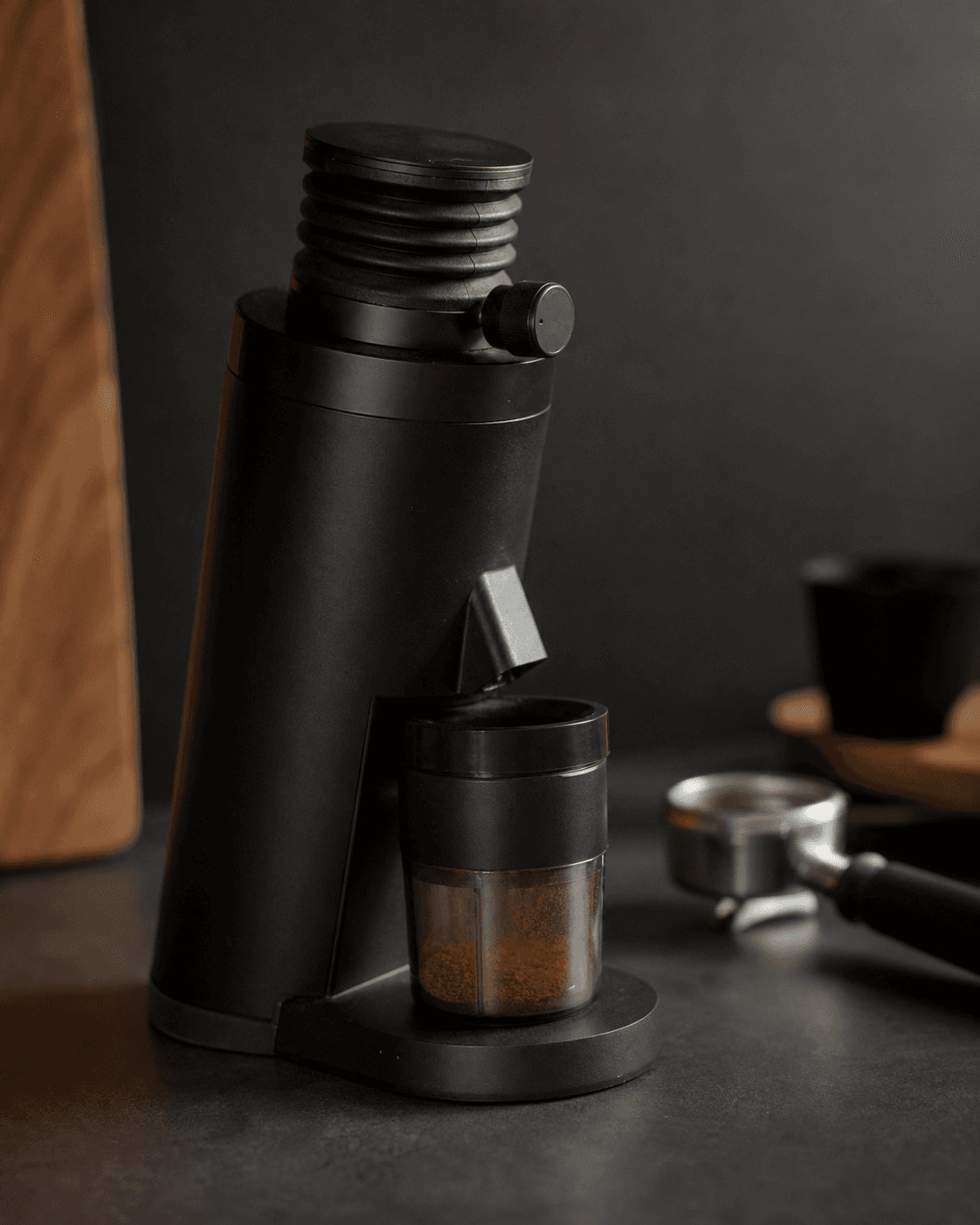
The DF64 chassis is functional rather than beautiful — a fairly plain metal body, a stepless adjustment collar that in many units ships without printed reference numbers, and a bare catch cup rather than a magnetically seated bin. None of this affects how it grinds, but it does affect how it feels to own day to day, and buyers coming from a Fellow or Breville product will notice the difference in finish immediately.
The 64 mm flat burr set is where the real story is. Stock burrs are perfectly usable and a meaningful step above entry hopper-fed grinders, but the DF64's real claim to fame is how easily it accepts aftermarket burr sets from established makers — swap in a premium burr set and this same $239 chassis can compete with grinders costing several times as much on pure grind quality. That upgrade path is the product, in a lot of ways, as much as the grinder itself is.
Core performance
Grind consistency and particle distribution
Even with stock burrs, particle distribution is tight enough to produce clean, well-extracted espresso once dialed in — a real testament to how good 64 mm flat burr geometry is at this price point when a manufacturer doesn't cut corners on the burrs themselves, even while cutting corners everywhere else. Owners who invest in an aftermarket burr swap consistently report a further, noticeable jump in consistency, which says the ceiling here is unusually high for the starting price.
Adjustment mechanism and range
Stepless collar adjustment gives you effectively infinite fine-tuning resolution, which is a real advantage for espresso where tiny grind changes matter — but the lack of numbered reference points on many units turns "return to yesterday's setting" into a guessing game unless you've marked the collar yourself or bought an aftermarket dial. This is the single biggest usability gap between the DF64 and every other grinder in this batch, and it's worth knowing before you buy, not after.
Retention and mess
Stock retention is reasonable for a single-dose design, but the DF64 community consensus is that a simple bellows attachment — agitating the chute to knock loose clinging grounds — closes most of the remaining gap for well under $20. Factor that small extra purchase into your real budget rather than treating the base unit's spec as the finished number.
Secondary performance
At around 1,400 RPM and 250 W, the motor has real torque behind it, grinding through a dose quickly without bogging down on darker, oilier roasts. Noise is on the louder side of this batch — there's no low-RPM whisper-quiet pretension here — and heat management is adequate but not class-leading; a fast grind cycle keeps total heat exposure low regardless.
Daily use and ergonomics
Loading a single dose into the funnel, grinding, and knocking the catch cup loose is a quick routine once you're used to it, though first-time owners often find the initial setup — leveling the burr gap, finding your dial reference points, deciding whether to add a bellows — takes real time in week one. After that initial investment, day-to-day use is straightforward and fast.
Maintenance and longevity
Simple mechanically, which is a genuine advantage for maintenance — fewer proprietary parts means fewer things that can only be fixed by the original manufacturer. Burr replacement is easy given how much of an aftermarket exists specifically for this platform. Longevity reports from the community are generally positive, though because support is split across several importers and resellers rather than one company, your experience getting help with a defective unit varies more than it would with a Baratza or Fellow product.
Upgrades and accessories
This is the DF64's real superpower. Premium burr sets from established burr manufacturers, aftermarket numbered dials, bellows and dosing funnels, even full base and motor upgrades exist for this platform because of how popular it became in the enthusiast community. Budget an extra $20-80 beyond the base price if you want the fuller experience most DF64 fans actually run.
How it compares
Against the Fellow Ode Gen 2, the DF64 is the rawer, more upgradeable option — cheaper up front, higher grind-quality ceiling once modified, but a rougher out-of-box experience with less design polish and a less finished retention solution stock.
Against the Eureka Mignon Specialita, the DF64 undercuts it significantly on price while closing much of the grind-quality gap once upgraded, though the Specialita remains the more complete, better-finished, hopper-fed daily driver for someone who wants zero tinkering.
Against the Baratza Encore ESP, the DF64's flat burr geometry and single-dose design give it an edge in pure grind consistency and mess control, but it trades away Baratza's decade-plus support reputation and beginner-friendly simplicity to get there.
Value analysis
Dollar for dollar, the DF64 is arguably the best grind-quality value in this entire batch — but that value is partly locked behind a willingness to spend a little more time and, often, a little more money on small accessories. Buy it purely stock and compare it to a fully finished competitor, and the value gap narrows. Buy it as most enthusiasts do — with a bellows and maybe an aftermarket dial — and it's hard to beat at the price.
Known issues
The most common complaints are the missing numbered dial reference on many units and inconsistent support depending on the specific importer or storefront you order from — this isn't one factory with one customer service line, and buyers should expect that variability rather than assume Baratza-level consistency. Stock retention before adding a bellows is a real, if minor, complaint as well.
Verdict
The DF64 earns its cult following honestly. It's not the most polished grinder here, and it asks a little homework of its buyer, but the raw grind quality for the money — especially once you invest a small amount further into the aftermarket built around it — is the best in this comparison. If you don't mind treating your grinder as a project with a great starting point, this is the one.
What we like
- Exceptional grind quality for the money once dialed in — enthusiast-favorite for a reason
- Massive aftermarket of burr sets, bellows, dosing funnels, and dials to upgrade every part of it
- True single-dose design with genuinely low retention when paired with a bellows
What we don't
- Bare-bones out of the box — stock experience feels unfinished next to a Fellow or Eureka
- No numbered adjustment reference on many units, making returning to a setting a matter of memory or aftermarket dials
- Support and warranty vary a lot depending on which importer or reseller you buy from
Specifications
| Burr type | Flat |
|---|---|
| Burr size | 64 mm |
| Burr material | Steel (stock 'DF' burr; commonly upgraded to SSP or Turin sets) |
| Grind settings | Stepless — no numbered indicator on base models |
| Adjustment | Stepless external collar |
| Single-dose | Yes |
| Hopper capacity | N/A — single-dose funnel/bellows, ~18-20 g per load |
| Retention | <0.5 g with bellows agitation |
| Motor | 250 W AC motor, ~1,400 RPM |
| Warranty | 1 yr, varies by importer/seller |
Frequently asked questions
Do I need to buy an aftermarket burr set immediately?
Not immediately — the stock burr set is genuinely usable and a lot of owners run it happily for a year or more. It's more that the upgrade path exists and is cheap enough that many people eventually take it, not that the stock burrs are bad.
Why doesn't it have numbered grind settings?
Many DF64 units ship with a plain stepless collar and no printed reference numbers, which is a real usability gap versus a grinder with a dial. Aftermarket adjustable dials with numbers are a common and inexpensive first upgrade for exactly this reason.
Is retention actually low without extra parts?
It's decent stock, but most owners add a simple bellows or funnel attachment — often under $20 — to agitate the chute and knock loose grounds down, which gets retention close to the numbers enthusiasts report.
Is this a good grinder for a total beginner?
It can be, if you're comfortable researching a bit and possibly ordering a small accessory or two. If you want something that works exactly as intended straight out of the box with zero research, a Fellow Ode or Baratza will feel more finished.
Why is it so cheap compared to grinders with similar burr size?
Simpler manufacturing, a barebones chassis, and competition among several near-identical Chinese factories producing similar 64 mm flat burr platforms — the savings come from stripped-down finish and support, not from a lesser core grinding mechanism.
Keep reading
- Comandante C40 Review: Why Coffee Nerds Pay This Much for a Crank
Excellent
Our score: 80 / 100
- 1Zpresso J-Max Review: The Hand Grinder That Wants to Replace Your Electric One
Excellent
Our score: 81 / 100
- Eureka Mignon Specialita Review: The Grinder That Makes Espresso Feel Like a Café Habit
Excellent
Our score: 81 / 100
- Fellow Ode Gen 2 Review: The Filter Grinder That Learned to Do Espresso
Good
Our score: 75 / 100