Researched
Baratza Encore ESP Review: The Sensible First Real Grinder
It won't win a shootout against grinders twice its price, but it's the grinder most people should actually buy first — consistent, repairable, and tuned for espresso instead of pretending to do everything.
On this page
Where this one actually sits
Baratza built its reputation on one grinder — the plain Encore — becoming the default answer to "what grinder should I buy" for the better part of fifteen years. Not because it's exciting. Because it's boring in the way a grinder should be: same output today as three years ago, parts available when something wears out, no surprises. The Encore ESP takes that platform and narrows its focus. Instead of trying to cover French press through espresso in one dial sweep, it gives up the coarse end entirely and puts all forty settings into the range that actually matters for a shot.
That's a real trade, not a marketing tweak. If you already own the standard Encore and use it for drip or French press, this isn't an upgrade — it's a different tool. If you're buying your first dedicated grinder specifically because you just got serious about pulling shots at home, it's the more honest purchase of the two.
Who this is actually for
Buy it if you own — or are about to own — an entry-to-mid espresso machine and have been using a built-in or blade grinder up to now. This is the jump that matters most in the whole hobby; a mediocre grinder caps your ceiling harder than a mediocre machine does, and this is a real burr grinder at a price that doesn't require justifying to a partner.
Skip it if you want one grinder for espresso and French press both — the range doesn't stretch that far, and you'll be annoyed at the coarse end constantly. Also skip it if retention bothers you on principle; there are single-dose designs in this same price neighborhood, namely the DF64, that solve that specific problem better.
Borderline case: if you're already deciding between this and a used or older-generation grinder for less money, buy this instead. Baratza's parts support is long enough that paying full price new beats saving fifty dollars on something whose burr set is already three years worn.
Build and what it's made of
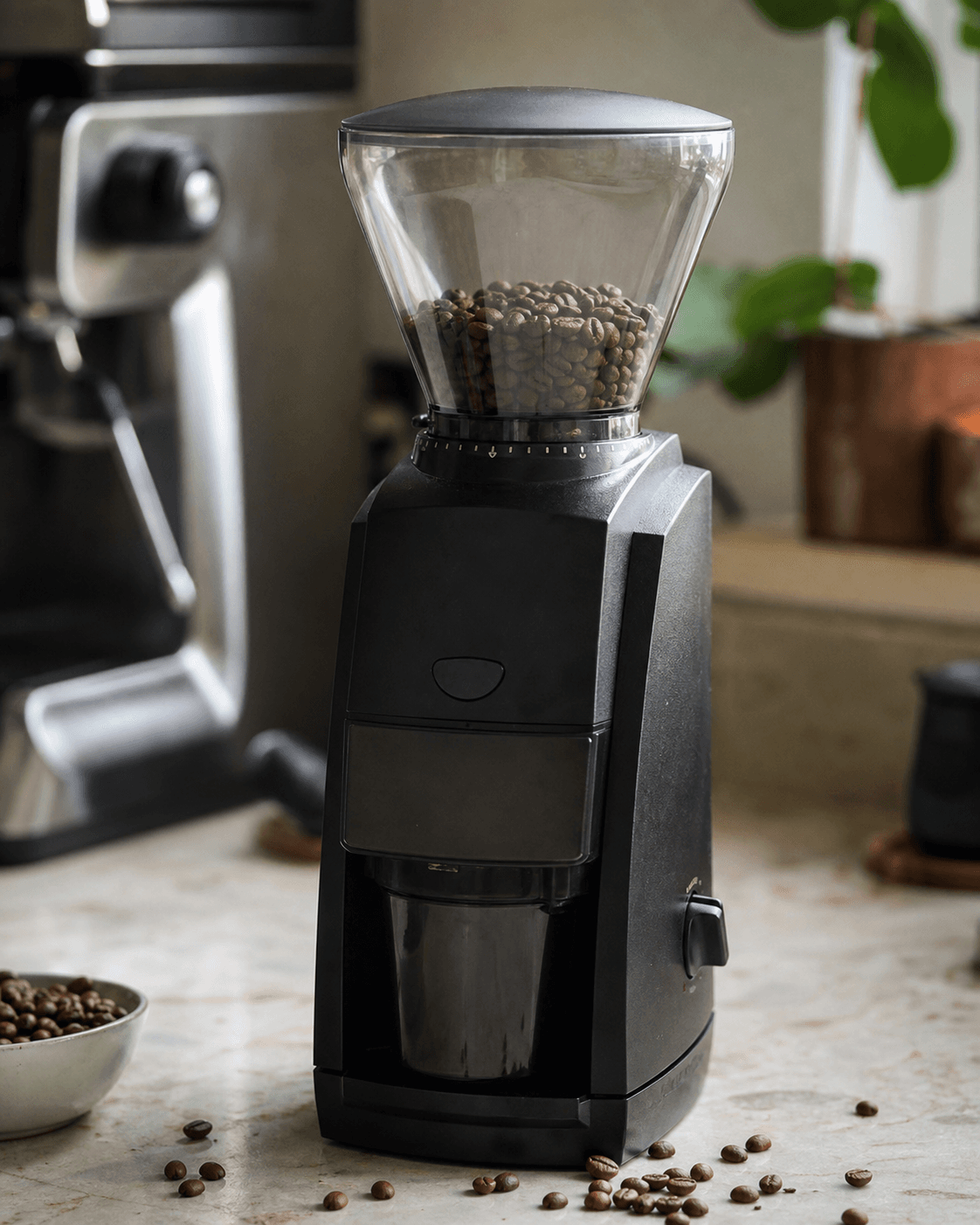
Pop the hopper off and the burr chamber is metal — a proper 40 mm conical steel burr set seated in a housing that doesn't flex when you push the collar. That's the part that matters for longevity, and it's the part Baratza has never cheaped out on across this entire product line. The hopper itself, the chute beneath it, and the grounds bin are plastic, and it shows a little — not fragile, but not the part you'd photograph for a product page either. The dial and macro/micro adjustment ring feel deliberate: turning them gives real resistance and a satisfying click rather than a loose wobble.
The motor is a low-RPM DC gearmotor, spinning around 450 RPM. That's slow compared to cheap blade-adjacent grinders that scream past 1,000+ RPM, and it's the reason the Encore ESP runs quieter and cooler than its price would suggest. Slower burr speed means less frictional heat transferred into the coffee before it even hits your portafilter — a genuinely underappreciated reason this grinder punches above its price in the cup.
Core performance
Grind consistency and particle distribution
This is where the Encore ESP earns its score. Baratza's conical burr geometry has been refined over multiple grinder generations, and the ESP inherits that maturity rather than starting from scratch. Particle distribution is tight enough that channeling from grind inconsistency — the number one cause of a sour, uneven shot for beginners — mostly stops being your problem. You'll still get occasional fines clumping if you don't use a distribution tool, but that's a workflow issue, not a burr issue.
Compare this against a grinder actually built for the price — a $100 blade-adjacent "burr" grinder — and the gap is enormous. Compare it against a $500 flat burr grinder like the Eureka Mignon Specialita, and the gap is real but narrower than the price difference implies. You're paying the last chunk of money for marginal consistency gains and a nicer adjustment mechanism, not for a fundamentally different grind.
Adjustment mechanism and range
Forty stepped settings, with the whole range recalibrated to sit inside the espresso-to-strong-filter window. The stepped design means you dial to a number, and you get back to that exact number every single time — there's no stepless collar to accidentally bump a hair off your dialed-in setting while cleaning. For someone new to espresso, that repeatability is worth more than raw grind quality; it removes one entire variable from your troubleshooting when a shot goes wrong.
The trade-off is the narrowed range itself. Baratza deliberately gave up the coarse settings the standard Encore covers, so if you're the kind of household that also brews a pot of drip or a jug of cold brew on weekends, this grinder will frustrate you at the top of its dial. It's an espresso tool, full stop, and it wants you to own a second grinder — or accept mediocre drip — if you need both.
Retention and mess
Not single-dose, and it shows. Baratza doesn't publish an official retention figure, but real-world testing by owners consistently lands around one to two grams of trapped grounds when moving between adjacent fine settings — enough that if you're chasing an exact 18-gram-in-36-gram-out recipe with zero variance, you'll notice old grounds contaminating a fresh dose after an adjustment. For most people making one drink at a similar grind setting every morning, this is a non-issue; the grinder purges itself naturally after the first shot of the day settles into a routine.
Secondary performance
Noise is genuinely one of the better parts of the ownership experience — that slow gearmotor means you can grind at 6 a.m. without waking the house, which is not something you can say about most grinders in this price range. Static is present but manageable; you'll get some clinging grounds in the chute, more noticeable on darker roasts with more surface oil. Heat buildup during grinding is minimal thanks to the low burr speed, which matters more than people expect for delicate light roasts where heat can flatten aromatics before the coffee even hits water.
Daily use and ergonomics
The routine is dead simple: fill the hopper (it holds enough for several days of typical single-person use), dial your setting, hold the switch or use the portafilter cradle if your model has one, grind. The dial's macro numbers plus micro sub-adjustments give you enough granularity that dialing in a new bag of beans takes a handful of test shots rather than a frustrating afternoon. It's not fussy, and that matters — a grinder you have to fight with every morning eventually gets used less, which defeats the entire point of buying a good one.
Maintenance and longevity
This is arguably Baratza's strongest card in the whole hand. The company sells replacement burrs, replacement gearboxes, and individual parts directly, and the Encore platform has a well-earned reputation for running a decade or more with nothing but a burr swap every few years of daily use. Weekly maintenance is a quick brush-out of the chute and burr chamber; monthly, a deeper clean with a grinder-specific brush pulls out the oily buildup that accumulates from darker roasts. None of this requires disassembly beyond removing the hopper.
Upgrades and what to pair it with
There isn't a large aftermarket burr-swap culture around Baratza grinders the way there is around DF64 or other single-dose enthusiast platforms — you're mostly staying within Baratza's own ecosystem for parts. The practical upgrade path is a bellows or distribution tool (a WDT tool, cheap and worth owning with any grinder) to fight clumping, and eventually a factory replacement burr set once yours wears down after a few years of daily use.
How it compares
Against the Fellow Ode Gen 2, the comparison is really "hopper-fed and repeatable" versus "single-dose and slightly more consistent." The Ode's flat burrs edge out the Encore ESP's conical set on pure particle uniformity, and its near-zero retention is a real advantage — but it costs more and, in its stock configuration, is built for filter coffee first. If espresso is your only use case and budget matters, the Encore ESP is the more direct tool.
Against the DF64, you're trading Baratza's polish and parts support for the DF64's single-dose design and enthusiast-community upgrade path. The DF64 arguably out-grinds the Encore ESP once you account for its flat 64 mm burr set, but it asks more of you — stock burrs are just okay until you invest in an aftermarket swap, and support is scattered across importers rather than one company with a phone number.
Against the Baratza Sette 270, a discontinued-but-still-floating-around sibling that used a different angled-burr geometry for faster, lower-retention grinding, the Encore ESP is the more conservative and more supported choice today — the Sette's parts situation has gotten harder since Baratza shifted focus.
Value analysis
At roughly $270, you're paying for burr geometry and a motor platform that Baratza has spent over a decade refining, plus a company that will still sell you parts five years from now. That's worth more than it sounds like on paper. The honest ceiling is that this grinder will not match a $500+ flat burr grinder in raw consistency — but it will out-consistency a $150 grinder by a wide enough margin that most people's palates can tell the difference immediately, while a step up from here mostly rewards people who already know what they're tasting for.
Known issues
The most common owner complaint is exactly the trade the ESP makes on purpose — no coarse settings, which annoys anyone who also wants drip or French press from the same machine. A smaller number of owners note the plastic hopper and chute feel like the cut corner on an otherwise metal-burr, metal-gearbox machine. Long-term reliability complaints are rare relative to how many units are in daily use, which says something on its own.
Verdict
The Encore ESP doesn't try to be everything, and that focus is exactly why it works. It's a consistent, repeatable, well-supported espresso grinder at a price that doesn't require a leap of faith, with the one honest caveat that it gives up flexibility to get there. If your next drink is espresso more mornings than not, this is a genuinely sensible first real grinder — not a placeholder you'll regret, but also not the last grinder you'll ever buy if you get deeper into the hobby.
What we like
- Genuinely consistent grind for the price, backed by Baratza's decade-plus reputation
- Stepped dial makes dialing in repeatable — return to a number, get the same grind
- Parts and burrs are available for years, and the company actually answers the phone
- Quiet-ish low-RPM motor keeps heat and noise down compared to cheap high-speed grinders
What we don't
- Not single-dose — some retention between settings, especially at the fine end
- Grind range skews toward espresso and misses true coarse settings like cold brew
- Plastic hopper and chute feel like the one place Baratza cut cost
Specifications
| Burr type | Conical |
|---|---|
| Burr size | 40 mm |
| Burr material | Steel |
| Grind settings | 40 stepped positions |
| Adjustment | Stepped |
| Single-dose | No — hopper-fed with a small transition chute |
| Hopper capacity | 8 oz (227 g) |
| Retention | ~1-2 g between adjacent fine settings |
| Motor | Low-RPM DC gearmotor |
| Warranty | 1 yr (extendable with product registration) |
Frequently asked questions
Is the Encore ESP just an Encore with a fancier name?
No — it shares the housing and motor, but the burr set and adjustment range are recalibrated toward espresso. A regular Encore bottoms out too coarse-biased for good espresso; the ESP shifts that whole range finer.
Can it grind coarse enough for French press or cold brew?
Barely, and not well — the range is deliberately narrowed toward the fine end. If you want one grinder for espresso and French press, look at the standard Encore or a wider-range grinder instead.
How much retention should I expect switching between fine and coarse?
Baratza doesn't publish an official number, but real-world reports land around 1-2 grams between adjacent fine settings — enough to matter if you're chasing exact recipe repeatability, not enough to ruin your morning.
Is this a single-dose grinder?
No. It's hopper-fed, so beans sit above the burrs between grinds. You can dose small amounts by only loading what you need, but it isn't engineered around zero-retention single dosing the way a DF64 is.
Will it survive daily use for years?
That's Baratza's whole reputation — this platform has a long track record of running for a decade with nothing but the occasional burr replacement, and parts are easy to source when something does wear out.
Keep reading
- Comandante C40 Review: Why Coffee Nerds Pay This Much for a Crank
Excellent
Our score: 80 / 100
- 1Zpresso J-Max Review: The Hand Grinder That Wants to Replace Your Electric One
Excellent
Our score: 81 / 100
- Eureka Mignon Specialita Review: The Grinder That Makes Espresso Feel Like a Café Habit
Excellent
Our score: 81 / 100
- DF64 Review: The Grinder the Enthusiast Forums Won't Stop Talking About
Good
Our score: 75 / 100