Researched
Bialetti Moka Express Review: Ninety Years On, Still the Cheapest Way to a Strong Cup
An aluminum pot that's barely changed since 1933 because it doesn't need to. Ninety seconds on the stove gets you something between drip coffee and espresso — no machine required.
On this page
Ninety seconds on a low flame, and the whole kitchen smells like a café
That's the actual daily experience of a moka pot, and it's the reason this octagonal aluminum pot has barely changed shape since Alfonso Bialetti designed it in 1933. It's not nostalgia keeping it around — the physics still work, and nobody's found a cheaper way to get a strong, concentrated cup without a powered machine.
Who it's for
Buy this if you want something stronger than drip coffee but don't want to spend $250+ on an espresso machine, or if you travel and cook on gas or electric coil stoves where a plug-in appliance isn't always practical. It's also a great fit for anyone who likes the ritual of stovetop cooking generally — this is a hands-on, watch-the-pot kind of brew, not a set-and-forget one.
Skip it if you want a true espresso shot with crema and 9-bar extraction, or if your stovetop is induction and you don't want to buy the specific induction-compatible version. It's also not the pick if you dislike the maintenance side of aluminum cookware — no dishwasher, no harsh soap, and a gasket that needs replacing periodically.
Borderline: if you already own a stovetop and just want to try "real" concentrated coffee before investing in an espresso machine, this is the cheapest legitimate way to find out if you like that style.
Build and materials
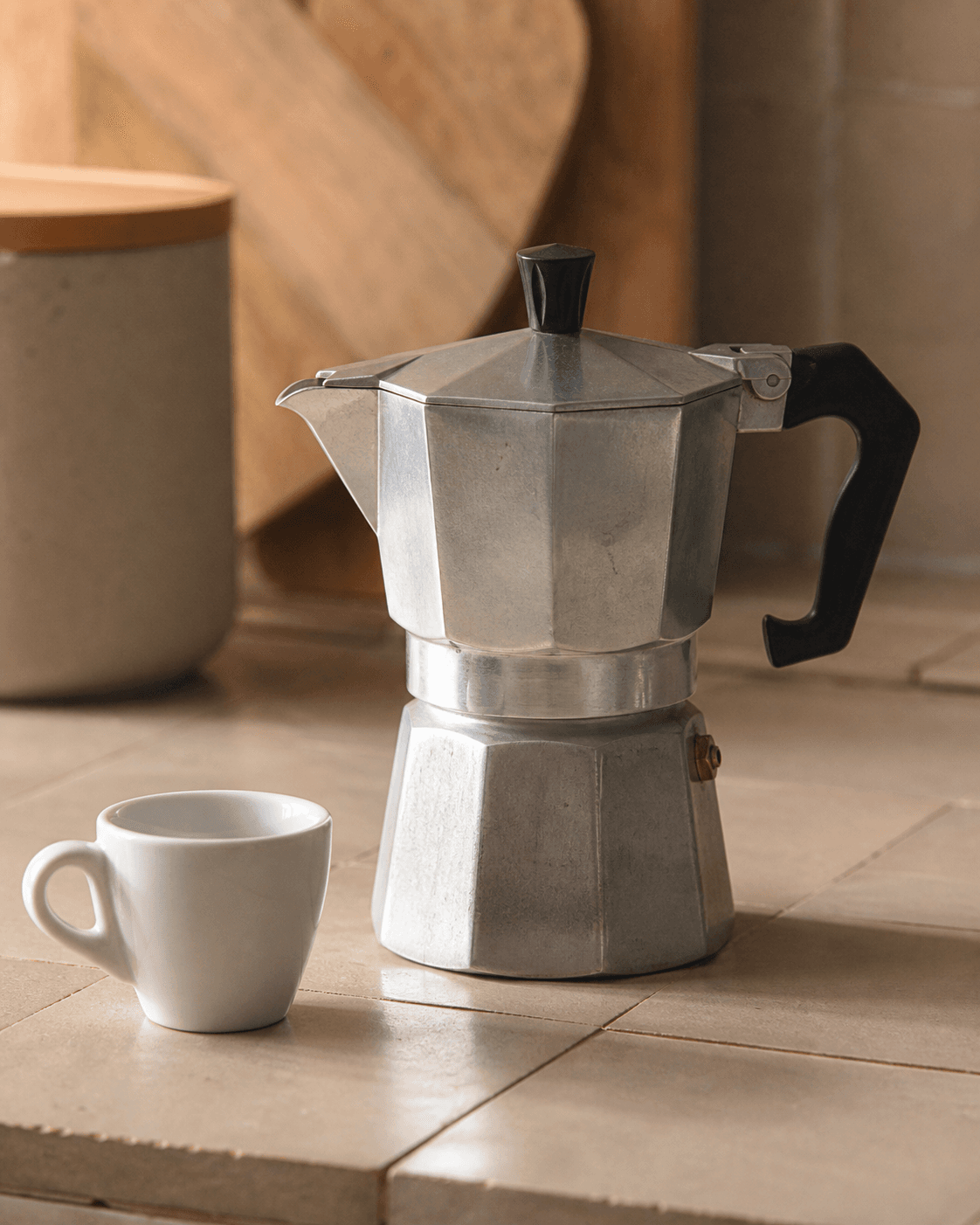
Cast aluminum, unchanged in basic form since the 1930s — a bottom water chamber, a metal funnel and basket for grounds, and a top chamber that collects the brewed coffee, all threaded together and sealed by a rubber gasket. Aluminum heats fast and evenly, which is part of why the moka pot brews as quickly as it does, but it's also reactive enough that acidic cleaning or harsh detergents can affect flavor over time — hence the hand-wash-only, rinse-don't-scrub tradition among longtime owners.
The gasket is the one true wear part. It's a simple rubber ring that seals the two chambers under pressure, and it hardens and cracks with age and heat cycling. Replacements are cheap and take about a minute to swap, and most owners treat it as a routine annual part rather than a flaw.
How it brews
Extraction method
Steam pressure, not gravity or immersion. Water in the bottom chamber heats until steam pressure — roughly 1 to 2 bars, nowhere near real espresso's 9 — pushes the water up through a funnel packed with finely ground coffee and into the top chamber. The whole cycle from stovetop to finished pot runs about four to six minutes on a moderate flame, though the actual "brewing" portion once it starts bubbling up is closer to 60-90 seconds.
Filter type and what it does to the cup
There's no paper filter at all — just a metal funnel and a small screen basket holding the grounds. That means more oils and fine particles make it into the final cup than any paper-filtered method, producing a thick, syrupy, concentrated coffee closer in body to espresso than to drip. It's genuinely its own texture category, and it's part of why moka pot coffee doesn't taste like a weaker version of anything else — it's stronger and different, not a compromise.
Technique required
More than people expect for something with no controls beyond a stove dial. Grind matters — finer than drip, coarser than espresso, since too fine clogs the funnel and can cause dangerous pressure buildup, while too coarse lets water rush through without proper extraction. Heat matters even more: too high a flame scorches the coffee and can produce a burnt, bitter cup, while too low takes forever and risks stalling mid-brew. Most experienced owners use medium-low heat and pull the pot off just as the gurgling sound signals the chamber's nearly empty, rather than letting it run dry on the burner.
Living with it day to day
Fill the bottom chamber to just below the safety valve, pack (don't tamp) the grounds level in the basket, screw the top on, and set it on medium-low heat. You'll hear a soft gurgle when it's nearly done — that's your cue to pull it off the burner, since the last bit pushing through tends to be steam more than water and can scorch the coffee if left too long. Total hands-on time is minimal, but it does require actually watching the stove rather than walking away, unlike a drip machine.
Cleanup and durability
Rinse with hot water only — no soap, no dishwasher, no aggressive scrubbing. This is more particular than most other brewers in this batch, and it's genuinely inconvenient compared to a rinse-and-done pour-over cone. The upside is longevity: a well-cared-for moka pot, gasket replacements aside, can last for decades. It's genuinely common to find these being handed down between family members, still working exactly as they did new.
How it compares
Vs. the Bodum Chambord: completely different brew style and strength. The Chambord makes a full-bodied but mellow multi-cup pot with no heat management required; the moka pot makes a small, strong, concentrated shot that needs active stovetop attention. Pick the moka pot if you want intensity in a small serving, the Chambord if you want volume with less babysitting.
Vs. the AeroPress: the AeroPress is faster, needs no stove, and produces a cleaner cup, though its "aeropresso" mode is the closest comparison in strength. The moka pot has more history and a more distinctly Italian flavor profile that AeroPress enthusiasts admit doesn't fully replicate.
Vs. an actual espresso machine: no contest on precision or crema — a real machine's 9-bar pump and PID temperature control produce a meaningfully different, more nuanced shot. The moka pot's entire appeal is doing something in the same strength neighborhood for a fraction of the price and zero electronics.
Value
At $35, this is one of the cheapest ways into concentrated, stronger-than-drip coffee, and there's no recurring filter cost at all — just coffee and the occasional few-dollar gasket. Given how long these pots typically last with basic care, the long-term cost per cup is close to unbeatable.
Known issues
Gasket failure is the single most common complaint, showing up as steam hissing from the sides instead of pushing water up through the coffee — it's a wear part, not a defect, and cheap to replace. A second common issue is scorched, bitter coffee from leaving the pot on heat too long after the gurgle starts. Some buyers are also surprised by the hand-wash-only care requirement and treat it like ordinary cookware, which shortens gasket life and can affect flavor over time.
Verdict
Brew quality earns a 7 — strong and distinctive, though it's a different beverage from drip or pour-over rather than a directly comparable one. Build quality is solid thanks to nearly a century of design refinement, and value is outstanding given the near-zero recurring cost. Cleanup loses points for the hand-wash-only, no-soap tradition that's fussier than a rinse-and-go pour-over cone. If you want real intensity without buying a machine, this is still the way in.
What we like
- Produces a strong, espresso-adjacent shot for a fraction of a machine's price
- No electricity needed — works on any stovetop, including camping burners
- Nearly a century of unchanged design means parts and know-how are everywhere
- Genuinely low ongoing cost — just coffee, no filters or pods
What we don't
- Rubber gasket and metal screen wear out and need periodic replacement
- Easy to over-extract or scorch if left on heat too long
- Aluminum construction means it's not dishwasher- or induction-friendly out of the box
Specifications
| Type | Stovetop moka pot (steam pressure) |
|---|---|
| Material | Cast aluminum |
| Capacity (oz) | 10 oz (6-cup model, most common size) |
| Filter type | None — built-in metal funnel and basket |
| Ease of cleaning | Fair — hand wash only |
| Warranty (yr) | Unknown |
Frequently asked questions
Is moka pot coffee the same as espresso?
No — a moka pot generates around 1-2 bars of pressure from steam, while real espresso machines push 9 bars through a much finer grind. What you get is stronger and more concentrated than drip coffee, with a bit of crema-like foam, but it's its own category, not espresso.
Can I use a moka pot on an induction stove?
Not the classic aluminum Moka Express as sold — aluminum isn't magnetic, so it won't heat on an induction cooktop. Bialetti sells an induction-compatible version with a steel plate on the base if that's your stovetop.
How often does the rubber gasket need replacing?
Roughly once a year with daily use, sooner if it starts looking cracked or you notice steam hissing out the sides instead of pushing water up through the coffee. Replacement gaskets cost only a couple dollars and take a minute to swap.
Should I use soap to clean it?
Traditionalists say no — rinse with hot water only, since soap residue in the aluminum can affect flavor over time and strip the seasoning aluminum pots develop. A quick hot-water rinse and air dry is standard practice.
Keep reading
- Bodum Chambord Review: The French Press Everyone Pictures When You Say 'French Press'
Good
Our score: 77 / 100
- Fellow Stagg X Review: A Pour-Over Dripper With Training Wheels That Actually Work
Excellent
Our score: 81 / 100
- Chemex 6-Cup Review: The Coffee Maker That's Also in a Design Museum
Good
Our score: 78 / 100
- Hario V60 02 Review: The Dripper That Makes You Prove You Can Pour
Excellent
Our score: 82 / 100