Researched
Chemex 6-Cup Review: The Coffee Maker That's Also in a Design Museum
It brews as well as it displays — a genuinely clean cup from an object that's spent 80 years being both a lab flask and a centerpiece.
On this page
It's in the permanent collection of the Museum of Modern Art
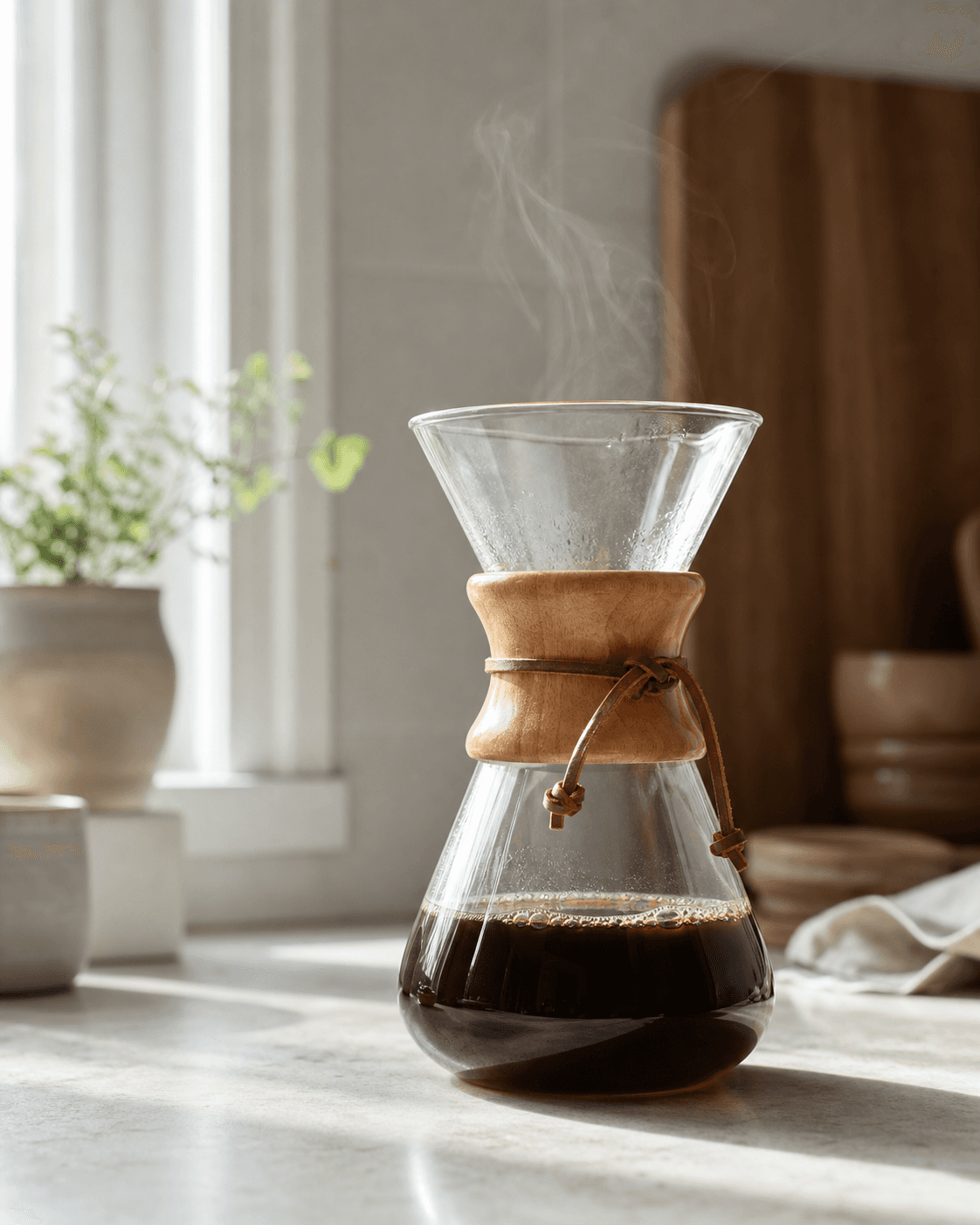
That's not a marketing line, it's a fact — designer Peter Schlumbohm patented the Chemex in 1941, drawing on his chemistry background (the hourglass shape borrows directly from lab flasks and an Erlenmeyer funnel), and MoMA added it to its design collection not long after. Eighty-plus years on, the shape hasn't changed, and it's still one of the only coffee makers that gets bought as much for how it looks on a counter as for how it brews.
That would be a hollow reason to recommend it if the coffee weren't good. It is.
Who it's for
Buy this if you make coffee for two to four people fairly often and want a single vessel you brew into, serve from, and put back on the counter without hiding it in a cabinet. It's also the pour-over to get if you want the V60's clarity without quite the same pouring precision — the thick filter does some of the forgiving for you.
Skip it if you live alone and mostly want one cup at a time; a 30-ounce carafe is overkill for a single serving, and reheated Chemex coffee loses the crispness that's the whole point of owning one. It's also not the move if you're rough on kitchenware — this is one continuous piece of glass with no metal frame protecting it, unlike the Chambord's chrome cage.
Borderline: if counter space and display matter to you as much as the brew itself, the Chemex earns its keep in a way a plain plastic dripper never will.
Build and materials
The carafe is one continuous piece of borosilicate glass — no seams, no metal frame, no plastic base. Borosilicate resists thermal shock better than ordinary glass, so pouring near-boiling water into it isn't a crack risk the way it would be with a cheap glass vessel. The wood collar (traditionally polished walnut, though other woods are used) and its leather tie exist purely as a heat-safe handle; they don't touch the coffee and don't affect the brew in any way.
The trade-off for all that clean, uninterrupted glass is fragility. There's no chrome cage like the Chambord has to catch a knock against the faucet. Owners who've had one for years generally report it survives fine with normal care, but a hard hit against a hard surface is a real risk in a way it simply isn't for the AeroPress or a metal dripper.
How it brews
Extraction method
Gravity pour-over, same family as the V60, but through a taller cone and directly into the carafe body rather than onto a separate vessel. The extra height and volume of the Chemex cone mean total contact time runs slightly longer than a V60 — often 4 to 5 minutes for a full 30-ounce brew.
Filter type and what it does to the cup
This is the whole story. Chemex filters are bonded paper, thicker than almost any other pour-over filter on the market. That thickness does two things: it filters out virtually all fine sediment and most coffee oils, producing a cup that's often described as closer to tea than coffee in texture — extremely clean, bright, with none of the silty mouthfeel a French press or metal filter leaves behind. It also slows the flow rate, which buys you some forgiveness on pour speed that the V60 doesn't offer.
Technique required
Less demanding than the V60 but not effortless. You still bloom the grounds first, then pour in stages, keeping the water level from creeping too high in the cone (which can slow flow to a crawl and stall the brew). The larger volume means more total pours than a single-cup V60 session, which takes some getting used to, but the tolerance for a slightly uneven pour is meaningfully higher thanks to the thick filter doing some of the regulating.
Living with it day to day
Medium-coarse grind (coarser than you'd use for a V60, since the filter is already slowing flow considerably), water just off boiling, roughly 1:15 to 1:16 ratio. Budget five to six minutes total for a full carafe, plus a couple minutes for water to heat if you're not using an electric kettle. It's slower than the AeroPress and roughly on par with the V60 for a comparable amount of coffee, but you're brewing three or four times the volume in that same window, which is the actual advantage over a single-cup dripper.
Cleanup and durability
The glass carafe rinses out easily — lift the spent filter by its edges (grounds come with it, no separate scraping), rinse the cone with warm water, and you're done. The one thing to know: the wood collar and leather tie can't be dishwashed or fully soaked, since water damages both over time. A quick wipe-down keeps them fine for years; owners who've submerged theirs report the leather stiffening and cracking faster.
How it compares
Vs. the Hario V60: the V60 gives you a marginally cleaner, brighter cup in expert hands and is far cheaper, but it's less forgiving and brews smaller batches. The Chemex is the better choice for serving more than one person and for buyers who want some built-in tolerance for pour mistakes.
Vs. the Fellow Stagg X: the Stagg X is a single-cup-to-modest-batch brewer with active flow control; the Chemex is a genuine multi-cup carafe with passive flow control via filter thickness. Different jobs — pick the Chemex if you regularly brew for a small group and want to serve straight from the vessel.
Vs. the Bodum Chambord French press: totally different cup. The Chambord gives you a heavier, oilier, more textured cup with sediment; the Chemex gives you the cleanest possible cup of any brewer in this batch. If you've tried French press and found it too heavy or muddy, the Chemex is close to the opposite experience.
Value
At $48, it costs about the same as a mid-tier pour-over kit, but you're also buying a serving vessel that replaces a separate carafe or pitcher. The recurring cost is the proprietary filters, which run noticeably more per filter than a generic V60 cone — plan on that being the real ongoing expense of ownership, not the upfront price.
Known issues
The most common complaint is filter cost and availability — some regions and stores stock them inconsistently, which is annoying for a device that doesn't work well with substitutes. A second recurring gripe is the wood collar loosening or the leather tie fraying after a couple years of regular use; both are replaceable but not always easy to find as standalone parts. And, unavoidably, some owners report cracking or chipping the glass after a knock, which ends the carafe's life entirely since it's not a repairable part.
Verdict
Brew quality lands a 9 — genuinely one of the cleanest cups you can make at home, verging on tea-like clarity. Ease of use beats the V60 thanks to the thick filter's built-in forgiveness, though it's still a hands-on pour, not a hands-off brew. Value takes a small hit from filter cost, and cleanup loses a point to the wood collar's special handling. If you want a brewer that serves as well as it brews, this is still the standard other pour-over carafes get measured against.
What we like
- Produces a remarkably clean, sediment-free cup thanks to the thick filter paper
- Doubles as an attractive carafe you can bring straight to the table
- One-piece glass body means nothing to assemble or misalign before brewing
- Filters are thick enough to forgive minor pouring inconsistencies
What we don't
- Proprietary filters cost noticeably more than standard cone filters
- Wood collar and leather tie can't be soaked or dishwashed, and the leather ages
- All-glass build means one hard knock against the sink can end its life
Specifications
| Type | Pour-over (hourglass carafe brewer) |
|---|---|
| Material | Borosilicate glass with wood collar and leather tie |
| Capacity (oz) | 30 oz (6-cup) |
| Filter type | Proprietary thick |
| Ease of cleaning | Good — glass rinses easily |
| Warranty (yr) | Unknown |
Frequently asked questions
Why are Chemex filters so much thicker than regular pour-over filters?
They're bonded paper, roughly 20-30% thicker than a standard cone filter, which traps more fine sediment and coffee oils. That's the whole source of the famously clean Chemex cup — and also why the filters cost more and flow more slowly than off-brand paper.
Can I use regular V60 filters in a Chemex?
You can fold a round filter to approximate the shape, but it won't seal against the glass the same way and you'll lose the clarity that makes a Chemex a Chemex. The proprietary filters are worth the extra cost here.
Is the wood and leather collar just for looks?
Mostly, yes — it's there so you can pick up a carafe full of near-boiling coffee without a handle burning your hand. It doesn't affect the brew, but it does mean you can't submerge it, so wipe it down rather than soak the whole carafe.
How many cups does the 6-cup model actually make?
Chemex 'cups' run about 5 ounces each, so the 6-cup carafe holds roughly 30 ounces total — closer to four standard American mugs than six.
Keep reading
- Bialetti Moka Express Review: Ninety Years On, Still the Cheapest Way to a Strong Cup
Good
Our score: 75 / 100
- Bodum Chambord Review: The French Press Everyone Pictures When You Say 'French Press'
Good
Our score: 77 / 100
- Fellow Stagg X Review: A Pour-Over Dripper With Training Wheels That Actually Work
Excellent
Our score: 81 / 100
- Hario V60 02 Review: The Dripper That Makes You Prove You Can Pour
Excellent
Our score: 82 / 100