Researched
Bodum Chambord Review: The French Press Everyone Pictures When You Say 'French Press'
Full-bodied, no learning curve, brews a full pot in four minutes. The one real caveat is that a mesh filter always lets some grit through.
On this page
This is the French press you picture when someone says French press
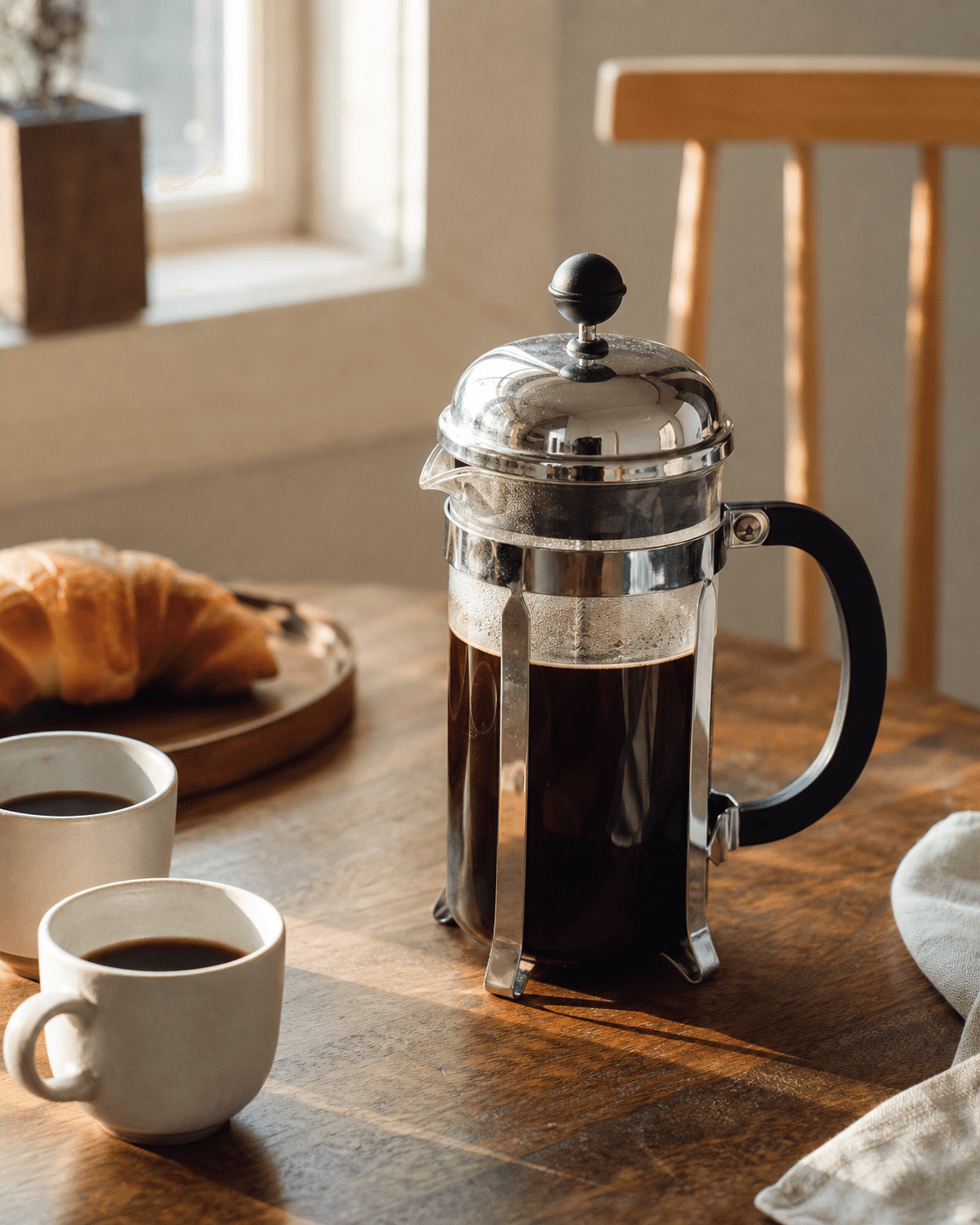
Chrome frame, glass beaker, a plunger with a domed steel lid — that silhouette has been Bodum's Chambord since 1958, and it's become so synonymous with the category that plenty of people who've never heard the word "Chambord" would recognize it instantly if you put a picture in front of them. It's the French press equivalent of a Kleenex or a Q-tip: the specific product name that became the generic mental image.
Who it's for
Buy this if you want to make coffee for two, three, or four people with zero technique and minimal cleanup fuss compared to setting up a pour-over station. It's the easiest device in this batch to hand to a houseguest and say "you'll figure it out" — there's no pour rate to master, no bloom timing to nail, just hot water, a stir, and a four-minute wait.
Skip it if you're sensitive to sediment in your cup or you like your coffee crystal clear — no French press, this one included, fully eliminates the silty bottom-of-the-mug grit that a paper filter would catch. If that bothers you, the Chemex or V60 will serve you better.
Borderline: if you like a heavier-bodied, more textured cup (some people genuinely prefer it to the "cleaner" pour-over style), this is likely to become your daily driver rather than a novelty.
Build and materials
Borosilicate glass beaker sitting inside a chrome-plated steel frame — the frame does real protective work here, unlike a bare glass carafe. It's not indestructible; the glass can still crack if you knock it hard against a faucet or drop the whole assembly, but the frame absorbs a lot of the everyday bumps that would doom an unprotected carafe like the Chemex's.
The plunger assembly is where quality varies most across French presses generally, and the Chambord's is a genuine strength — a stainless mesh screen backed by a secondary filter disc, held together by a spring-loaded frame that seals reasonably well against the glass walls. It's not a perfect seal (nothing mesh-based is), but it's a well-engineered version of an inherently imperfect filtering method.
How it brews
Extraction method
Full immersion — coarse grounds sit steeping directly in hot water for about four minutes, no pressure, no gravity drip. This is the most hands-off method in the entire batch: add coffee, add water, stir once, wait, press, pour.
Filter type and what it does to the cup
Stainless steel mesh, not paper. That's the entire personality of French press coffee — the mesh lets natural coffee oils and fine sediment pass through that a paper filter would trap. The result is a heavier-bodied, more textured, sometimes described as "fuller" or "murkier" cup depending on who you ask. It's a legitimately different flavor profile from every paper-filtered method in this batch, not a worse one, just different.
Technique required
About as low as brewing gets. Coarse grind, water just off boiling, four-minute steep, one slow press straight down. The main technique point that actually matters: press slowly and evenly. Rushing the plunge can force fine grounds around the edges of the mesh seal and dump more sediment into your cup than a careful press would.
Living with it day to day
This is the fastest way in the batch to make coffee for more than one person with no equipment beyond a kettle. Four minutes steep time, no pour technique, no filter to fold or seat correctly. The catch, and it's a real one: French press coffee keeps extracting even after you press, because the mesh doesn't create a fully sealed barrier between grounds and liquid. Pour the whole beaker out into cups or a separate carafe immediately after pressing, or you'll come back to an over-extracted, bitter second cup twenty minutes later.
Cleanup and durability
This is the weakest part of daily ownership. The plunger assembly — spring, mesh screen, filter disc, cross plate — benefits from full disassembly every few uses, since fine coffee particles work their way into the mesh and the spring mechanism over time. It's not hard, just more involved than rinsing a pour-over cone. The glass beaker itself is easy to wash, but the metal parts take real attention if you want the seal to keep working well long-term. Skip the disassembly for too long and you'll notice more sediment creeping into your cup and a plunger that doesn't seal as cleanly.
How it compares
Vs. the AeroPress: the AeroPress uses paper and pressure to produce a cleaner cup with dramatically easier cleanup, but only brews one serving at a time. The Chambord wins on batch size and hands-off technique; the AeroPress wins on cup clarity and cleanup speed.
Vs. the Chemex: essentially opposite philosophies. The Chemex produces the cleanest, brightest cup in this whole batch via a thick paper filter; the Chambord produces the heaviest, most textured cup via a mesh screen. Neither is "better" — it's a genuine style preference, and it's worth owning both if you like variety.
Vs. the Bialetti Moka Express: different beverage entirely, really — the moka pot produces a much stronger, more concentrated, espresso-adjacent cup via steam pressure, while the Chambord produces a full-strength but more mellow immersion brew. If you want something closer to American drip strength for multiple people, the Chambord is the better fit; if you want a small, strong shot, the moka pot wins.
Value
At $45 for the most common 8-cup size, this is one of the cheapest ways to brew a full pot of genuinely good coffee for a group, and the parts — beaker, screens, springs — are all sold separately when something eventually wears out, so a Chambord you buy today can realistically last a decade or more with occasional part swaps.
Known issues
Sediment in the cup is the most common complaint, and it's inherent to the mesh-filter method, not a manufacturing flaw — a coarser grind minimizes it but never eliminates it. Cracked glass beakers from knocks against faucets or countertops come up regularly in owner reviews, though replacement beakers are cheap and easy to source. A smaller number of owners note the mesh seal loosening over a few years of heavy use, at which point a new plunger assembly (sold separately) restores it to like-new performance.
Verdict
Brew quality sits at a 7 — very good, but the sediment and heavier body keep it below the paper-filtered methods on pure clarity, which is a style trade-off more than a flaw. Ease of use is excellent, essentially foolproof. Value is outstanding given the batch size and part longevity. Cleanup is the honest weak spot, needing more regular disassembly than any pour-over device here. If you want a full pot with zero pouring technique and don't mind a fuller-bodied cup, this is still the standard-bearer.
What we like
- Brews multiple full cups at once with zero technique required
- Full-bodied, oil-retaining cup that paper-filtered methods can't replicate
- Iconic, repairable design — replacement glass beakers and screens are easy to find
- Cheapest way to brew a genuinely good multi-cup pot at home
What we don't
- Some sediment in every cup is unavoidable with a mesh filter
- Glass beaker is the classic weak point — a knock against the faucet can crack it
- Coffee goes from great to over-extracted and bitter if left sitting in the beaker post-brew
Specifications
| Type | French press (full immersion) |
|---|---|
| Material | Borosilicate glass beaker |
| Capacity (oz) | 34 oz (8-cup, most common size) |
| Filter type | Stainless steel mesh (no paper) |
| Ease of cleaning | Fair — plunger disassembles for a proper clean |
| Warranty (yr) | 1 yr |
Frequently asked questions
Why does French press coffee have grit at the bottom?
The mesh screen filters out large grounds but lets fine particles through — there's no paper to catch them. A slightly coarser grind reduces the amount of sediment, but you'll never fully eliminate it with this brewing method.
How long can I leave coffee in the Chambord after pressing?
Not long — the grounds stay in contact with the brewed coffee even after you press, since the mesh doesn't fully seal them off. Pour it out within a few minutes of pressing or it keeps extracting and turns bitter and over-strong.
Is the glass beaker replaceable if it breaks?
Yes — Bodum sells replacement beakers separately for most Chambord sizes, and they're inexpensive enough that a cracked beaker doesn't mean buying a whole new press.
What grind size works best?
Coarse, roughly like breadcrumbs or coarse sea salt. Too fine a grind clogs the mesh, makes plunging difficult, and pushes more sediment into your cup.
Keep reading
- Bialetti Moka Express Review: Ninety Years On, Still the Cheapest Way to a Strong Cup
Good
Our score: 75 / 100
- Fellow Stagg X Review: A Pour-Over Dripper With Training Wheels That Actually Work
Excellent
Our score: 81 / 100
- Chemex 6-Cup Review: The Coffee Maker That's Also in a Design Museum
Good
Our score: 78 / 100
- Hario V60 02 Review: The Dripper That Makes You Prove You Can Pour
Excellent
Our score: 82 / 100