Researched
Hario V60 02 Review: The Dripper That Makes You Prove You Can Pour
The cleanest cup in this lineup if you're willing to learn a pour, and a mediocre one if you're not. There's no autopilot setting.
On this page
The single hole is the whole point, and it trips people up
New buyers assume the V60's giant single hole at the bottom is a design shortcut — fewer parts, cheaper to mold. It's actually the opposite of a shortcut. That one large opening means the dripper itself does almost nothing to regulate water flow. Every other pour-over on the market uses multiple small holes or a flow-restricting valve to manage things for you. The V60 hands that job entirely to your kettle hand. That's either the most honest brewing device you can buy or the most punishing one, depending on how much you feel like practicing.
Who it's for
Buy this if you already enjoy the process of making coffee, not just drinking it — people who like a slow Saturday-morning ritual, or who want the clearest, brightest possible expression of a light-roast single origin. It's also the cheapest entry point into "serious" pour-over; at $27 for the ceramic version, you're not risking much to find out if you like the format.
Skip it if you want a repeatable cup on autopilot on a rushed weekday morning. A bad pour with the V60 — too fast, too centered, too much agitation — gives you a thin, sour, or unevenly extracted cup, and there's no mechanism in the dripper to save you from that. If that sounds like a chore rather than a hobby, the Chemex or a flow-controlled dripper like the Fellow Stagg X will forgive more of your mistakes.
Borderline: if you're buying your first pour-over dripper and don't yet know if you'll stick with the ritual, the V60's low price makes the risk small even if the payoff (a genuinely great cup) takes a few weeks of practice to unlock.
Build and materials
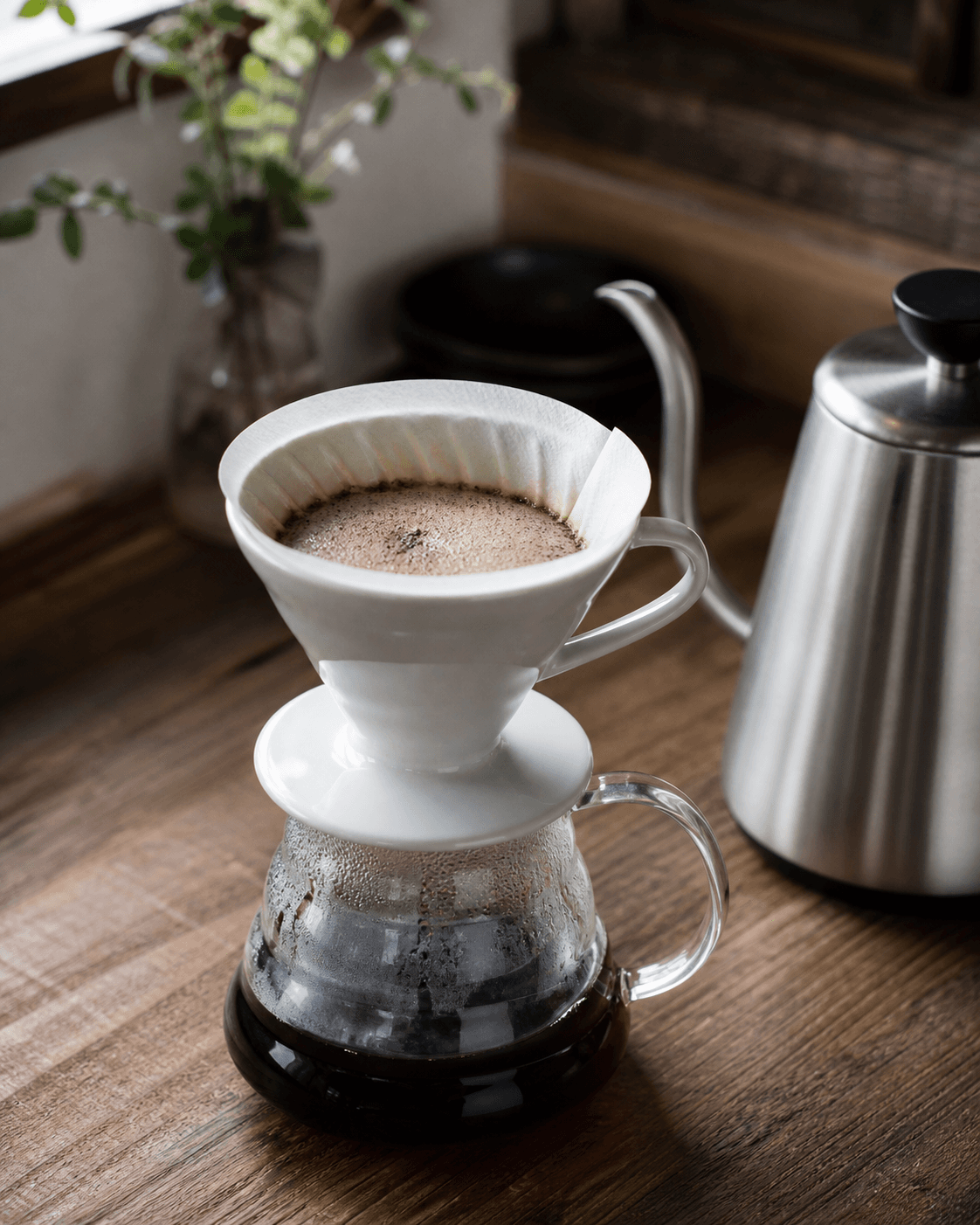
Hario sells the V60 in four materials — ceramic, glass, plastic, and metal — and they are not interchangeable in performance despite sharing a shape. Ceramic retains heat the best of the four and is what most cafés use; it's also the heaviest and the one that can chip if dropped on tile. Glass looks the nicest on a counter and holds heat reasonably well but is the most fragile. Plastic is nearly indestructible and travels well, losing only a little thermal performance. Metal (usually copper or stainless) looks sharp but bleeds heat the fastest of the four, which can actually work against you on a cold morning.
The spiral ribs on the inside of the cone aren't decorative — they create a channel for air to escape as water fills the cone, preventing the paper filter from sealing flat against the ceramic and choking flow. That detail is why cheap V60 knockoffs without properly cut ribs tend to brew unevenly.
How it brews
Extraction method
Straight gravity pour-over — no pressure, no immersion beyond the brief bloom. Water passes through the coffee bed once, pulled by gravity through the paper and out the single hole. Total contact time between water and grounds runs about 2.5 to 3.5 minutes for a typical 20-ounce brew.
Filter type and what it does to the cup
V60 paper filters are thin and tabbed to fit the cone's specific angle (60 degrees, which is where the name comes from). Thin paper means minimal flavor stripping and very little oil retention, which is why V60 coffee reads as brighter and more tea-like than a French press or even an AeroPress. It also means the filter offers the pourer almost no help — there's no thick paper wall slowing things down for you the way a Chemex filter does.
Technique required
This is the whole story with the V60. A proper pour starts with a bloom — a small amount of water (roughly double the coffee's weight) poured to saturate the grounds, then a 30-45 second rest to let CO2 escape. After that, you pour in slow, controlled circles, keeping the water level roughly consistent and avoiding the edges of the filter where water can channel down the side without passing through the coffee bed. Pour too fast and you under-extract; too slow, or too centered, and you get uneven extraction with sour and bitter notes in the same cup. This takes real repetition to get consistent — expect your first two or three weeks of cups to vary more than you'd like.
Living with it day to day
Once you've got a pour dialed in, the whole process from kettle to cup takes about four minutes including the bloom. Medium-fine grind, water around 200°F, a 1:16 coffee-to-water ratio is the standard starting recipe. The ceramic version benefits from a hot-water rinse right before brewing — pour boiling water through an empty filter first, both to rinse away papery taste and to pre-heat the ceramic so it doesn't steal heat from your actual brew.
Cleanup and durability
About as easy as it gets — lift the spent filter out by the edges, spent grounds go with it, rinse the cone under the tap, done. No mesh to unclog, no plunger to disassemble. The main durability risk is dropping the ceramic version on a hard floor; there's no glass-and-metal frame protecting it like the Chemex has.
How it compares
Vs. the Chemex: the Chemex's thick, bonded filter does more of the flow-regulating work for you, so it's more forgiving of an imperfect pour and produces a slightly heavier-bodied, less delicate cup. The V60 is more precise and rewards skill more directly, but punishes mistakes harder.
Vs. the Fellow Stagg X: the Stagg X uses a "ready rate" hole system designed to correct for pour speed automatically, essentially building training wheels into the dripper. It's much more forgiving and about three times the price. If you want the V60's clarity without the V60's learning curve, the Stagg X is the upgrade path — but you're paying for consistency, not necessarily a better ceiling.
Vs. the AeroPress: totally different cup profile. The AeroPress is faster, more forgiving, and gives you more body; the V60 is slower, harder to nail, and gives you a cleaner, brighter cup when you do nail it.
Value
Twenty-seven dollars for the ceramic version is close to nothing for a device that, in skilled hands, competes with brewers costing ten times as much. The only ongoing cost is filters, which run a few cents each. If you're willing to put in the practice, there's no better dollar-for-dollar ceiling in pour-over.
Known issues
The most common complaint isn't a defect — it's frustration during the learning phase, when cups vary more than buyers expect from something this simple-looking. A smaller number of owners report chipping the ceramic rim after a drop, which isn't repairable. Cheap third-party filters that don't match Hario's exact paper thickness can also throw off flow rate and give inconsistent results, so it's worth sticking to genuine V60 filters, at least until you know your grind and pour well enough to compensate.
Verdict
Brew quality earns a 9 — among the best in this batch when the person pouring knows what they're doing, which is exactly the caveat that keeps ease of use down at a 6. Build quality is strong for ceramic, value is outstanding, and cleanup is about as simple as pour-over gets. This is the dripper to buy if you want to get better at making coffee, not just make coffee.
What we like
- Produces one of the cleanest, most tea-like cups of any brew method here
- Cheap enough to own two or three without thinking about it
- Ceramic body holds heat far better than plastic versions
- Simple to clean, nothing to disassemble
What we don't
- Unforgiving — a rushed or uneven pour gives you a genuinely worse cup
- Single large hole means flow rate is almost entirely on you, not the dripper
- Ceramic version needs a warm-up rinse or it steals heat from your brew
Specifications
| Type | Pour-over (conical dripper) |
|---|---|
| Material | Ceramic (also sold in glass |
| Capacity (oz) | Up to 20 oz (2–4 cups) |
| Filter type | V60-specific paper cone filters |
| Ease of cleaning | Excellent — rinse and it's done |
| Warranty (yr) | Unknown |
Frequently asked questions
Why does the V60 have one giant hole instead of several small ones?
It's the whole design philosophy — the single large hole hands flow control to you instead of to the dripper itself. A machine or a multi-hole dripper regulates flow for you. The V60 doesn't, which is why the same dripper can produce wildly different cups depending on who's pouring.
Ceramic, glass, plastic, or metal — does it matter?
Ceramic holds heat the longest and is the standard for a reason. Plastic is nearly as good thermally and far more travel-friendly. Metal loses heat fastest and glass sits in the middle — for home use, ceramic is the safer default choice.
Do I need a gooseneck kettle to use this well?
Not strictly, but it helps enormously. A regular kettle makes it much harder to control where and how fast water lands on the grounds, which is most of the skill this dripper demands.
What's the difference between the 01 and 02 sizes?
The 01 brews one to two cups, the 02 brews two to four — the 02 is the more common size for a single-person household that occasionally makes coffee for a guest, which is why it's the one worth owning by default.
Keep reading
- Bialetti Moka Express Review: Ninety Years On, Still the Cheapest Way to a Strong Cup
Good
Our score: 75 / 100
- Bodum Chambord Review: The French Press Everyone Pictures When You Say 'French Press'
Good
Our score: 77 / 100
- Fellow Stagg X Review: A Pour-Over Dripper With Training Wheels That Actually Work
Excellent
Our score: 81 / 100
- Chemex 6-Cup Review: The Coffee Maker That's Also in a Design Museum
Good
Our score: 78 / 100